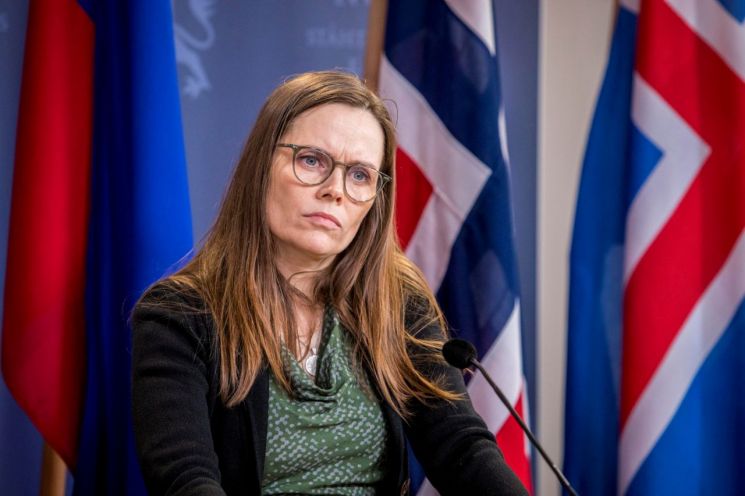
[Asia Economy Reporter Park Byung-hee] According to major foreign media reports on the 27th (local time), the initial result of the Iceland general election, which showed a majority of female lawmakers, was overturned to a majority of male lawmakers after a recount.
Iceland, a small country with a population of about 370,000, held a general election on the 25th to elect 63 members of parliament. The initial count showed that 33 female lawmakers were elected. However, the recount on the 26th confirmed that there were 33 male lawmakers and 30 female lawmakers.
As a result, the male-dominated parliament was maintained, but the number of female lawmakers increased by six from 24 in the 2017 general election.
According to data from the Inter-Parliamentary Union (IPU), only three countries?Rwanda, Cuba, and Nicaragua?have more female lawmakers than male. The parliaments of Mexico and the United Arab Emirates (UAE) have an equal number of men and women, while the majority of other parliaments are male-dominated.
In Europe, the proportion of female lawmakers in the parliaments of Sweden and Finland is high at 47% and 46%, respectively, but there has been no case of a female-majority parliament so far. Iceland was expected to become the first European country with a female-majority parliament, but this was nullified after the recount.
Iceland was ranked as the number one country for gender equality for 12 consecutive years in a report released by the World Economic Forum (WEF) in March.
Initial polls predicted that the current coalition would secure fewer than a majority of seats. However, as support for the center-right Progressive Party rose significantly, the final count showed that the current coalition secured 37 seats, exceeding the majority. The Progressive Party gained 13 seats, five more than in the 2017 general election, becoming the second-largest party in the parliament.
The current coalition consists of three parties: the Progressive Party, the Left-Green Movement, and the conservative-leaning Independence Party. The Independence Party maintained its position as the largest party in the parliament with 16 seats, the same as in the 2017 general election. Meanwhile, the Left-Green Movement, which had 11 seats in 2017, saw its seats reduced to 8 in this election.
The three parties forming the coalition stated that they would negotiate to maintain the coalition if they secure a majority of seats. Katr?n Jakobsd?ttir, the current Prime Minister from the Left-Green Movement, expressed optimism about the coalition negotiations but said she would not demand to keep the prime minister position.
© The Asia Business Daily(www.asiae.co.kr). All rights reserved.

















