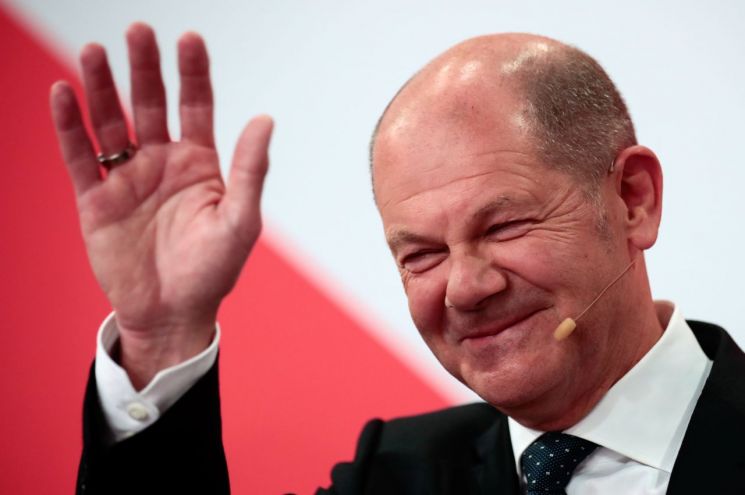
 Olaf Scholz, the German Social Democratic Party (SPD) chancellor candidate, is waving and smiling at party members at the Berlin headquarters immediately after the announcement of the exit poll results for the federal parliamentary election on the 26th (local time).
 [Image source=Yonhap News]
[Asia Economy Reporter Cho Hyun-ui] In the German federal parliamentary election, the center-left Social Democratic Party (SPD) narrowly defeated the center-right Christian Democratic Union (CDU) and Christian Social Union (CSU) alliance, to which Chancellor Angela Merkel belongs.
According to the provisional tally posted on the election commission's website after the counting of votes in all 299 constituencies was completed on the 27th, the SPD recorded 25.7% of the vote, beating the CDU/CSU alliance, which received 24.1% (CDU 18.9%, CSU 5.2%), by a margin of 1.6 percentage points.
This has drawn attention to whether a power shift from the conservative alliance to the center-left party will occur in Germany for the first time in 16 years since 2005.
Throughout the vote counting, the two parties engaged in a neck-and-neck race and each declared their intention to lead negotiations for forming a coalition government.
Barring any surprises, one of the SPD or CDU/CSU candidates will succeed Chancellor Merkel, who is stepping down after this election.
Olaf Scholz, the SPD's chancellor candidate, stated, "The SPD has won this election," adding, "Voters want me to form a coalition government."
On the other hand, Armin Laschet, the CDU/CSU alliance's chancellor candidate, said, "It has not always been the party with the highest vote share that produces the chancellor," and pledged, "We will do our best to form a coalition led by the CDU/CSU alliance."
Scholz, who has led the grand coalition as vice chancellor and finance minister alongside Chancellor Merkel, highlighted his stability as a candidate to lead the government after Merkel and succeeded in an unprecedented close race in this election.
Earlier this spring, the SPD's support rate had fallen to as low as 13%, but it nearly doubled within half a year. If the SPD succeeds in forming a coalition, it will mark a change of government after 16 years.
Conversely, the CDU/CSU alliance, which had support rates as high as 37% earlier this year, suffered an unprecedented decline, resulting in the worst election outcome since the founding of the Federal Republic of Germany in 1949.
The Green Party achieved its highest-ever vote share at 14.8%, rising to become the third-largest party, while the Free Democratic Party (FDP) also performed well with 11.5%, up from 10.7% four years ago.
The far-right Alternative for Germany (AfD) received 10.3%, down from 12.6% four years ago.
The Left Party garnered only 4.9%, halving its support from 9.2% four years ago, and was pushed out of the parliament. In Germany, only parties that receive more than 5% of the vote can enter the parliament.
In terms of seats, out of a total of 735 seats, the SPD secured 206 seats, the CDU/CSU alliance 196 seats (CDU 151 seats, CSU 45 seats), the Green Party 118 seats, the FDP 92 seats, AfD 83 seats, and the Left Party 39 seats.
Based on the current seat distribution, coalition scenarios such as a grand coalition (SPD - red, CDU - black), a traffic light coalition (SPD - red, FDP - yellow, Green Party - green), or a Jamaica coalition (CDU - black, FDP - yellow, Green Party - green) are possible.
Since both the SPD and CDU have declared their intention to lead coalition formation, each party is expected to attempt coalitions with the Green Party and the FDP, respectively.
Both parties' chancellor candidates have pledged to do their best to conclude coalition negotiations by Christmas.
The Bundestag, which elects members on this day, is likely to continue coalition talks after its inauguration on the 26th of next month. This is expected to be a difficult process as it will be the first time since 1953 that a coalition government must be formed by three parties.
The provisional voter turnout was 78.0%, up from 76.2% four years ago.
© The Asia Business Daily(www.asiae.co.kr). All rights reserved.
![Clutching a Stolen Dior Bag, Saying "I Hate Being Poor but Real"... The Grotesque Con of a "Human Knockoff" [Slate]](https://cwcontent.asiae.co.kr/asiaresize/183/2026021902243444107_1771435474.jpg)
















