Conflict Over Use of Modular Classrooms Spreads on Campus
51% of Parents Surveyed Say "Freshmen Should Use Them"
45% of Overcrowded Classes with 30+ Students Concentrated in Gyeonggi Province
No Standard for Overcrowded Classes, Varies Greatly by Region
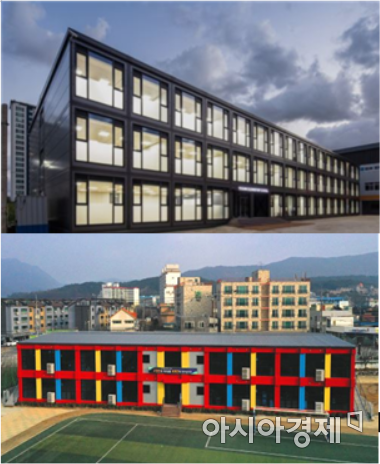
[Asia Economy Reporter Han Jinju] An elementary school in Hanam-si, Gyeonggi Province conducted a survey among parents earlier this month to see if they agreed with the installation of modular classrooms to alleviate overcrowded classes and to determine which grade should use them. The survey results showed that 51.3% favored giving the classrooms to next year's new students. Although 63.9% supported the introduction of modular classrooms, the majority opinion was to allocate them to new students who have not yet enrolled. A parent of a prospective new student, Mr. A, said, "It was absurd that the survey results suggested giving modular classrooms to new students who have no voting rights while avoiding their own child's grade."
Modular classrooms are school buildings completed by manufacturing standardized structures, finishes, and mechanical systems in a factory, transporting them to the site, and simply assembling and installing them. Earlier, in August, the Ministry of Education proposed increasing the number of classes when there are more than 28 students per class, and suggested alternatives such as modular classrooms and converting special classrooms into general classrooms as part of the 'Comprehensive Plan for Education Recovery.' However, on the ground, the government measures are considered insufficient. There is a growing atmosphere of conflict within schools over modular classrooms and related issues.
According to the Ministry of Education, as of last year, the number of classes with 30 or more students was highest in Gyeonggi with 8,342 classes, followed by Seoul with 2,326 classes, Chungnam with 1,373 classes, Incheon with 1,062 classes, and Gyeongnam with 874 classes. Gyeonggi Province accounts for 45.8% of all classes with 30 or more students. In South Korea, the average number of students per class was 23.0 in elementary schools and 26.1 in middle schools as of 2019, which is 1.9 and 2.8 students more than the OECD average (21.1 in elementary and 23.3 in middle schools), respectively.
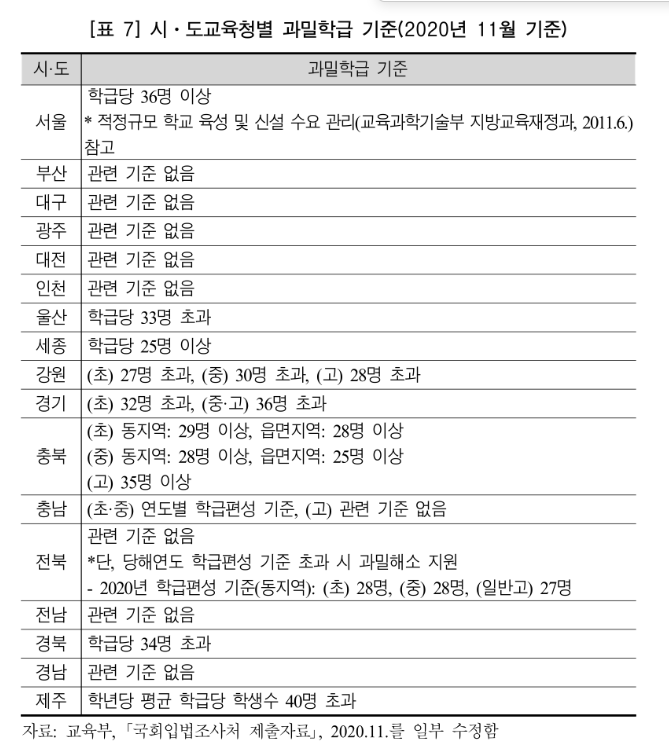 Overcrowded Class Criteria by Metropolitan and Provincial Offices of Education (Source: National Assembly Legislative Research Office, Ministry of Education)
The criteria for overcrowded classes also vary by region. Each metropolitan and provincial office of education sets different standards ranging from a minimum of 25 students or more (Sejong) to a maximum of over 40 students (Jeju). Seoul defines overcrowded classes as those exceeding 36 students, while Gyeonggi specifies over 32 students for elementary schools and over 36 students for middle and high schools. There are calls to specify appropriate student-per-class standards in the Elementary and Secondary Education Act to resolve overcrowded classes by region. The revised 'Framework Act on Education' in August mandates the government to set appropriate student numbers per class and requires local governments to establish and implement policies to achieve this.
The National Assembly Legislative Research Office suggested, "It is necessary to consider establishing legal provisions to set appropriate student numbers per class considering region, school level, and school conditions, and to promote policies to effectively resolve overcrowded classes exceeding these numbers. Metropolitan and provincial superintendents of education should set overcrowded class standards, implement measures to improve situations when exceeded, and report the results to the local councils."
Efforts are also needed to reduce resistance to modular classrooms during the process of improving overcrowded or aging schools. Professor Song Ki-chang of the Department of Education at Sookmyung Women's University explained, "Fundamentally, the issue should be resolved by expanding or building new schools and relocating, but if modular classrooms are introduced, incentives such as reducing the number of students per class to below 20 should be offered to parents."
© The Asia Business Daily(www.asiae.co.kr). All rights reserved.
![Clutching a Stolen Dior Bag, Saying "I Hate Being Poor but Real"... The Grotesque Con of a "Human Knockoff" [Slate]](https://cwcontent.asiae.co.kr/asiaresize/183/2026021902243444107_1771435474.jpg)

















