FIU Detects Suspicious Fund Flows... Police Launch Internal Investigation
Additional Household Loan Regulations to Be Announced "Possibly Early Next Month"
Concerns Over Real Demand Borrowers Like Jeonse Loans... "Will Ensure No Harm"
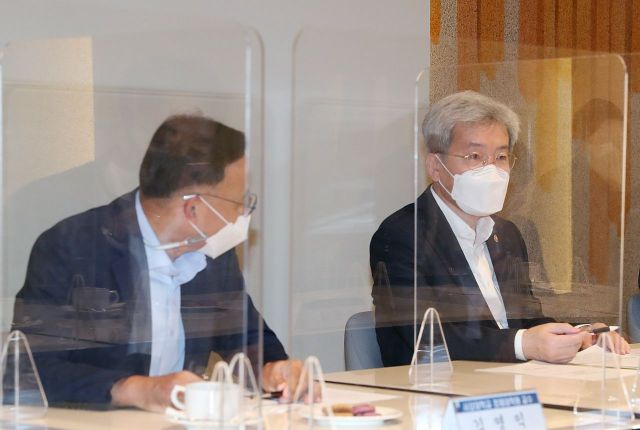 Chairman Ko Seung-beom of the Financial Services Commission delivering opening remarks at the economic and financial market experts meeting held on the 27th at the Korea Federation of Banks in Jung-gu, Seoul. [Photo by Financial Services Commission]
[Asia Economy Reporters Jin-ho Kim and Kwang-ho Lee] Ko Seung-beom, Chairman of the Financial Services Commission, stated on the 27th regarding the Financial Intelligence Unit (FIU) under the Financial Services Commission detecting suspicious fund flows related to Hwacheon Daeyu, "Since the investigative authorities have stepped in, we will monitor and respond accordingly."
After an economic and financial market experts meeting held at the Korea Federation of Banks in Jung-gu, Seoul, Chairman Ko told reporters, "The FIU is structured to report suspicious transactions, and providing information to the police was done from this perspective," explaining the situation.
According to the Hwacheon Daeyu audit report posted on the Financial Supervisory Service’s electronic disclosure system, major shareholder Kim Man-bae borrowed 47.3 billion KRW from Hwacheon Daeyu under the name of long-term loans until last year. CEO Lee Sung-moon also borrowed 2.68 billion KRW from the company in 2019 and repaid it, and last year borrowed 1.2 billion KRW under the name of short-term loans.
In response, the police obtained intelligence in April from the FIU about suspicious fund flows related to Hwacheon Daeyu and are conducting an internal investigation. The FIU is reported to have judged that there is a possibility of embezzlement and breach of trust.
Chairman Ko also mentioned that additional household loan regulations will be announced as early as the beginning of next month or by mid-next month at the latest. He explained, "We have decided to extend the timeline related to household loans," adding, "This refers to the need to tightly manage household loans next year as well, following this year."
He added, "We are currently conducting a comprehensive review of various measures regarding household debt countermeasures."
According to the financial sector, the government is considering advancing the schedule for phased implementation of the Debt Service Ratio (DSR) regulations per borrower as an additional household debt management measure, and strengthening DSR regulations on the secondary financial sector. Measures to tighten securities firms’ margin loans and the possibility of applying DSR to card loans are also being discussed. The announcement is expected shortly after the National Assembly audit.
Regarding this, Chairman Ko said, "We are reviewing various measures including applying DSR to securities firms’ margin loans and card loans," but added, "However, nothing has been finalized yet."
Regarding the recently rapidly increasing jeonse (long-term lease) loans regulation, he responded, "There is a connection to actual demand, and since the conditions for jeonse loans are favorable, the increase is partly due to this," adding, "We will look at this comprehensively but carefully to avoid causing harm to actual demand borrowers." He further said, "We will also strive to discuss overall management measures including jeonse loans with the financial sector."
On concerns that the additional household loan regulations might lead to a 'loan suspension' phenomenon spreading across all banks, he was cautious, saying, "Banks are managing this on their own initiative." According to the financial sector, following NH Nonghyup Bank and Hana Bank, KB Kookmin Bank is also significantly reducing household loan limits. The household loan growth rate is approaching the financial authorities’ management target of 5-6% annually this year, putting loan windows at risk of closing entirely. With loan cliffs becoming a reality at three of the five major banks, there is a strong possibility of a balloon effect shifting to Shinhan and Woori Banks, which still have some leeway.
Meanwhile, the economic and financial market experts meeting held that day was attended by Professor Kim Young-ik of Sogang University, economic commentator Lee Jong-woo, economist Oh Seok-dae of SG Securities, Kim Young-il, head of the Research Center at NICE Information Service, Kim Dong-hwan, director of the Alternative Finance Economic Research Institute, Shin Dong-jun, head of the KB Securities Research Center, and Shin Yong-sang, director of the Korea Institute of Finance.
Market experts expressed consensus with Chairman Ko’s emphasis on the need for strict management of household debt. Shin Yong-sang, director of the Korea Institute of Finance, expressed concern at the meeting, saying, "Preemptive measures such as total volume and qualitative management of household debt are urgent." He suggested risk management directions including ▲ controlling total debt volume and growth speed ▲ lending practices within borrowers’ repayment capacity ▲ blocking balloon effects by resolving regulatory discrepancies. However, he added that separate support and supplementary measures should be prepared for vulnerable groups left out during the strengthening of management.
Economic commentator Lee Jong-woo also pointed out, "Strict control over loan accessibility is necessary," and emphasized, "The cost of loans should be increased, such as by expanding principal and interest installment repayments."
© The Asia Business Daily(www.asiae.co.kr). All rights reserved.

















