Korean Companies Caught in Thucydides's Trap
US Blatantly Demands Semiconductor Information
Protectionism Intensifies
Major M&A Hampered by Global Checks
Investment Contracts Delayed One After Another
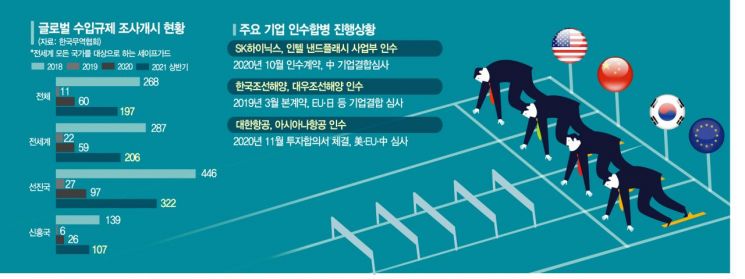
[Asia Economy reporters Choi Dae-yeol, Jung Hyun-jin, Lee Dong-woo] "Over the past eight months, we have prioritized rebuilding alliances and revitalizing partnerships. We are back on the international stage." This was said by U.S. President Joe Biden during his speech at the United Nations (UN) on the 21st (local time). The remark was made with awareness of the criticism faced by former President Donald Trump’s ‘go-it-alone’ approach on the international stage, as he strengthened protectionist policies under the slogan "Make America Great Again."
Despite Biden’s declaration, the international community remains skeptical. Although less overt than Trump, there are claims that America First policies have intensified. Amid ongoing global hegemony competition between the U.S. and China, key foundational industries such as semiconductors have become increasingly important from a security perspective, prompting a fervent effort to ‘secure allies.’ Large-scale mergers and acquisitions (M&A) led by Korean companies are also under intense scrutiny, as they are directly and indirectly entangled with the interests of various countries. Critics argue that advanced countries, backed by huge markets and wielding strong authority, are pulling the ladder away from latecomers.
Japan Falters Under Pressure... Is It a D?j? Vu?
Semiconductors are a field of great interest to President Biden, who instructed to first examine the supply chain after taking office. This time, the U.S. has become even more explicit in demanding information, going as far as conducting surveys. Such demands raise concerns as fierce competition among companies for global semiconductor market dominance is underway.
The U.S. government emphasizes that companies can voluntarily decide whether to provide information and that confidentiality will be protected. However, considering that U.S. companies are aiming to expand their market share in the semiconductor sector, there is a possibility that this information will be used to support domestic firms. If this happens, Korean semiconductor companies, which compete fiercely with U.S. firms across the semiconductor market, will face threats.
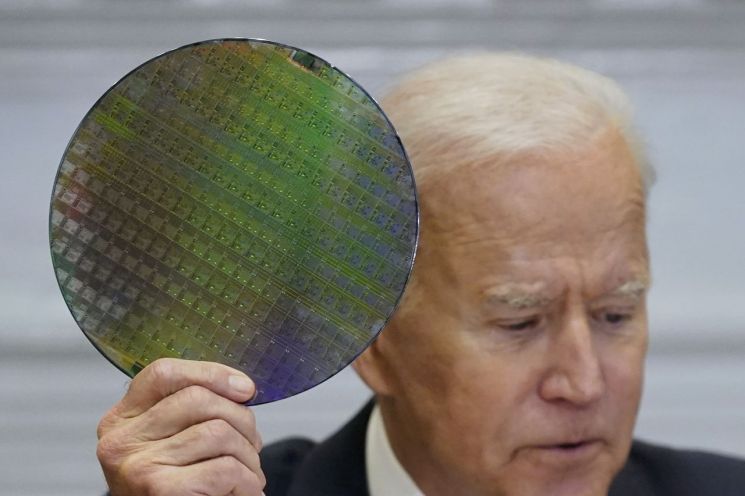 In the semiconductor supply chain CEO meeting last April, U.S. President Joe Biden holding a silicon wafer
 In the DRAM market, U.S. company Micron stands shoulder to shoulder with Korean firms, maintaining a top-three position. In the NAND flash market, news has emerged that U.S. Western Digital, ranked second in the industry, is pursuing a merger with third-ranked Kioxia, raising the possibility of closing the gap with industry leader Samsung Electronics and widening the distance from fourth-ranked SK Hynix. In the foundry (semiconductor contract manufacturing) sector, Taiwan’s TSMC and Samsung Electronics currently hold the first and second positions, handling advanced processes, but U.S. Intel declared its re-entry into the foundry market last March and is pouring massive investments backed by U.S. government support.
This situation recalls the 1980s when the U.S. pressured Japan, then a semiconductor powerhouse, leading to the U.S.-Japan Semiconductor Agreement, which gradually caused the decline of Japan’s semiconductor industry. At that time, the U.S. government imposed retaliatory tariffs on Japan, which was expanding its footprint in the semiconductor market, and later secured commitments through the agreement to disclose semiconductor production costs and guarantee a 20% market share for U.S. semiconductor companies in Japan. During this process, Japan’s semiconductor market share plummeted, while Korea’s semiconductor industry experienced rapid growth. Considering this, the U.S. attempt to seize semiconductor companies’ information under the pretext of the global semiconductor supply chain appears to be another manifestation of nationalism.
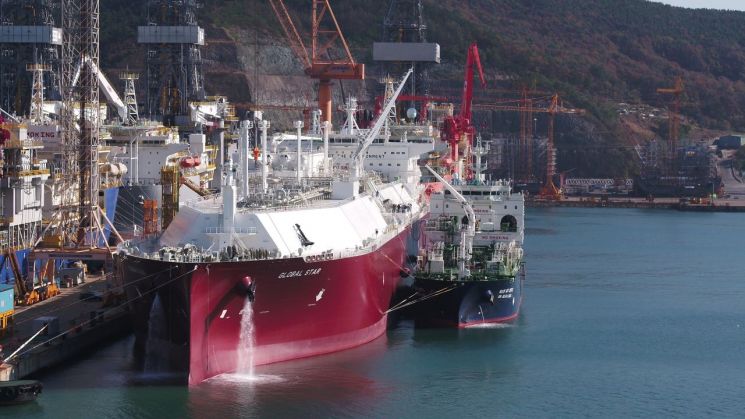 Loading LNG onto an LNG carrier. LNG vessels are representative high value-added ships, most of which are built at Korean shipyards.
 M&A Schedules Also Disrupted
There is a prevailing outlook that large-scale mergers and acquisitions (M&A) in key sectors are likely to be delayed for some time. For example, Korea Shipbuilding & Offshore Engineering and Korea Development Bank had planned to proceed with in-kind contributions and investment contracts by the end of this month, but it is now likely to be postponed once again.
Outwardly, the reason cited is that due to COVID-19 issues that arose last year, merger reviews could not be properly conducted. However, the industry believes the real concern is over Korea Shipbuilding & Offshore Engineering’s dominant position in liquefied natural gas (LNG) vessels, which are gaining attention as eco-friendly ships. According to the industry, LNG carriers are high-value vessels worth around $200 million each, and as of the first half of this year, the three major Korean shipbuilders hold over 90% of the order share.
Among these, the order backlog of Korea Shipbuilding & Offshore Engineering, the three major shipbuilders, and Daewoo Shipbuilding & Marine Engineering is estimated to exceed 7 million CGT (Compensated Gross Tons), accounting for more than 60%. The industry sees this as a concern that the Korean shipbuilding sector will dominate LNG vessel pricing. An industry insider said, "Since many LNG vessel owners are based in Europe, the competition restriction factors must be carefully examined, but due to a lack of information, the deadline has been delayed, leaving only rampant speculation."
© The Asia Business Daily(www.asiae.co.kr). All rights reserved.
![Clutching a Stolen Dior Bag, Saying "I Hate Being Poor but Real"... The Grotesque Con of a "Human Knockoff" [Slate]](https://cwcontent.asiae.co.kr/asiaresize/183/2026021902243444107_1771435474.jpg)


















