Uighur Population Increased from 4.33 Million in 1949 to 11.62 Million Last Year
The Xinjiang Issue Is a Lie by the US and Western Bloc to Contain China
[Asia Economy Beijing=Special Correspondent Jo Young-shin] The Information Office of the State Council of China (hereinafter referred to as the Information Office) has published a white paper on the population of Xinjiang Uyghurs, calling the Western camp's claims, including the United States, of human rights abuses and genocide against Uyghurs in Xinjiang absurd. The Information Office of the State Council is an agency that supervises and manages media within China, and this is the first time it has published a white paper related to the population of Xinjiang Uyghurs.
According to Chinese media such as the Communist Party organ People's Daily and the state-run Xinhua News Agency on the 27th, the Information Office of the State Council released a white paper titled "Population Development in Xinjiang" the day before. This white paper is mainly focused on the population trends of the Uyghur ethnic group, describing Xinjiang's development history, current population status, and population trends.
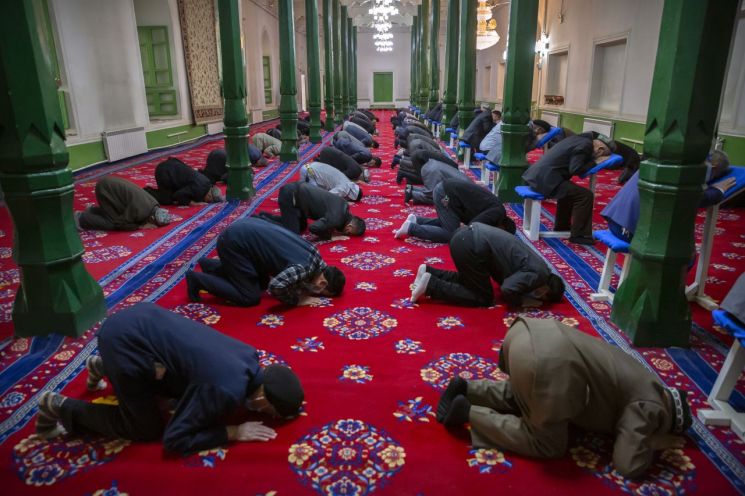
The white paper explains that the Xinjiang region has been geopolitically vulnerable to foreign invasions and that residents' lives were unstable due to religious issues, which slowed population growth. For this reason, it points out that the population of Xinjiang did not exceed one million from 60 BCE to the 18th century. It further states that at the founding of the People's Republic of China in 1949, the Uyghur population was only 4,333,400 but increased to 11.62 million by 2020. In particular, it claims that from 2000 to 2020, the average population growth rate of Xinjiang Uyghurs was 1.67%, much higher than the average growth rate of 0.83% for other ethnic minorities.
Regarding the recent decline in the population growth rate of Xinjiang Uyghurs, the white paper explains it as a phenomenon resulting from economic development. It elaborates that Xinjiang's Gross Domestic Product (GDP) surged from 792 million yuan in 1952 to 1.379758 trillion yuan last year, indicating rapid economic growth in Xinjiang.
The white paper emphasizes that as the economy rapidly grew, Uyghurs began marrying later and having fewer children. In the past, Uyghur women married around age 15 after graduating middle school and had an average of three children, but with economic growth, marriages were delayed, leading to lower birth rates. It argues that the population decline was not due to human rights abuses, forced sterilizations, or mass killings as claimed by the Western camp including the United States, but rather a general phenomenon occurring in other countries or regions due to economic growth.
The Global Times cited experts involved in the white paper's publication, including those from Xinjiang University, stating that changes in Uyghur birth patterns are the result of modernization through economic development and advances in education and healthcare, and strongly denied the Western camp's claims of Uyghur genocide as completely untrue.
The white paper also reported that during the time when religious extremism had widespread influence in Xinjiang, early childbirth and consanguineous marriages were common, but such phenomena no longer occur due to the Chinese government's modernization and anti-terrorism policies.

The white paper also refuted claims about boarding schools in Xinjiang. The Western camp, including the United States, alleges that China established boarding schools in Xinjiang to separate children from their parents and implement cultural eradication policies, but the white paper condemned this as a false claim that overlooks the reality in China. It explained that Xinjiang covers an area of 1,664,900 km², and the distances between villages are far, making it inconvenient for children to attend school. To eliminate this inconvenience, boarding schools were established, and living in school dormitories is entirely based on parents' voluntary decisions. It also emphasized that boarding schools can be established according to the constitution and education law, and nationwide, the number of boarding students in elementary and middle schools reaches 10,878,000 and 23,017,000 respectively.
The white paper stated, "Truth overcomes error, and justice overcomes evil," accusing the Western camp, including the United States, of misleading public opinion and deceiving the international community. It added that the Western camp's deceptive fabrication of lies aims to hinder China's development and that their evil conspiracy will fail.
A source in Beijing said, "It appears that the Information Office of the State Council directly produced the white paper to actively respond to allegations of human rights abuses in Xinjiang," but added, "However, since it is practically impossible for overseas media to freely report from Xinjiang, it is difficult to fully trust the contents of the white paper."
© The Asia Business Daily(www.asiae.co.kr). All rights reserved.


















