Korea Automotive Research Institute: "Domestic Cars Highly Dependent on Overseas Solutions Must Strengthen Competitiveness"
[Asia Economy Reporter Changhwan Lee] With the advent of the autonomous vehicle era, it is forecasted that American big tech companies equipped with high-performance semiconductors and the latest software (SW) technologies will further strengthen their dominance in the future car market.
There is a claim that, as automotive industry nationalism centered on the United States is likely to intensify, domestic automakers in Korea, which heavily rely on overseas solutions, must strengthen their platform competitiveness to secure their competitiveness.
On the 27th, the Korea Automotive Technology Institute released a report titled “Transition to Future Cars, the Rise of Platformers and Implications,” stating that, following the trend of integration and platformization of future car electronic technologies, major American semiconductor companies are seeking market dominance strategies as global platformers.
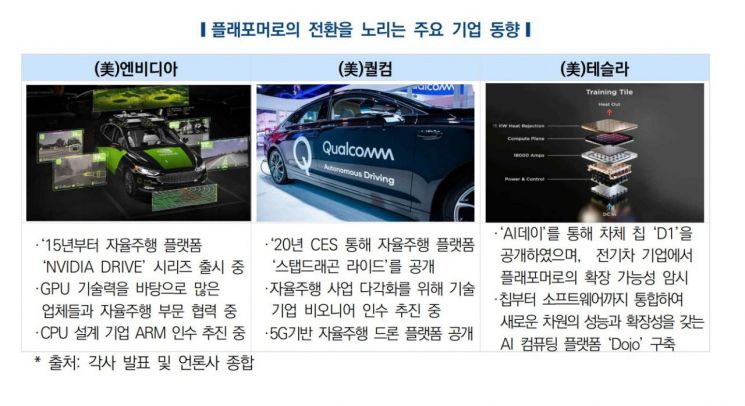
Representative platformer companies include Nvidia, Qualcomm, and Tesla. Nvidia, based on its outstanding GPU (graphics processing unit) technology, is collaborating with many companies in the autonomous driving sector and is also pursuing the acquisition of ARM, a CPU (central processing unit) design company.
Qualcomm has unveiled its autonomous driving platform “Snapdragon Ride” and is pursuing the acquisition of the tech company Veoneer to diversify its autonomous driving business. Tesla, meanwhile, is building an AI (artificial intelligence) computing platform called “Dojo,” which integrates everything from semiconductor chips to software, offering a new level of performance and scalability.
The report emphasized that these platformers package everything from semiconductors to autonomous driving software and supply it turnkey to automakers requiring autonomous driving, enabling them to strengthen market dominance and maximize profits. The stronger the platformers’ market dominance becomes, the more likely U.S. nationalism policies will gain momentum.
Furthermore, as their influence grows, it is expected that domestic companies will become more dependent on overseas solutions, raising concerns about technological dependency.
Korean automakers have mostly relied on foreign products for vehicle semiconductors, which require a high level of reliability, and are currently in the early stages of forming a domestic ecosystem for supply chain diversification and localization, triggered by the global semiconductor shortage.
Regarding software, the domestic industry is very weak in future car SW technologies such as operating systems, artificial intelligence inference engines, and parallel computing, and mostly applies overseas solutions. Therefore, there is a need to avoid overseas technological dependency and to build and expand development and cooperation ecosystems to secure competitiveness.
A positive example cited is Hyundai Mobis, which declared its leap to a software-specialized company and began structural reform. In March, Hyundai Mobis formed the “SW Development Cooperation Ecosystem Consortium” with 13 domestic SW specialized developers to promote SW platform standardization in autonomous driving and infotainment fields through an open innovation ecosystem. Hyundai Mobis plans to nurture internal SW talent and expand cooperation by building an ecosystem with external SW specialized companies.
As an overseas example, ARM, a semiconductor design company, developed an open electronic architecture and is building an ecosystem where semiconductor, automaker, and cloud companies collaborate to maximize compatibility and accelerate design speed.
Jominwook, a senior researcher at the Korea Automotive Technology Institute, emphasized, “Support must be provided for the early establishment and expansion of a development cooperation ecosystem through open SW platforms centered on automakers,” adding, “Through this, competitiveness should be strengthened by promoting business transformation of domestic small and medium enterprises and nurturing global SW Tier-1 companies.”
© The Asia Business Daily(www.asiae.co.kr). All rights reserved.

















