Implemented for 2 months from October 1... Government to refund up to 100,000 KRW per month
Some industries' online malls can be combined, but large stores are excluded... Large department stores, marts, and duty-free shops excluded from aggregation
Entertainment and gambling industries, as well as taxes, fees, and prepaid card recharges, are also excluded
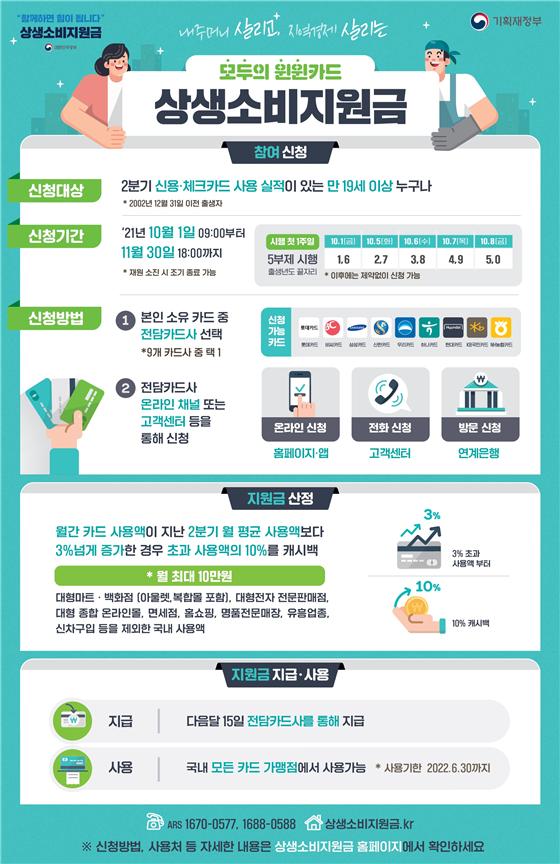
[Sejong=Asia Economy Reporters Kim Hyunjung, Jang Sehee] To revitalize household consumption weakened by the spread of COVID-19, the government will implement the Win-Win Consumption Support Fund (cashback) program for two months starting next month, providing up to 100,000 KRW per adult per month who increases their consumption. Considering the quarantine situation, online malls will also be included in consumption performance aggregation, but large marts, department stores, luxury brand stores, entertainment, and gambling industries will be excluded.
On the 27th, the government announced the 'Win-Win Consumption Support Fund Implementation Plan' through a joint briefing with related ministries. The plan will be carried out for two months starting October 1, with a total budget of 700 billion KRW, targeting adults aged 19 and over (born on or before December 31, 2002) who have credit or debit card usage records under their name in the second quarter of this year. If the monthly card usage amount increases by 3% or more compared to the average monthly usage in the second quarter, 10% of the excess amount will be refunded as cashback (cash-equivalent recharge) with a monthly limit of 100,000 KRW per person. For example, if the average monthly usage is 1,000,000 KRW and the card usage in October is 1,530,000 KRW, the increase is 530,000 KRW; excluding 3% (30,000 KRW), 10% of the remaining 500,000 KRW, which is 50,000 KRW, will be paid.
The usage target is primarily domestic spending, but a negative list approach will be applied to restrict industries or items inappropriate for the program's purpose. The following are excluded from accumulation: large marts such as E-Mart, Homeplus, Lotte Mart, Costco (including warehouse stores); large department stores including Lotte, Shinsegae, Hyundai, Galleria, AK, NC, and E-Land group (including outlets); Lotte and Shinsegae complex shopping malls; duty-free shops; large electronics specialty stores; large comprehensive online malls such as Coupang, Gmarket, Auction, G9, 11st, Wemakeprice; home shopping; entertainment industries; gambling industries; other non-consumption expenditures such as automobile purchases, luxury specialty stores, outdoor golf courses, taxes, insurance, gift certificates, prepaid card recharges, and annual fees.
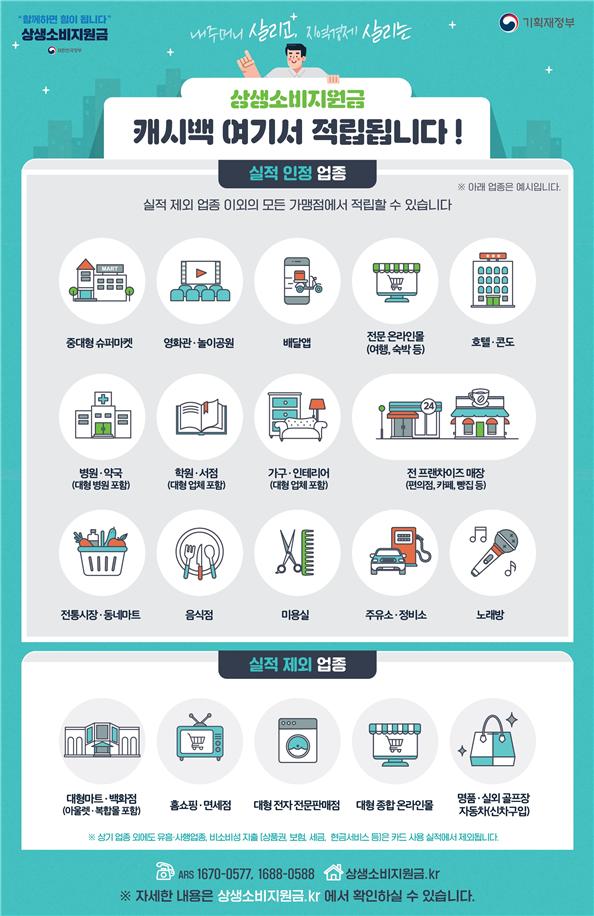
Specialized online mall transactions related to industries affected by COVID-19 such as travel, tourism, exhibitions, performances, culture, and sports, as well as small to medium-sized online malls, are eligible for accumulation. According to this standard, consumption through Norangpungseon, Yes24, Ticketlink, Hanssem Mall, Baedal Minjok, Market Kurly, and Yanolja will be recognized for accumulation. Additionally, consumption at individually leased stores within large marts or department stores can also be aggregated.
The plan also actively reflects the recent rapid increase in COVID-19 confirmed cases. Han Hoon, Deputy Minister of the Ministry of Economy and Finance, stated, "As the number of confirmed cases has increased significantly recently, we held another consultation with the quarantine authorities over the weekend," adding, "The quarantine authorities requested that not only face-to-face consumption but also non-face-to-face consumption be allowed."
Foreigners who have a registration number and have credit or debit card usage records in their name for the second quarter can also apply. The consumption amount will be aggregated for all credit and debit cards under the individual's name, but for convenience in cashback accumulation and usage, one of nine card companies (Lotte, BC, Samsung, Shinhan, Woori, Hana, Hyundai, KB Kookmin, NH Nonghyup) must be designated as the dedicated card company.
However, some voices point out that this government consumption stimulation program may fuel the recent inflation trend. According to Statistics Korea, as of August, the cumulative consumer price index rose 2.0% year-on-year, marking the largest increase since 2012. If the upward trend continues, it is likely to exceed the government's inflation stabilization target (2.0%). Professor Andonghyun of Seoul National University's Department of Economics explained, "The quarantine authorities should present a 'With Corona' direction focusing on reducing deaths rather than reducing confirmed cases," adding, "It is a time when trustworthy policies are needed to ensure that quarantine and economic policies do not conflict."
© The Asia Business Daily(www.asiae.co.kr). All rights reserved.


















