Concerns Over Supply Shortages of Textile and Mechanical Parts
UK Government Turns to Nuclear Power
[Asia Economy Reporter Kwon Jaehee] As the COVID-19 pandemic continues, signs of an energy crisis are emerging worldwide due to heatwaves and cold spells caused by climate change, as well as eco-friendly policies. In particular, China, known as the "world's factory," is facing its worst power shortage in a decade, posing a threat to the global economy. With some Chinese factories shutting down, analysts predict supply shortages across various sectors, from global textiles to machinery parts.
According to Bloomberg on the 27th (local time), half of China's 23 provinces are experiencing power restrictions imposed by government authorities. The hardest hit areas are Jiangsu, Zhejiang, and Guangdong provinces, which are industrial cities accounting for one-third of China's annual Gross Domestic Product (GDP). In Jiangsu, near Shanghai, steel mills have closed, and some cities have turned off streetlights. In neighboring Zhejiang, about 160 companies have shut down, and 14 cities in Liaoning province have ordered emergency blackouts.
China's power crisis is attributed to a combination of soaring coal and gas prices and the Chinese government's strict carbon emission reduction targets. Particularly, President Xi Jinping is pushing strongly for decarbonization ahead of the Beijing Winter Olympics in February next year.
The industrial sector in China is taking a direct hit. According to the Nihon Keizai Shimbun, suppliers for Apple and Tesla halted some production plants in China on Sunday the 26th. Yunnan Aluminium also reduced production under pressure from the Chinese government.
Nomura Securities forecasted, "China's power restrictions will send shockwaves through the global market, causing supply shortages across all sectors, from textiles and toys to machinery parts."
There is also analysis that China's energy crisis will become another trigger for the Chinese economy, which has faced multiple pressures following last year's V-shaped economic rebound.
Larry Hu, a China economic expert at Macquarie Group, stated, "Chinese authorities are willing to accept slower growth for the remainder of this year to meet carbon emission targets. While the GDP growth target of over 6% can be easily achieved, considering the strong growth in the first half, meeting the emission targets will not be easy."
In the UK, as signs of an energy crisis such as oil hoarding appear, the government is turning its attention to nuclear power.
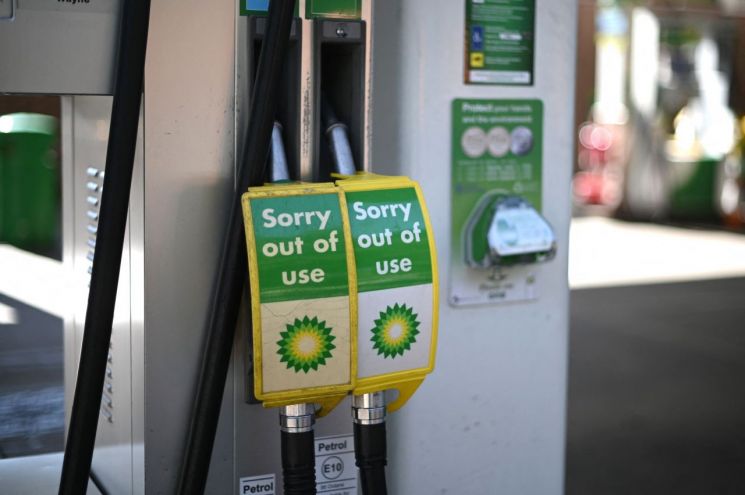
According to the Associated Press on the 26th (local time), due to a shortage of truck drivers to transport oil, queues of vehicles waiting to refill fuel tanks have formed at gas stations nationwide. About 30% of gas stations operated by British Petroleum (BP) across the UK have run out of fuel.
The UK's energy crisis is worsening due to a combination of soaring international gas prices, carbon emission reduction obligations, and a shortage of truck drivers caused by Brexit (the UK's withdrawal from the European Union).
The UK government is focusing on nuclear power to resolve the energy shortage and achieve carbon neutrality in the long term. According to The Times on the same day, Kwasi Kwarteng, the Secretary of State for Business, is expected to approve support for Rolls-Royce's Small Modular Reactor (SMR) project. The Rolls-Royce consortium plans to build 16 mini nuclear power plants in central England, which they say will create over 4,000 jobs by 2050. They have secured ?210 million (approximately 339 billion KRW) in investment and are requesting matching funds from the government.
Initially, the government was negative about new nuclear power plants due to rising construction costs, but it has shifted its stance, recognizing the need for small nuclear reactors to achieve the 2050 carbon neutrality goal and ensure energy security.
Rishi Sunak, the UK Chancellor of the Exchequer, has stated, "Nuclear power must play a major role in the UK's future energy policy, and we cannot rely solely on wind and solar power." The new nuclear power plants planned in the UK aim to be operational by the mid-2030s, with a generation capacity sufficient to supply electricity to about 6 million households.
© The Asia Business Daily(www.asiae.co.kr). All rights reserved.

















