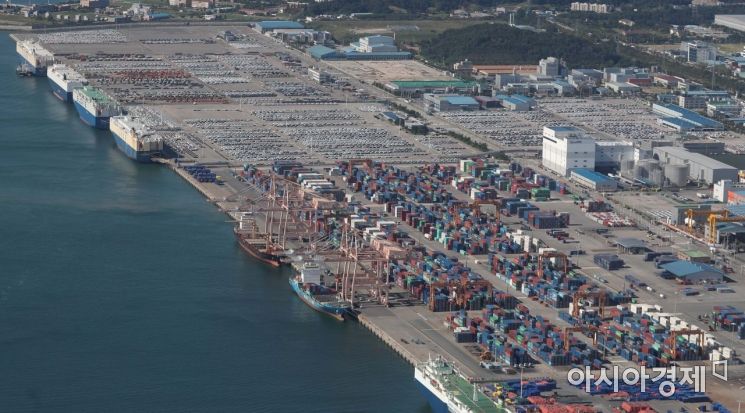
 On the 17th, one day before the Chuseok holiday, export vehicles are waiting to be loaded at Pyeongtaek Port in Gyeonggi. Photo by Mun Ho-nam munonam@
[Sejong=Asia Economy Reporter Kwon Haeyoung] Amid the recovery trend of the global economy following the COVID-19 downturn, the volume of export and import cargo handled at nationwide trade ports last month increased by nearly 10% compared to the same period last year.
The Ministry of Oceans and Fisheries announced on the 26th that buoyed by strong exports of petrochemical products and automobiles, the volume of export and import cargo in August was recorded at 110.74 million tons, a 9% increase from 101.62 million tons in the same period last year.
Coastal cargo volume increased by 6.9% to 17.87 million tons from 16.71 million tons in the same period last year, due to increased volumes of petroleum and cement. Including this, the total port cargo volume handled at nationwide trade ports last month was 128.61 million tons, up 8.7% from 118.33 million tons in the same period last year.
The container cargo volume handled at nationwide ports last month was 2.42 million TEU (1 TEU equals one 20-foot container), a 3.4% increase from 2.34 million TEU in the same period last year. Export and import combined increased by 3.4% to 1.36 million TEU. Exports decreased by 1.9% to 670,000 TEU, while imports increased by 9.1% to 690,000 TEU. The increase in export and import was largely influenced by a 27% rise in trade with the United States, a major trading partner.
By major ports, Busan Port handled 1.817 million TEU, up 4.2% from the same period last year. Incheon Port handled 274,000 TEU, down 1% during the same period, and Gwangyang Port handled 170,000 TEU, up 2.9%.
The non-container cargo volume at nationwide ports last month totaled 85.33 million tons, a 9.7% increase from 77.78 million tons in the same period last year. By port, Gwangyang Port increased by 14.2% to 21.85 million tons, Ulsan Port decreased by 4.4% to 13.76 million tons, and Incheon Port increased by 15.6% to 8.58 million tons. Pyeongtaek-Dangjin Port handled 8.26 million tons, up 29.1%.
By item, petroleum cargo volume increased by 15.8% to 38.87 million tons compared to the same period last year, thermal coal increased by 9.6% to 11.78 million tons, ore decreased by 10.8% to 10.56 million tons, and automobiles increased by 14.5% to 5.83 million tons.
Park Youngho, Director of Port Logistics Planning at the Ministry of Oceans and Fisheries, stated, "Although the volume of export and import cargo is increasing, cargo handling at Busan Port is somewhat delayed due to the cascading congestion at major global ports. Since the global maritime logistics congestion is expected to continue until early next year, we will continue to monitor cargo storage trends at Busan Port and supply storage spaces for export cargo to ensure that export cargo does not become congested."
© The Asia Business Daily(www.asiae.co.kr). All rights reserved.
![Clutching a Stolen Dior Bag, Saying "I Hate Being Poor but Real"... The Grotesque Con of a "Human Knockoff" [Slate]](https://cwcontent.asiae.co.kr/asiaresize/183/2026021902243444107_1771435474.jpg)
















