Professor Cha Seungnam's Research Team at Sungkyunkwan University Successfully Fabricates Electronic Devices Based on Two-Dimensional Molybdenum Disulfide
[Asia Economy Reporter Kim Bong-su] A Korean research team has developed an ultrathin semiconductor device that can self-heal damaged functions.
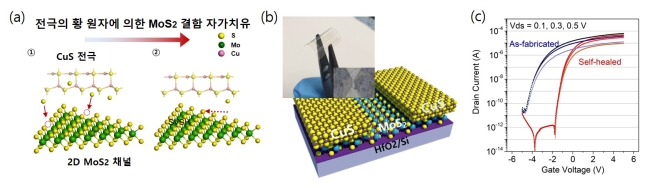
The National Research Foundation of Korea announced on the 26th that Professor Cha Seung-nam's research team at Sungkyunkwan University, together with the Korea Research Institute of Chemical Technology and Kookmin University research teams, succeeded in fabricating a 2D molybdenum disulfide-based electronic device with self-healing properties by newly proposing a two-dimensional copper sulfide electrode instead of the conventional metal electrode.
Two-dimensional semiconductor materials are attracting attention as next-generation semiconductor materials due to their flexibility and transparency. However, since their thickness is as thin as an atomic layer, they are easily damaged during the semiconductor device fabrication process. Defects at the interface between the electrode and the 2D semiconductor make it difficult for electrons to move effectively, significantly degrading device performance.
The research team developed an electrode-semiconductor material system with self-healing performance for defects in 2D semiconductor materials. Most defects in two-dimensional molybdenum disulfide arise from sulfur atom deficiencies, and the copper sulfide electrode supplies excess sulfur atoms present in the material to the sulfur-deficient sites of the 2D molybdenum disulfide to heal the defects. This defect healing is analyzed to facilitate charge transport within the 2D semiconductor material, thereby improving device characteristics.
The research team stated, “The 2D molybdenum disulfide-based transistor device with self-healing functionality achieved the highest electron mobility reported to date,” adding, “This increases the potential for use as a core component in next-generation flexible and wearable devices.”
The research results were published online as a cover paper in the international journal Advanced Materials on the 4th.
© The Asia Business Daily(www.asiae.co.kr). All rights reserved.
![Clutching a Stolen Dior Bag, Saying "I Hate Being Poor but Real"... The Grotesque Con of a "Human Knockoff" [Slate]](https://cwcontent.asiae.co.kr/asiaresize/183/2026021902243444107_1771435474.jpg)











