US Giant Semiconductor Companies Likely to Increase Dominance in Future Car Market
[Asia Economy Reporter Changhwan Lee] As the future car market becomes increasingly advanced, there is a growing argument that domestic automobile companies must strengthen their platform competitiveness to avoid technological dependence on overseas firms.
According to the report "Future Car Transition, the Rise of Platformers and Implications" by the Korea Automotive Technology Institute on the 27th, following the trend of integration and platformization of future car electronic technologies, major U.S. semiconductor companies are seeking market dominance strategies as global platformers.
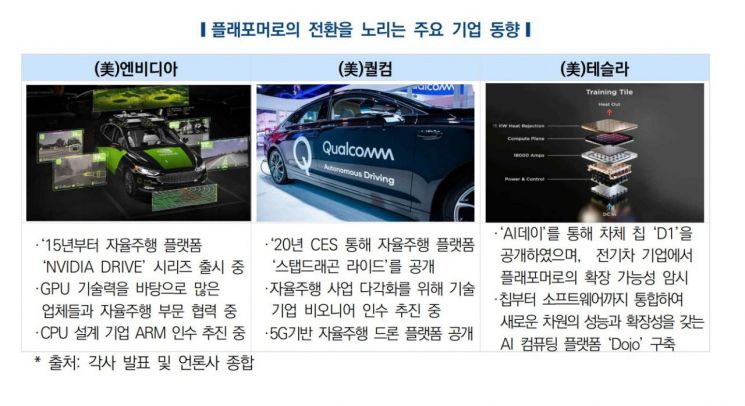
Representative companies include Nvidia, Qualcomm, and Tesla. Nvidia is collaborating with many companies in the autonomous driving sector based on its outstanding GPU (Graphics Processing Unit) technology and is also pursuing the acquisition of ARM, a CPU (Central Processing Unit) design company.
Qualcomm has unveiled the autonomous driving platform "Snapdragon Ride" and is pursuing the acquisition of the technology company Veoneer to diversify its autonomous driving business. Tesla is building an AI (Artificial Intelligence) computing platform called "Dojo," which integrates everything from semiconductor chips to software, offering a new level of performance and scalability.
The report emphasized that these platformers package everything from semiconductors to autonomous driving software and supply turnkey solutions to automobile companies requiring autonomous driving, enabling them to strengthen market dominance and maximize profits.
As the influence of platformers grows, it is expected that domestic companies will increasingly depend on overseas solutions, raising concerns about technological dependence.
In the case of domestic semiconductors, vehicle semiconductors requiring a high level of reliability have mostly depended on overseas products, and the domestic ecosystem is currently in the early stages of formation for supply chain diversification and localization, triggered by the global semiconductor shortage.
Regarding software, the domestic industry is very weak in future car software technologies such as operating systems, artificial intelligence inference engines, and parallel computing, and mostly applies overseas solutions.
Therefore, there is a call for the establishment and expansion of development and cooperation ecosystems to avoid overseas technological dependence and secure competitiveness for the domestic industry.
Senior Researcher Minwook Cho of the Korea Automotive Technology Institute explained, "It is necessary to support the early establishment and expansion of a development cooperation ecosystem through software platform openness centered on finished car manufacturers, and to promote competitiveness enhancement by fostering domestic small and medium-sized enterprises and global software Tier-1 companies through business transformation."
As a representative example, he cited Hyundai Mobis, which in March this year formed the "SW Development Cooperation Ecosystem Consortium" with 13 domestic specialized software development companies and is promoting software platform standardization in autonomous driving and infotainment fields through an open innovation ecosystem.
© The Asia Business Daily(www.asiae.co.kr). All rights reserved.
![Clutching a Stolen Dior Bag, Saying "I Hate Being Poor but Real"... The Grotesque Con of a "Human Knockoff" [Slate]](https://cwcontent.asiae.co.kr/asiaresize/183/2026021902243444107_1771435474.jpg)











