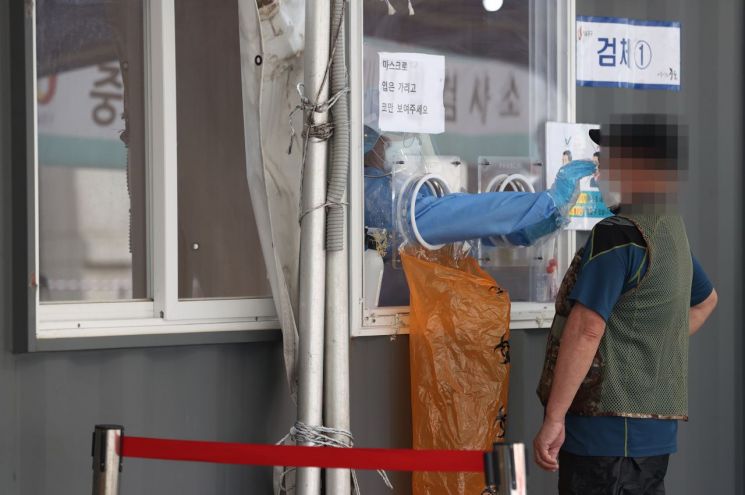
 As the Chuseok holiday ended and the number of new COVID-19 cases surged daily, surpassing 3,000, medical staff are collecting samples at the Jung-gu Temporary Screening Clinic set up at Seoul Station Plaza on the morning of the 25th.
 [Image source=Yonhap News]
[Asia Economy Reporter Lee Chun-hee] On the 25th, the number of new COVID-19 cases reached an all-time high of 3,273. This indicates a rapid resurgence of the fourth wave following the end of the Chuseok holiday. Despite a decrease in testing due to the holiday, the surge in mobility has accelerated the spread, and combined with the low vaccination rates among young people and the spread of the Delta variant, there are concerns that next week will also see record-high numbers of confirmed cases.
Increased Mobility During Chuseok Holiday... Explosive Rise in Cases as Testing Numbers, Which Had Decreased, Surge
The Chuseok holiday is identified as the main cause of the current spread. Even on Friday, September 17, just before the holiday, 2,008 new cases were confirmed amid a rising trend. The government eased restrictions by allowing gatherings of up to eight people even in level 4 areas, signaling relaxation of quarantine measures, which led to increased mobility during the Chuseok holiday. Meanwhile, the number of diagnostic tests sharply decreased due to the holiday, resulting in a surge of accumulated test waiters after the holiday ended.
Jung Eun-kyung, Commissioner of the Korea Disease Control and Prevention Agency (KDCA), said at the COVID-19 response briefing on the 25th, "The main reason for the sharp increase in cases is the continued spread of the highly transmissible Delta variant, combined with a significant increase in population mobility around Chuseok and increased interpersonal contact." She added, "Especially during the Chuseok holiday, mobility increased markedly, showing a level much higher than before the start of the fourth wave."
According to the Ministry of Land, Infrastructure and Transport, the number of people traveling during this year’s Chuseok holiday was 32.76 million (an average of 5.46 million per day), which is 5.1% higher than last year’s Chuseok. Considering that last year’s Chuseok was a lull period after the second wave had subsided, this increase occurred even as the fourth wave was peaking.
On the other hand, the number of COVID-19 diagnostic tests decreased. Normally, the number of tests during weekdays before the holiday was around 150,000 per day, but during the five days of the Chuseok holiday, the daily test numbers were 96,310 → 75,233 → 90,317 → 99,473, all below 100,000, only rising to 165,457 on the last day of the holiday, September 22.
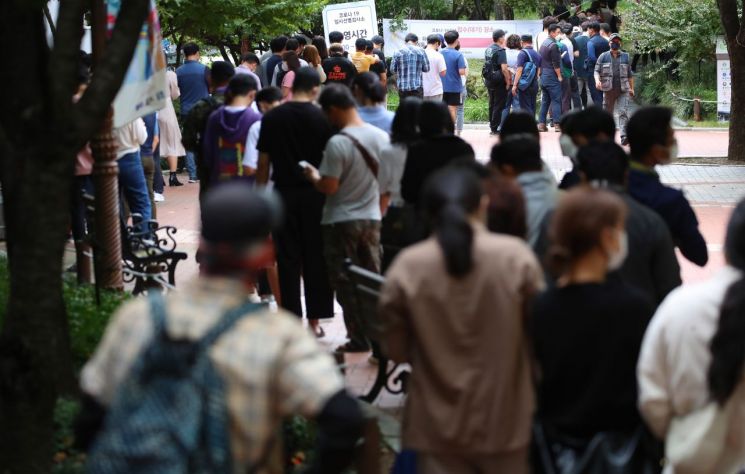 On the afternoon of the 24th, citizens are lined up waiting to get tested at a temporary screening clinic set up in Gukchaebosang Park, Jung-gu, Daegu. [Image source=Yonhap News]
However, despite the low number of tests, the number of confirmed cases at midnight from the 18th to the 21st was 2,087 → 1,909 → 1,604 → 1,729, marking the highest daily counts for four consecutive days, indicating a steady spread. Meanwhile, the number of tests surged to 246,468 on the 23rd and 227,874 on the 24th, and confirmed cases began to rise sharply again.
The concern is that this trend may continue into next week. Commissioner Jung said, "As interpersonal contact increases, transmission naturally rises, leading to more confirmed cases." She added, "The current reproduction number is 1.03 and is believed to have increased further. We assess that there is a possibility of more than 3,000 confirmed cases."
Professor Kim Shin-woo of Kyungpook National University Hospital’s Infectious Diseases Department also stated, "Gatherings to prepare for the holiday began even before Chuseok, including among unvaccinated individuals. The current occurrence of cases in the 3,000 range is expected to continue for another one to two weeks, causing ongoing 'n-th generation infections.'"
Young People Left Out of Vaccination... Directly Exposed to Infection Risk
Another aspect of the recent surge is the spread mainly among young people. Among the 3,273 new cases as of midnight on the 25th, 1,981 (60.5%) were in the 20-40 age group. Breaking down the 3,273 cases by age group: 20s - 810 cases (24.8%), 30s - 660 cases (20.2%), 40s - 511 cases (15.6%), 50s - 339 cases (10.4%), teens - 299 cases (9.1%), 60s - 269 cases (8.2%), 0-9 years - 205 cases (6.3%), 70s - 120 cases (3.7%), and 80+ - 60 cases (1.8%).
As vaccination among socially active young people has been delayed, the transmission speed appears to be accelerating. Since vaccination prioritized 'high-risk groups' based on severity and fatality rather than social activity levels, the young and middle-aged groups have been relatively neglected and are now directly exposed to infection risk.
Commissioner Jung also warned, "Among 21,741 confirmed cases aged 18 and over from September 5 to 18, 85.5% occurred in unvaccinated or partially vaccinated groups," emphasizing the higher risk of infection without vaccination.
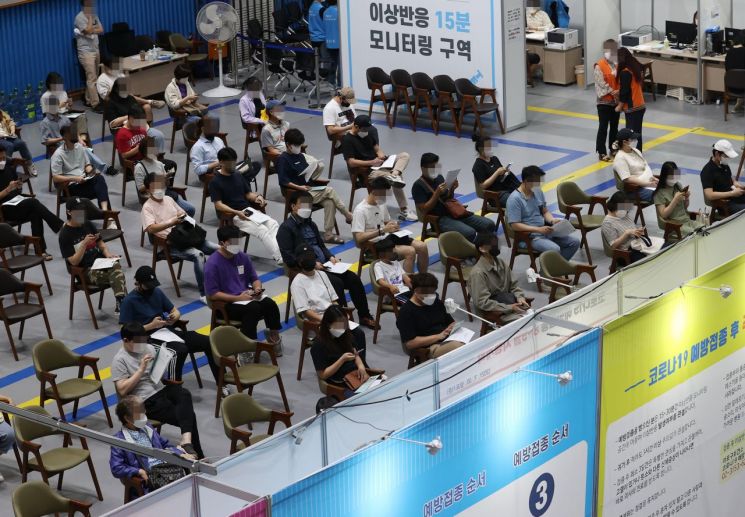 On the 24th, citizens are waiting while monitoring for adverse reactions after receiving the vaccine at the COVID-19 vaccination center set up at Mapo-gu Community Sports Center in Seoul.
 [Image source=Yonhap News]
However, as of midnight on that day, the vaccination completion rate for those aged 60 and over was 86.8%, with 11,413,019 out of 13,153,568 people fully vaccinated, and for those in their 50s, over half (50.5%) had completed vaccination. In contrast, only 32.3% (7,243,913 out of 22,415,616) of the 18-49 age group had received the recommended number of vaccine doses.
Vaccination for the general 18-49 age group only began on August 26, and the government extended the interval between mRNA vaccines?Pfizer from 3 weeks and Moderna from 4 weeks?to 6 weeks due to vaccine supply issues. Therefore, vaccination completion among young people remains distant. Even if vaccinated on the first day, August 26, the second dose can only be administered on October 7 following the 6-week interval, and considering the antibody formation period, effective full vaccination would only be achieved by October 22.
Rapid Spread of Highly Transmissible Delta Variant... Detected in 98% of Confirmed Cases
Additionally, the rapid spread of the Delta variant, which has higher transmissibility and infectivity than previous strains, is further fueling the surge. The Delta variant has become dominant, detected in the majority of variant-analyzed confirmed cases.
According to health authorities, among 3,033 confirmed cases analyzed for variants during the week ending September 18, 2,977 cases (98.2%) were identified as the Delta variant. This means that nearly all COVID-19 viruses circulating domestically are the Delta variant.
As the Delta variant is known to partially evade immunity from developed COVID-19 vaccines, the number of suspected 'breakthrough infections'?cases testing positive after full vaccination?is rapidly increasing. Authorities use the term 'suspected breakthrough infection' because they cannot confirm whether the infection occurred at least 14 days after the second dose (or first dose for Janssen) to definitively classify it as a breakthrough case.
As of September 12, among 14,611,702 fully vaccinated individuals, 5,880 (0.04%) tested positive for COVID-19 after vaccination. The number of suspected breakthrough infections rose sharply from just 2 cases in April to 2,765 last month, with 1,810 confirmed cases as of the 12th this month.
Among 1,619 cases with completed variant analysis, 1,396 (86.2%) were variant viruses, and of these, 1,363 (97.6%) were confirmed as the Delta variant.
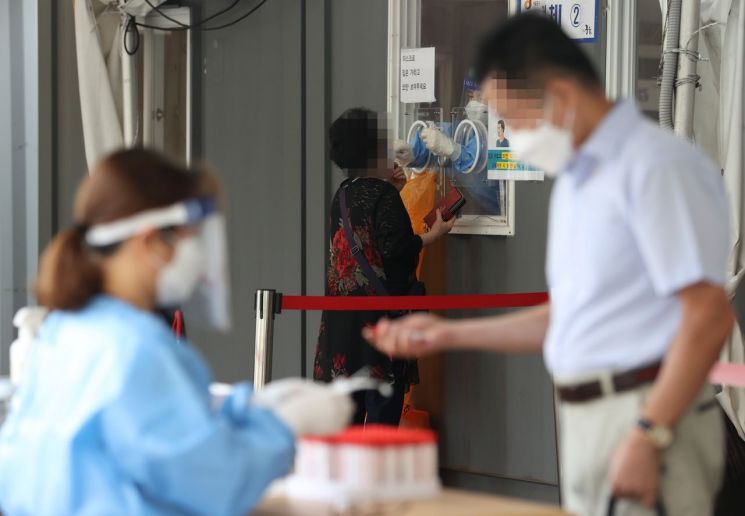 As the Chuseok holiday ended and the number of new COVID-19 cases surged daily, surpassing 3,000, medical staff are collecting samples at the Jung-gu Temporary Screening Clinic set up at Seoul Station Plaza on the morning of the 25th.
 [Image source=Yonhap News]
Another characteristic of the Delta variant that contributes to the spread is the symptom onset pattern. Commissioner Jung explained, "The Delta variant causes symptoms to appear two days before the infected person realizes or suspects infection, making it very difficult to trace who infected whom." Analysis shows that 38.1% of confirmed cases in the past two weeks (September 12?25) had unknown infection routes, influenced by the Delta variant.
Commissioner Jung added, "We conduct contact tracing on the same day for confirmed cases and promptly isolate contacts to block further transmission in quarantine. However, epidemiological investigations alone have clear limitations in identifying all infection routes and sources, so reducing interpersonal contact through appropriate social distancing serves as a second line of defense."
© The Asia Business Daily(www.asiae.co.kr). All rights reserved.
![Clutching a Stolen Dior Bag, Saying "I Hate Being Poor but Real"... The Grotesque Con of a "Human Knockoff" [Slate]](https://cwcontent.asiae.co.kr/asiaresize/183/2026021902243444107_1771435474.jpg)


















