Seoul and Greater Seoul Area Sales and Jeonse Price Increases Slow Down
Weakened Buying Demand Before Chuseok Holiday
Possibility of Renewed Price Surge... Concerns Over Jeonse Shortage
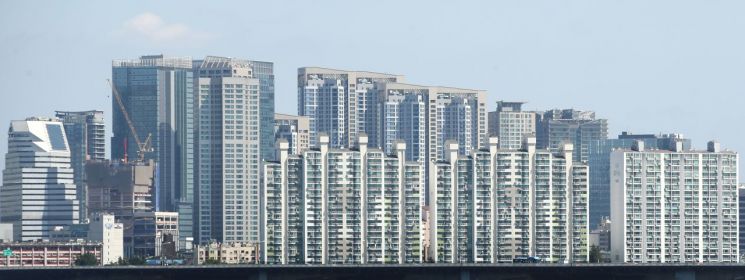
The upward trend in apartment prices in the Seoul metropolitan area, which had been at record-high levels for nine consecutive weeks, has somewhat eased. This is interpreted as being influenced by fatigue from the prolonged high rate of increase and a decrease in buying activity before the Chuseok holiday. However, since the supply of new housing units is expected to decrease in the second half of this year and concerns about the autumn rental market are significant, there are also forecasts that the rate of increase could expand again in the future.
According to the weekly apartment price trend for the third week of September announced by the Korea Real Estate Board on the 24th, the apartment price increase rate in the Seoul metropolitan area rose by 0.36% as of the 20th, down from 0.40% the previous week. The metropolitan area had maintained record-high increase rates for nine consecutive weeks since the second week of July. In particular, for the past five weeks, it has maintained an increase rate of 0.40%, the highest since the Korea Real Estate Board began compiling weekly statistics in May 2012.
The reduction in the rate of increase in the metropolitan area was mainly due to the slowdown in Gyeonggi-do, where apartment prices have been soaring recently due to development benefits such as the Seoul Metropolitan Area Express Train (GTX). The increase rate in Gyeonggi-do slowed for two consecutive weeks this month (0.51 → 0.49 → 0.43%). The sharp rise in prices in Anseong, where a ‘price matching’ phenomenon is occurring, dropped significantly from 0.83% to 0.48% in one week, and buying activity also weakened somewhat in Gunpo, Uiwang, Siheung, and Osan.
Seoul also saw a reduced increase rate this week, rising by 0.20%, down for the first time in three weeks. The upward trend eased somewhat in most districts, including Nowon and Dobong-gu, where the real estate market had overheated due to expectations of eased reconstruction regulations. However, Gangseo-gu, centered around the Magok district where development expectations are growing, and Seocho-gu, which has reconstruction relocation demand, showed similar increase rates to the previous week. Incheon also recorded the same increase rate of 0.45% for two consecutive weeks.
Apartment rental prices also saw a nationwide slowdown in the rate of increase. In the metropolitan area, the increase rates in Seoul (0.17 → 0.15%), Gyeonggi-do (0.29 → 0.27%), and Incheon (0.25 → 0.24%) all narrowed. This is interpreted as being caused by fatigue from the prolonged high increase rates and a decrease in chase buying due to loan regulations. In fact, this week, both the sales and rental supply-demand indices in Seoul, the metropolitan area, and provinces all shrank simultaneously, showing a trend opposite to the recent real estate market.
However, this phenomenon is seen as a temporary weakening of trading activity before the Chuseok holiday, and many analyses suggest that the rate of increase may soon expand again, intensifying housing price instability. In particular, it is widely expected that the sharp rise in rental prices during the autumn moving season will fuel the upward trend in apartment prices. Industry insiders see the pre-sale of new towns scheduled for the second half of the year and rental policy measures as major variables affecting the market. The government plans to conduct a second pre-sale for about 12,000 households in mid-next month and is also considering strengthening loan regulations to manage household debt.
© The Asia Business Daily(www.asiae.co.kr). All rights reserved.
![Clutching a Stolen Dior Bag, Saying "I Hate Being Poor but Real"... The Grotesque Con of a "Human Knockoff" [Slate]](https://cwcontent.asiae.co.kr/asiaresize/183/2026021902243444107_1771435474.jpg)
















