Enforcement of Revised Juvenile Protection Act from Today
40 Undercover Investigators Deployed for Digital Sex Crime Investigations
Expected Strong Effect in Suppressing Purchase and Sale of Sexual Exploitation Materials
"Inducement of Criminal Intent" Concerns Raised
Police Operate Undercover Investigation Inspection Team to Address Issues

[Asia Economy Reporter Song Seung-yoon] After the so-called ‘n-beonbang incident’ shocked our society last year, digital sex crimes committed online seemed to disappear for a while. However, these crimes have only gone deeper underground and still exist. Even on Telegram, which was identified as the main platform behind the n-beonbang incident, the problematic distribution of videos continues secretly, and the buying and selling of sexual exploitation materials have moved to other platforms or back to existing ones, making eradication difficult.
The partial amendment to the ‘Act on the Protection of Children and Juveniles from Sexual Abuse,’ which took effect on the 24th, is expected to somewhat help prevent and eradicate such types of sex crimes. Since the law is limited to children and juveniles, it has limitations in applying to digital sex crimes targeting adults. However, it is expected to have a significant effect in suppressing the purchase and sale of sexual exploitation materials, which constitute the vast majority of digital sex crimes. Among 3,575 suspects related to digital sex crimes caught during the nine months from March to December last year when the Digital Sex Crime Special Investigation Unit was operating, 1,875 were purchasers or possessors of child sexual exploitation materials, and 1,170 were sellers or distributors, with most being offenders related to sexual exploitation materials.
Under the amended law, police can conduct undercover investigations by posing as buyers and approaching possessors or sellers of sexual exploitation materials, so sellers have no way of knowing who the police are. In particular, to enter chat rooms related to sexual exploitation materials such as n-beonbang, authentication processes often require identification cards or business cards that can prove identity, and in such cases, it has become possible to create virtual identification cards. As part of the investigation, it is also possible to trade, possess, sell, or advertise sexual exploitation materials in reverse. From the criminal’s perspective, the authentication process to identify the police becomes futile.
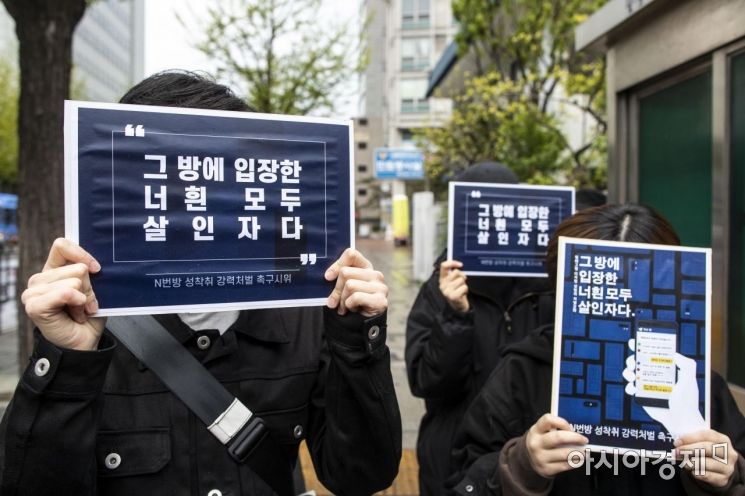 On the morning of the 17th, at the Jongno Police Station in Seoul, citizens held a picket demanding severe punishment as the vehicle carrying Kang Hoon, known as "Butta," an accomplice who assisted operator Jo Joo-bin in running and managing chat rooms on the Telegram "Baksa Bang," and charged with violating the Act on the Protection of Children and Youth against Sexual Offenses, left the Jongno Police Station and headed to the Seoul Central District Prosecutors' Office. Photo by Kang Jin-hyung aymsdream@
It is not that the police were unable to conduct undercover investigations before. However, they were carried out within limited scopes. According to Supreme Court precedents, ‘opportunity-providing’ sting operations that catch those with criminal intent by providing crime opportunities are legal, but ‘inducement-type’ sting operations that provoke crimes from those without criminal intent are considered illegal. Therefore, even if criminals were caught, there were increasing concerns that evidence might not be admissible in court or that investigators could be accused of illegal acts during the investigation. However, under the amended law, investigators can be exempted from criminal, disciplinary, and civil liability except in cases of intentional or gross negligence. Since the legality of the investigation can be recognized in advance, more proactive investigations can be conducted.
There are also considerable concerns. Since the investigative agencies might appear to be involved in illegal acts to some extent, there remains room for controversy depending on the form of sexual exploitation materials used in the investigation. Actual victimized sexual exploitation materials cannot be used as investigative tools. Although the police have not disclosed detailed information, they have produced and distributed a kind of manual called the ‘Undercover Investigation Guidelines,’ which includes approval and authorization procedures for undercover investigations and domestic and international investigation cases tailored to such situations.
There are also criticisms that proactive investigations could turn into inducement-type sting operations that provoke crimes from people who had no intention of committing crimes. Methods like those of the U.S. Federal Bureau of Investigation (FBI), which directly create and operate child pornography sites to catch child sex offenders, are realistically impossible to implement. The National Police Agency plans to operate a ‘Digital Sex Crime Undercover Investigation Inspection Team’ to review such issues and improvements arising from the implementation of undercover investigations and gradually supplement undercover investigators.
© The Asia Business Daily(www.asiae.co.kr). All rights reserved.

















