Deadlock Over Regular Employment Conversion Method
Hyundai Steel's Regular Employment Hiring for Non-Regular Workers Marks First Case in Manufacturing
Union Claims "Subsidiary Hiring Is Indirect Employment"
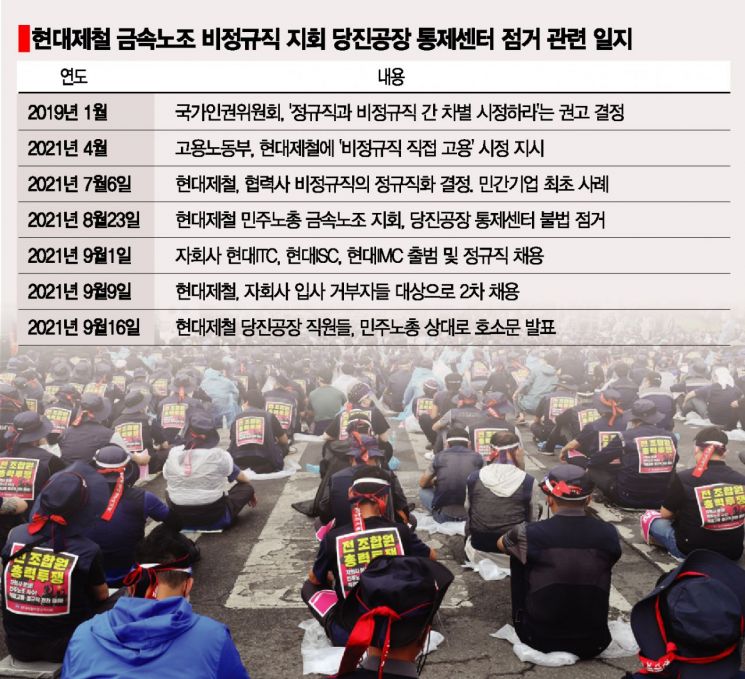
[Asia Economy Reporter Hwang Yoon-joo] The steel industry is experiencing a rare boom, but internal strife has continued at Hyundai Steel for a month. Members of the Korean Metal Workers' Union under the Federation of Korean Trade Unions have been occupying the Dangjin Plant control center for over a month since the 23rd of last month, demanding the direct employment of Hyundai Steel’s non-regular workers. As the illegal occupation of the control center by subcontracted non-regular workers at the Dangjin Plant prolongs, concerns about safety accidents are also emerging. The gap between Hyundai Steel and the non-regular workers’ union is wide, and the situation is expected to drag on.
◆ Sharp Differences in Perception Over Regular Employment Conversion Method = The conflict began with Hyundai Steel’s decision to convert non-regular workers to regular employees. After the Ministry of Employment and Labor issued a corrective order for the direct employment of non-regular workers in April this year, Hyundai Steel decided within three months to hire subcontracted non-regular workers as regular employees of subsidiaries, launching three subsidiaries?Hyundai ITC, ISC, and IMC?on the 1st of this month to employ them. The annual salary of non-regular workers, which had been only about 60% of Hyundai Steel’s regular employees, was raised to about 80%.
The business community regarded this as a bold decision. The conversion of subcontracted non-regular workers to regular employees through subsidiaries was the first case among large-scale manufacturing industries. Renault Samsung Motors’ Busan plant also received the same corrective order but did not accept it. In cases like Deokyang District Office in Goyang City and Hyundai Motor Company, ‘half-measures’ such as time-selective fixed-term public officials or job-specific regularization were implemented.
Nevertheless, Hyundai Steel’s non-regular workers’ union is strongly opposed. They claim that subsidiary employment is ‘indirect employment.’ This stems from differing interpretations of the corrective order for direct employment. According to the Ministry of Employment and Labor’s ‘Guidelines on the Conversion of Non-Regular Workers to Regular Employees in the Public Sector,’ each institution can decide on the conversion method, such as direct employment, subsidiaries, or social enterprises.
The reason why members of the Korean Metal Workers' Union at Hyundai Steel have been illegally occupying the control center since last month is that they insist Hyundai Steel itself, not the subsidiaries, must directly employ them. Hyundai Steel extended a hand by offering a second chance for subsidiary employment to protesting union members on the 9th. Even employees at the Dangjin Plant, unable to bear the situation, issued an appeal to the Korean Metal Workers' Union, warning that the illegal occupation could lead to a major safety accident. Amid the steel industry boom that has come after ten years, Hyundai Steel alone has yet to conclude wage and labor negotiations, deepening its worries.
◆ Silent Ministry of Employment and Labor... Hyundai Steel Takes Legal Action = There are also criticisms that no mediator is visible in the labor-management conflict at Hyundai Steel. The conversion of non-regular workers to regular employees through subsidiaries was effectively led by the Ministry of Employment and Labor. Although they have created a platform for labor-management dialogue, there are limits. Heo Jae-jun, senior researcher at the Korea Labor Institute, explained, "The recommendation for ‘conversion of non-regular workers to regular employees’ has been made since before 2007, starting in the public sector and then horizontally expanding to private companies. Private companies can choose direct employment or subsidiary employment depending on their circumstances, but problems arising in this process have begun to surface."
A business community official said, "The Ministry of Employment and Labor led the conversion of non-regular workers to regular employees through subsidiary establishment in the public sector. Public institutions like KEPCO also hired regular employees through subsidiaries, but due to labor opposition, the Ministry cannot express its opinion."
Hyundai Steel’s concerns are deepening. The illegal occupation by the union raises safety and environmental accident risks. Although the union has opened the production department inside the control center, it continues to occupy the safety, finance, production, maintenance, logistics, and environment departments, preventing related employees from working in the building. Consequently, Hyundai Steel filed an injunction to prohibit obstruction of business against the protesting union. The first hearing was held on the 14th, and results are expected as early as this month. Depending on the outcome, the illegal occupation of the control center may end.
A Hyundai Steel official said, "We are doing our best to prevent safety accidents, but the response speed may slow down, causing difficulties. We plan to resolve the issue through legal action."
© The Asia Business Daily(www.asiae.co.kr). All rights reserved.

















