Speeding Up Amendments to the Lease 3 Laws Before the Presidential Election... Experts Say "Only Tricks Increase, No Effect on Listing of Properties"
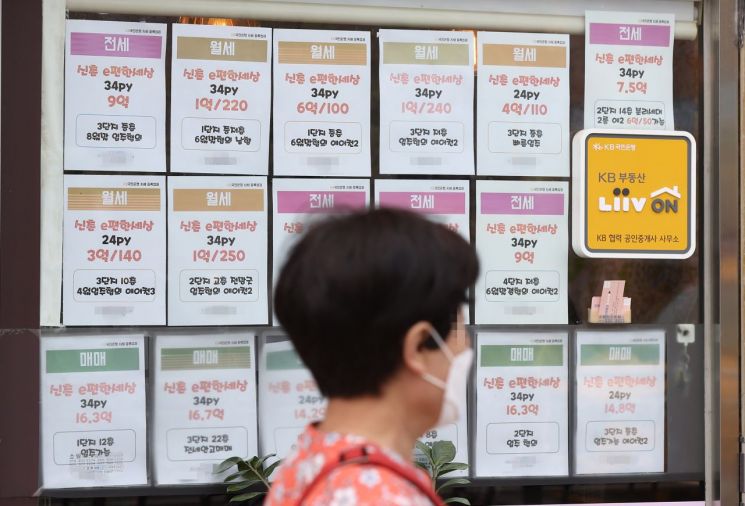
[Asia Economy Reporter Jang Sehee] The ruling party is considering a measure requiring landlords to report whether they are residing in their properties to alleviate the shortage of jeonse (long-term lease) listings. This move comes as a response to the side effects that have spread since the introduction of the new lease law in July last year, which caused a sharp decline in jeonse listings and a significant rise in prices. The party aims to more actively verify landlords who choose to live in their properties instead of leasing them. Since the ruling party and government have already decided to supplement the three lease laws (right to request contract renewal, rent ceiling system, and lease reporting system), the introduction of a landlord residency reporting system is expected to gain momentum.
According to the Democratic Party on the 24th, the ruling party plans to soon concretize amendments to the three lease laws, including the right to request contract renewal, which contain these measures. A key Democratic Party official stated, "There are cases where tenants' right to request contract renewal is rejected under the pretext of landlord residency, but the property remains vacant," adding, "It is necessary to operate the contract renewal right system effectively by introducing a reporting system." He further said, "We plan to discuss related matters such as identifying landlord residency in consultation with the government." It is highly likely that after verifying residency through the reporting system, sanctions will be imposed if landlords are found not residing in their properties.
The ruling party's decision to verify landlords' residency status stems from the increasing difficulties faced by tenants as jeonse listings disappear from the market. In particular, as listings vanish, jeonse has become scarce, causing prices to soar during the first year of the lease law's implementation. According to the Korea Real Estate Board, the average jeonse price for apartments in Seoul in July was 624.02 million KRW, a 27.7% increase compared to July last year. The market expects that with moving demand from October to December continuing until the end of the year, housing prices will keep rising, and jeonse and monthly rent prices will also show strong upward trends. The ruling party believes that introducing the reporting system will encourage landlords, who feel burdened by the residency reporting, to release jeonse listings.
A Democratic Party official explained, "Increasing transparency in the right to request contract renewal will protect tenants and help curb price increases." Alongside this, the ruling party is also reportedly considering expanding the rent ceiling system to resolve the dual pricing issue in the jeonse market. Senior Democratic Party spokesperson Ko Yong-jin previously mentioned, "Measures are needed to address the rapid rise in jeonse prices for new contracts," reflecting the party's internal sentiment.
Regulation + Regulation + Regulation... "More Loopholes, No Effect on Listing Supply"
However, experts have expressed concerns about the possibility of yet another regulation. Professor Shim Gyo-eon of Konkuk University's Department of Real Estate emphasized, "If a landlord residency reporting system is introduced, loopholes such as selling to relatives or acquaintances may increase," adding, "Continuously strengthening regulations will only complicate the market and will not effectively increase listings." He further stated, "Only lifting unprecedented regulations can stabilize housing prices in the mid to long term."
The ruling party remains lukewarm about easing measures related to housing sales. It has clearly stated that easing capital gains tax to induce listings in the market, in cooperation with the government, is not under consideration. A senior government official said, "Easing capital gains tax for multi-homeowners is realistically difficult," and added, "Even for the long-term holding special deduction for single-homeowners, it is necessary to examine the effects on the market." Although a bill to reduce the long-term holding special deduction for capital gains tax will be discussed at the National Assembly's Planning and Finance Committee's Tax Subcommittee in November, its passage remains uncertain due to partisan conflicts.
Experts agree that without tax relief, stabilizing housing prices will be difficult. Professor Kwon Dae-jung of Myongji University's Department of Real Estate stated, "Without lowering transaction costs for multi-homeowners, it will be difficult to increase listings." Professor Oh Moon-seok of Hanyang Women's University's Department of Tax Accounting (President of the Korean Tax Policy Association) also pointed out, "The imposition of heavy capital gains tax should have been deferred for at least three years."
© The Asia Business Daily(www.asiae.co.kr). All rights reserved.
![Clutching a Stolen Dior Bag, Saying "I Hate Being Poor but Real"... The Grotesque Con of a "Human Knockoff" [Slate]](https://cwcontent.asiae.co.kr/asiaresize/183/2026021902243444107_1771435474.jpg)
















