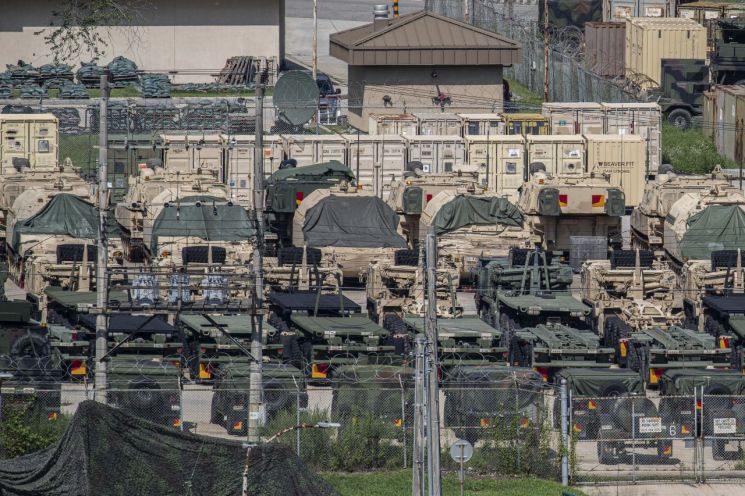
 On the 5th of last month, U.S. military self-propelled artillery and vehicles were on standby at Camp Casey, a U.S. military base in Dongducheon, Gyeonggi Province. (Photo by Yonhap News)
[Asia Economy Reporter Kum Boryeong] Following the U.S. House of Representatives, the Senate's 2022 fiscal year National Defense Authorization Act (NDAA) also appears to have excluded provisions that would prevent the reduction of the number of U.S. troops stationed in South Korea below a certain level.
On the 22nd (local time), the U.S. Senate Armed Services Committee submitted the 2022 fiscal year NDAA, which approves a budget expenditure of up to $768 billion (approximately 909 trillion KRW), to the full Senate, excluding such provisions in its report. Earlier this month, the NDAA passed by the House Armed Services Committee also lacked restrictions on reducing U.S. forces in South Korea.
From the 2019 fiscal year to the 2021 fiscal year during the Donald Trump administration, the NDAA included clauses that prohibited using the budget to reduce the current 28,500 U.S. troops stationed in South Korea. Congress acted as a check to prevent President Trump from unilaterally reducing U.S. forces in South Korea without consulting the allied nation, South Korea.
The disappearance of the restrictions on reducing U.S. forces in South Korea has been interpreted as a result of the Biden administration, which values alliances, making such provisions unnecessary.
However, with the removal of clauses limiting reductions in U.S. forces in South Korea in both the House and Senate, concerns have arisen that the size and role of U.S. forces in South Korea could change, especially as the Biden administration is conducting a comprehensive review of overseas U.S. troop deployments.
Meanwhile, when submitting the NDAA to the full Senate, the Senate Armed Services Committee referred to North Korea as a "rogue state" in an accompanying report. The committee stated, "The United States is engaged in strategic competition with China and Russia," and "at the same time, it faces threats from other 'aggressive rogue states' such as Iran and North Korea, which pursue instability and hostility, as well as terrorist organizations."
The committee also assessed the nuclear capabilities of North Korea, China, and Russia in the report. It explained, "North Korea has publicly announced plans and continues to pursue the development of miniaturized nuclear warheads and tactical nuclear weapons to threaten the territories of the United States and its allies, multiple independently targetable reentry vehicles (MIRVs) for missiles, solid-fueled ballistic missiles of various ranges, nuclear propulsion systems for submarines, and hypersonic glide vehicles (HGVs)."
© The Asia Business Daily(www.asiae.co.kr). All rights reserved.
![Clutching a Stolen Dior Bag, Saying "I Hate Being Poor but Real"... The Grotesque Con of a "Human Knockoff" [Slate]](https://cwcontent.asiae.co.kr/asiaresize/183/2026021902243444107_1771435474.jpg)
















