Cultural Heritage Administration Publishes Catalog "Records of Loyalty of the Seven Hundred Patriots"
Includes Information on "Relics Related to Jo Heon" and "Monument to Jo Champan Ilgunsun"
Chilbaekuisong in Geumsan, Chungnam, is a tomb dedicated to 700 righteous soldiers who lost their lives fighting against the Japanese army during the Imjin War. The militia leader Jo Heon (1544?1592) recaptured Cheongju Fortress with Monk Yeonggyu and promised to launch a joint attack on the enemy in Geumsan with the government troops led by General Kwon Yul. General Kwon Yul, recognizing the unfavorable odds (衆寡不敵, meaning a small number cannot face a large enemy), sent a letter suggesting postponing the battle. However, Jo Heon's militia did not receive the letter in time and fought a decisive battle at Yeongonpyeong in Geumsan, where they all died heroically. Four days later, Jo Heon's disciples Park Jeongryang and Jeon Seung-eop gathered the remains of the 700 righteous soldiers in one tomb and named it Chilbaekuisong (Seven Hundred Righteous Tomb).
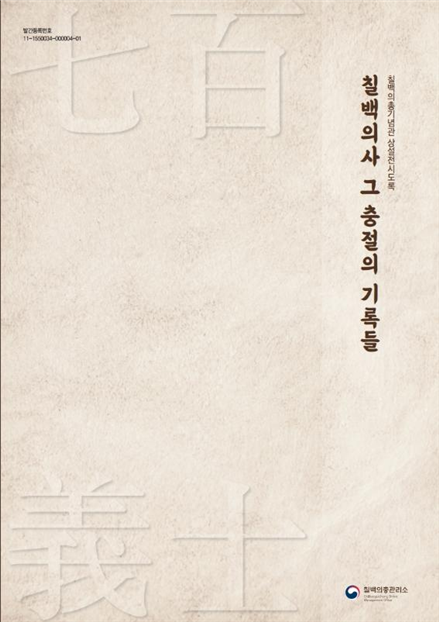
A catalog compiling cultural heritage information embodying the noble spirit of patriotism at Chilbaekuisong has been published. On the 23rd, the Cultural Heritage Administration announced the publication of a permanent exhibition catalog titled "The Records of the Loyalty of the Seven Hundred Righteous Soldiers," which includes photos and descriptions of about thirty artifacts held by the Chilbaekuisong Memorial Hall. A significant portion of the featured cultural assets are "items related to Jo Heon." Among them, seven items across six categories are nationally designated treasures. These include the "Jo Cheon Diary," a diary Jo Heon kept when he was dispatched as an envoy to Ming China in the 7th year of King Seonjo’s reign (1574), an appointment letter certifying his passing the civil service examination, a commission letter appointing him as militia leader, a memorial tablet for Jo Heon at the Confucian shrine, and two memorial documents.
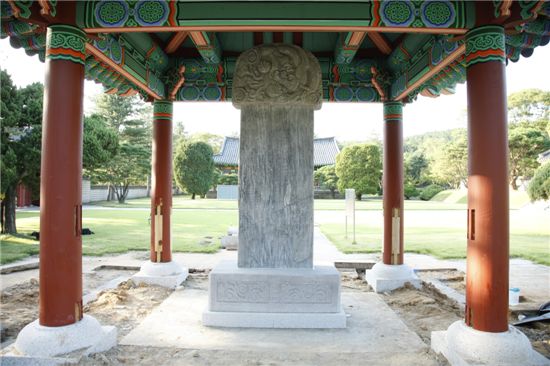 Restored Sunui-bi
The catalog also contains information about the "Jo Champan Ilgun Sunui Monument Rubbing Album (趙參判一軍殉義碑)." This monument, erected in 1603, records the details of the Battle of Geumsan and a eulogy honoring those who died heroically. Although it was blown up by Japanese police in the 1940s, it was restored in 2009 by the Cultural Heritage Conservation Science Center of the National Research Institute of Cultural Heritage. The rubbing album is held at the Jangseogak Library of the Academy of Korean Studies. Last year, the Chilbaekuisong Management Office confirmed that this material was rubbings taken in the late Joseon period and compiled into an album form. An official explained, "Through the rubbing of the Jo Gongsun Monument, we were able to understand the entire inscription," adding, "The person who wrote the postscript called 'Eumgihujiji (陰記後識)' was identified as Kim Su-jeung, a calligrapher from the late Joseon period, and we also confirmed the list of carvers who engraved the characters and stonemasons who worked on the stone."
At the end of the catalog, two scholarly articles are included: "Overview of the Battle of Geumsan during the Imjin War" by Professor Kim Kyung-tae of the Department of History Education at Chonnam National University, and "The Transmission of the Memory of the Battle of Geumsan and the Establishment of Chilbaekuisong" by Professor Park Beom of the Department of History at Kongju National University. The catalog will be distributed to national and public museums and organizations related to the Imjin War. It is also available for viewing on the Chilbaekuisong Management Office’s website.
© The Asia Business Daily(www.asiae.co.kr). All rights reserved.
![Clutching a Stolen Dior Bag, Saying "I Hate Being Poor but Real"... The Grotesque Con of a "Human Knockoff" [Slate]](https://cwcontent.asiae.co.kr/asiaresize/183/2026021902243444107_1771435474.jpg)
















