Seoul City Denies Non-Profit Status Over Sale of Genital-Shaped Cookies
"'Beoltteokju' Should Also Be Banned," Some Citizens Argue
Cookie Maker Says "Criticism Aimed at Sexual Objectification of Women"
Experts: "Cookie Sale Not Illegal, but Exposure to General Public Raises Concerns"
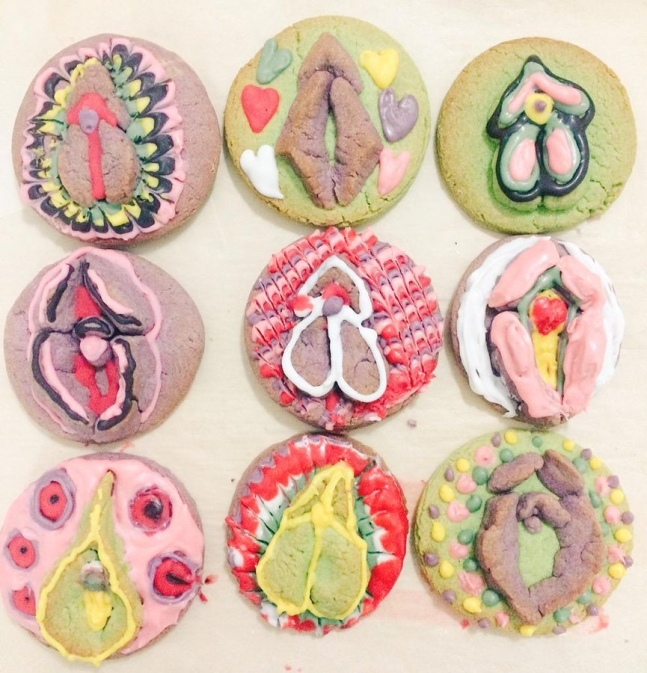 Cookies shaped like female genitalia sold at the 2015 Seoul Queer Culture Festival. / Photo by Twitter capture
[Asia Economy Reporter Kang Juhee] There has been backlash over Seoul City's decision to reject the Seoul Queer Culture Festival Organizing Committee's (Organizing Committee) application to establish a non-profit corporation, citing reasons including the sale of 'cookies shaped like female genitalia.' On social networking services (SNS) and online communities, criticism arose that it is discriminatory to single out cookies shaped like female genitalia as problematic while other products depicting genitalia are openly sold in the market.
Experts say it is difficult to classify the sale of genitalia-shaped cookies as illegal, but they suggest that coordination on the operation method is necessary as there is a possibility of issues such as violations of child and adolescent sexual protection laws.
According to the Organizing Committee, Seoul City notified the rejection of the non-profit corporation establishment application submitted by the Organizing Committee on the 25th of last month. Seoul City pointed out as grounds for the rejection that 'it was confirmed that products depicting genitalia were sold at booths operated during the parade event, which could constitute a violation of statutory law.'
The 'products depicting genitalia' mentioned by Seoul City refer to cookies and bread sold at the Seoul Queer Culture Festival in 2015. Seoul City judged that these products could fall under Article 243 of the Criminal Act concerning 'distribution of obscene materials' and Article 244 concerning 'manufacture of obscene materials.' According to the Criminal Act, those who distribute, sell, exhibit, or screen obscene documents, drawings, films, or other items, as well as those who manufacture, possess, import, or export them, can be punished.
Seoul City also cited as grounds for the rejection that during the queer festival parade, 'some participants' excessive exposure constituted acts potentially violating laws such as the Minor Offenses Act,' and 'social conflicts arose, including counter-protest gatherings during the event.'
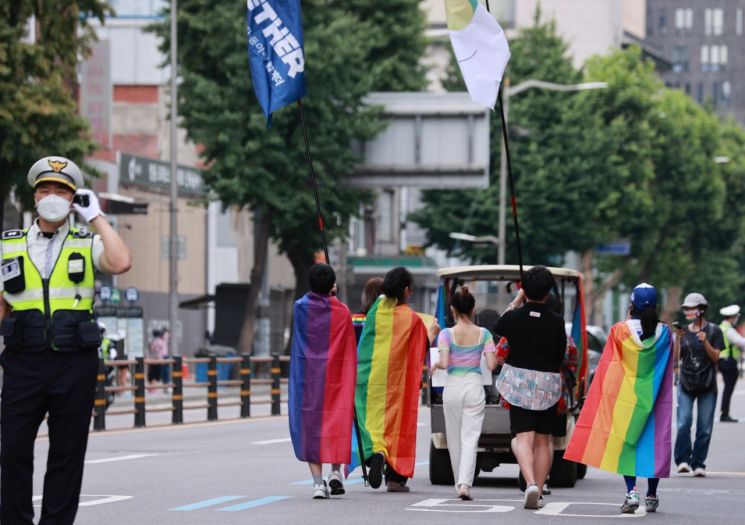 On the afternoon of June 27, participants of the 'Queer Parade' were marching near Namdaemun Market in Jung-gu, Seoul. Photo by Yonhap News
In response, the Organizing Committee has protested, calling it 'administrative discrimination.' In a statement on the 26th of last month, the Organizing Committee pointed out that "the reasons listed by Seoul City merely repeat the logic of anti-LGBTQ forces whose facts have not even been verified." The Organizing Committee also explained that regarding the possibility of statutory law violations, the then organizing committee chair received a non-prosecution notice of 'no charges,' and that the sale of genitalia-shaped cookies was not led by the Organizing Committee.
On SNS, there were also criticisms that Seoul City's rejection decision was excessive. Popular culture columnist Lee Seunghan wrote on Facebook on the 6th, "(If genitalia-shaped cookies are illegal) shouldn't 'Beoltteokju'?which is lined up and sold at rest stops and tourist attractions nationwide?also be banned?"
He added, "It is taboo and considered indecent and obscene to openly and routinely talk about female genitalia or mention their names or depict their shapes, while the phallus raised toward the sky is accepted as 'humor' even when borrowed as a product design."
The feminist visual arts collective 'Unni Moja,' which made the female genitalia cookies, criticized the controversy, saying that "there is an absurd lack of cultural infrastructure for women and sexual minorities."
Unni Moja stated on the 23rd, "The reason we made the cookies was to resist images that portray female genitalia only from pornographic or childbirth-centered perspectives. Our work was explosively popular at the festival at the time," adding, "Seoul City's claim that our work criticizing the sexual objectification of women is problematic ironically reveals the absurd lack of sex education and public cultural infrastructure for women and sexual minorities."
Experts say that while genitalia-shaped cookies cannot be definitively classified as obscene or illegal, coordination in festival operation methods is necessary due to concerns about potential violations of child and adolescent sexual protection laws.
A legal expert commented, "It cannot be concluded that genitalia-shaped cookies are illegal or obscene. However, the sale of these cookies raises concerns about various issues such as violations of child and adolescent sexual protection laws. For example, while the purchase of Beoltteokju and adult products is limited to adults, cookies can be exposed to an unspecified large number of people visiting the festival, which raises concerns."
However, the expert added, "It is not possible to prohibit the making and selling of genitalia-shaped cookies itself. If the sale of cookies is problematic, there should have been a prior warning before the decision to reject the corporation establishment and a process to hear the Organizing Committee's response. Also, reasons such as excessive exposure and prevention of physical clashes cited by Seoul City as grounds for rejection are difficult to see as legitimate reasons for the rejection decision."
© The Asia Business Daily(www.asiae.co.kr). All rights reserved.
![Clutching a Stolen Dior Bag, Saying "I Hate Being Poor but Real"... The Grotesque Con of a "Human Knockoff" [Slate]](https://cwcontent.asiae.co.kr/asiaresize/183/2026021902243444107_1771435474.jpg)












