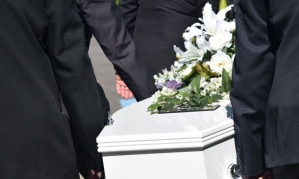
<6> Their Final Resting Place
3 out of 5 People in the Seoul Metropolitan Area Die in Medical Institutions
1,352 People Died at Their Residences
Late Discovery in Mountains, Rivers, and Construction Sites
Statistics Reflect Only Cases with Confirmed Identities
Many More Unclaimed Deaths on the Streets Expected
![[2021 Muyeongo Report] 60% of Muyeongo Patients Die in Hospitals... Street Deaths Not Even Counted](https://cphoto.asiae.co.kr/listimglink/1/2021092407573940048_1632437859.jpg)
[Asia Economy Special Coverage Team = Team Leader Ko Hyung-kwang, Reporters Yoo Byung-don, Jung Dong-hoon, Lee Jung-yoon]
Mr. Choi ㅇㅇ (male) was born in 1963 and lived in Jongno-gu, Seoul. He passed away on August 16, 2021, at a hospital in Jongno-gu, Seoul.
Ms. Jung ㅇㅇ (female) was born in 1942 and lived in Eunpyeong-gu, Seoul. She passed away on September 5, 2021, at a nursing hospital in Eunpyeong-gu, Seoul.
The website of Nanum and Nanum, an organization supporting funerals for unclaimed deceased persons, posts funeral schedules daily for 2 to as many as 4 unclaimed deceased individuals. Among these, a significant number were confirmed to have ended their lives at medical institutions, including nursing hospitals.
Three out of five unclaimed deceased persons meet their final moments in medical institutions
This figure is also reflected in statistics. Asia Economy conducted a full survey of unclaimed deceased persons in the metropolitan area including Seoul, Gyeonggi, and Incheon (excluding Yangcheon-gu in Seoul and Anseong, Anyang, Hwaseong in Gyeonggi due to lack of data). Among a total of 5,224 unclaimed deceased persons, 3,149 were recorded as having died in medical institutions. This corresponds to 60.28%, exceeding three out of five unclaimed deceased persons.
Looking at the regions, in Seoul, 1,451 out of 2,396 unclaimed deceased persons (60.56%) died in medical institutions; in Gyeonggi, 1,109 out of 1,940 (57.16%) passed away in medical institutions. Particularly in Incheon, 589 out of 888 unclaimed deceased persons died in medical institutions, accounting for 66.33%.
Especially in Namdong-gu, Incheon, among 42 unclaimed deceased persons, more than 80% (34 persons) met their final moments in medical institutions, which is analyzed to be due to the concentration of medical institutions including Gachon University Gil Medical Center. Similarly, Seodaemun-gu in Seoul, where Severance Hospital is located, showed that 85 out of 115 unclaimed deceased persons died in medical institutions, exceeding 73%. Yeongdeungpo-gu in Seoul, home to Hallym University Hangang Sacred Heart Hospital and Catholic University Yeouido St. Mary's Hospital, also recorded over 65% of unclaimed deceased persons dying in medical institutions.
A significant number also faced lonely deaths at home while living alone
The second most common place of death for unclaimed deceased persons after medical institutions was their residence. These ranged from poor housing such as rental housing or gosiwon (small rooms) to apartments and one-room units with relatively better environments. Over the past five years, 1,352 unclaimed deceased persons in the metropolitan area quietly passed away in their own homes, accounting for 25.88% of all unclaimed deceased persons in the metropolitan area.
In Seoul, a total of 683 died at their residences. Particularly, Seongdong-gu, where area-wide redevelopment projects are underway, recorded 46 out of 56 unclaimed deceased persons (82.14%) dying at home. Other areas farther from central Seoul such as Guro-gu (48.89%), Geumcheon-gu (39.13%), Gangbuk-gu (36.67%), Jongno-gu (31.07%), and Jungnang-gu (30.65%) also showed high rates of death at residences. Conversely, relatively affluent areas such as Gangnam-gu (21.81%), Songpa-gu (24.07%), and Yongsan-gu (21.64%) showed generally lower rates of death at home.
In Gyeonggi Province, 490 out of 1,940 unclaimed deceased persons died at their residences, about one in four. Among these, Uiwang-si (100%), Pyeongtaek-si (60%), and Yeoncheon-gun (50%) had more than half of their unclaimed deceased persons dying at home, while Yangju-si (33.34%), Uijeongbu-si (32.67%), and Ansan-si (32.21%) also recorded high proportions. In Incheon, where 20.16% of unclaimed deceased persons died at home, only Yeonsu-gu (36.73%) and Bupyeong-gu (30.26%) reached the 30% range, with the other eight districts showing distributions between 11% and 24%.
![[2021 Muyeongo Report] 60% of Muyeongo Patients Die in Hospitals... Street Deaths Not Even Counted](https://cphoto.asiae.co.kr/listimglink/1/2021091613590733665_1631768347.jpg)
Those who departed alone until the very end in unfamiliar places
There are likely many who faced their final moments trembling with fear in unfamiliar places they might not even have known. Over the past five years, 322 unclaimed deceased persons were found outdoors?such as in mountains, riversides, or construction sites?and classified as unclaimed deceased in the metropolitan area.
Unclaimed deceased persons who died outdoors are often discovered very late because most people do not visit these locations. This is evidenced by the large number of unclaimed deceased persons found outdoors in areas like Ongjin-gun, Incheon (65% of total unclaimed deceased persons) with coastal areas, and Gapyeong-gun, Gyeonggi (82.61%) with many valleys.
Because many are found long after death in skeletal remains, identifying the deceased and determining whether they are unclaimed is difficult. Therefore, only cases with confirmed identities are included in the unclaimed deceased statistics. This suggests that the actual number of unclaimed deceased persons who died alone outdoors is much higher than the statistics indicate.
Unclaimed deceased persons who tried to live until the end but sadly passed away
The number of unclaimed deceased persons who wandered without a fixed residence and died in unfamiliar places in the metropolitan area over the past five years is 150. These individuals died in commercial service facilities such as lodging houses or gosiwon.
Although this place accounts for the smallest proportion of unclaimed deceased persons' death locations, those who died here likely tried harder than anyone else to live until the very end. Some may have endured day by day as day laborers, dreaming of a better tomorrow in a cramped room barely one pyeong (approximately 3.3 square meters) in size.
Seoul, where life is more intense than anywhere else, recorded 3.59% of all unclaimed deceased persons dying in such commercial service facilities, while Gyeonggi (2.53%) and Incheon (1.69%) showed relatively lower figures.
※ This article was produced with government advertising fees supported by the Korea Press Foundation.
© The Asia Business Daily(www.asiae.co.kr). All rights reserved.