Outstanding Loans of 20s Reach 2.5787 Trillion Won as of Late June
Increased by 38% Over the Past 3.5 Years
'Debt Investment' and 'Yeongkkeul' Frenzy Fueling Crisis
Stricter Loan Regulations May Worsen Financial Hardship for 20s
Experts Advise "Adjust Speed to Minimize Market Anxiety"
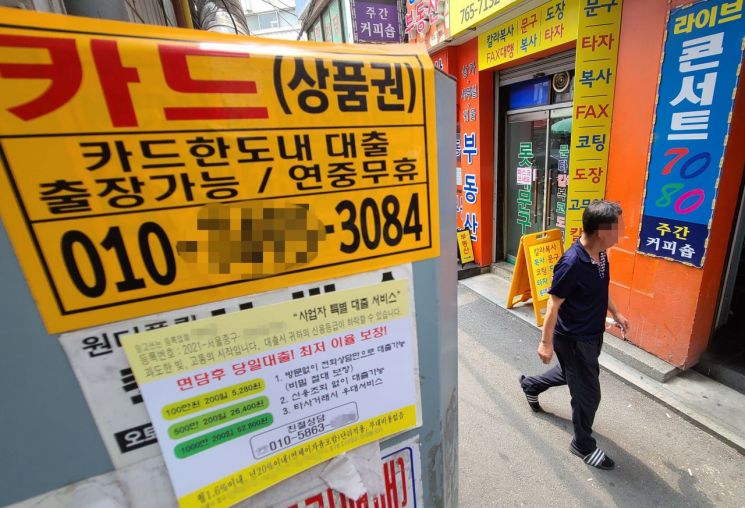 On the afternoon of the 12th of last month, credit loan advertisement flyers were posted around downtown Seoul. The photo is not related to any specific expressions in the article. / Photo by Yonhap News
[Asia Economy Reporter Lim Juhyung] It has been revealed that the loan balances of people in their 20s are rapidly increasing, raising warning signs about the possibility of a "mass bankruptcy." It is pointed out that the high-risk investment craze such as 'Debt Investment (Bitt-u)', 'All-in (Yeongkkeul)'?which were popular among young people last year?has come back as a boomerang.
Moreover, recent financial authorities' emphasis on 'household debt management' and hawkish remarks have heightened concerns. Since people in their 20s generally have relatively low income and asset levels, their repayment ability is weaker, so they may feel the impact of tightened loan regulations and interest rate hikes more severely. Experts suggest that careful and consistent policies are needed to reduce the damage to genuine loan demanders.
According to data received on the 21st from the Financial Supervisory Service by Jeon Jae-su, a member of the National Assembly's Political Affairs Committee from the Democratic Party of Korea, as of the end of June this year, the loan balance of people in their 20s was recorded at 2.5787 trillion KRW.
The loan balance of people in their 20s has steadily increased over recent years. It rose by 38% over three and a half years from 1.8681 trillion KRW in 2017. In the last year, when the COVID-19 pandemic began, it surged by nearly 500 billion KRW.
As debt continued to increase, young people were also drawn to so-called 'card loans.' As of the end of June, the card loan balance totaled 11.2 billion KRW, an increase of 1.5 billion KRW (15.5%) compared to last year, marking the largest growth. Card loans have simpler procedures than commercial banks but come with higher interest rates.
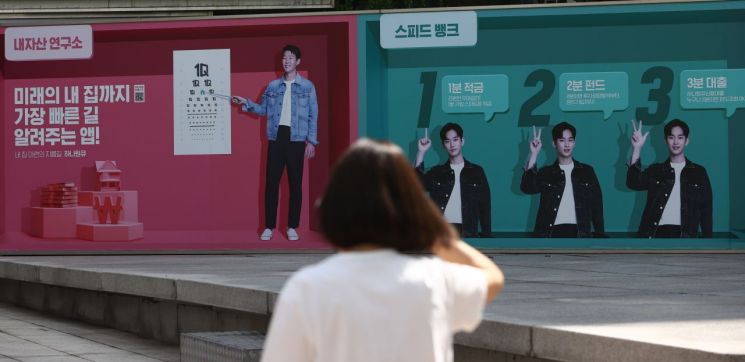 A citizen is passing in front of an advertisement board for bank financial products such as loans displayed at a bank in Seoul last month on the 20th. / Photo by Yonhap News
There is a view that the craze for 'Debt Investment (Bitt-u)' and 'All-in (Yeongkkeul)', where people recklessly borrow to invest in stocks and other assets, has become the cause of the 'debt bomb.' This high-risk investment method was a hot topic last year, especially popular among young people in their 20s and 30s.
According to a survey conducted earlier this year by the Korea Financial Investment Investor Protection Foundation targeting 2,000 adults, 29% of people in their 20s started or resumed financial investments after COVID-19, higher than 30s (20.5%), 40s (20.2%), and 50s (12.6%).
As highly volatile cryptocurrencies gained attention as investment tools, young people established themselves as 'big players.' In the first quarter (January to March), among 2,495,289 newly opened real-name accounts at Korea's four major cryptocurrency exchanges (Bithumb, Upbit, Korbit, Coinone), 32.7% (816,039) were people in their 20s, ranking first among all age groups.
The problem lies in the fact that the repayment ability of people in their 20s is significantly lower than other generations. As they are early in their careers, their income is low, and they have little accumulated assets. According to data from the Korea Institute of Finance, as of the end of last year, the debt-to-income ratio (LTI) growth rate for young people was about 24 percentage points, rising sharply compared to 40s (13.3 percentage points) and 50s (6 percentage points). This means their debt burden is increasing rapidly relative to their income.
Furthermore, with tightened loan regulations and rising market interest rates, as interest payments increase, young people with high debt ratios may suffer much more damage than other generations. They could face situations where even paying interest alone becomes difficult.
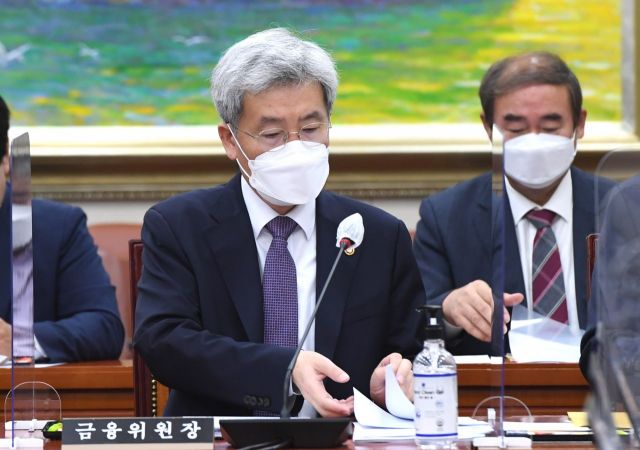 Financial Services Commission Chairman Ko Seung-beom is reviewing documents at the full meeting of the Political Affairs Committee held at the National Assembly in Yeouido, Seoul on the 16th. / Photo by Yonhap News
Financial authorities have already warned about the importance of managing household debt and expressed intentions to tighten unsecured loans.
Ko Seung-beom, the new chairman of the Financial Services Commission, stated at last month's confirmation hearing that managing household debt would be the top policy priority. At a briefing on the 10th, he emphasized, "Excessive accumulation of household debt could become a potential risk factor for our economy, so proactive management efforts are necessary," adding, "Our goal is to restore the household debt growth rate to the pre-COVID-19 level of around 4% by next year."
Given this situation, young people with heavy debt expressed fears about loan restrictions and interest rate hikes.
A 20-something office worker, Mr. A, said, "During the 'Donghak Ant' craze, I opened a credit line and invested but only suffered losses and quit. Since all my friends only talk about stocks and coins, I started investing out of fear of falling behind, but it only caused harm. I am already struggling to handle my debt, and now with interest rates rising, I feel overwhelmed."
Another office worker, Mr. B (29), said, "Sometimes I have no choice but to take out loans because my salary alone can't cover living expenses and rent. It feels like even those who live diligently are being punished. I think loan support for ordinary people is necessary."
The financial authorities emphasized that flexible support measures will be prepared considering low-income and financially vulnerable groups.
Chairman Ko said during a visit to the Seoul Jung-gu Integrated Financial Support Center for the Underprivileged on the 14th, "As household debt management tightens, it may become difficult to supply sufficient funds to low-credit and low-income individuals. Since the difficulties in the livelihood economy due to COVID-19 persist, sufficient support must be provided to ensure that the underprivileged and vulnerable groups do not face financial hardships."
Experts stressed the need for cautious and consistent government policies.
Professor Kim Taegi of Dankook University's Department of Economics pointed out, "The U.S. Federal Reserve (FED) has long warned the market before tightening or raising interest rates, but we seem to be somewhat rushing. If financial and monetary policies proceed without adjusting the pace, people's psychology may become unstable, causing adverse effects like a balloon effect."
He also advised, "A significant part of the current household debt problem stems from the rapid rise in real estate prices. If we block loans first without stabilizing real estate through housing supply, genuine demanders may suffer. I believe it is necessary to pursue consistent policies through close cooperation and coordination among key ministries such as the Financial Services Commission, Ministry of Economy and Finance, and Ministry of Land, Infrastructure and Transport."
© The Asia Business Daily(www.asiae.co.kr). All rights reserved.
![Clutching a Stolen Dior Bag, Saying "I Hate Being Poor but Real"... The Grotesque Con of a "Human Knockoff" [Slate]](https://cwcontent.asiae.co.kr/asiaresize/183/2026021902243444107_1771435474.jpg)


















