Analysis of Latest NYT Study... "Small but Clear Differences Confirmed"
Experts Say "Both Vaccines Are Good... Effective in Preventing Severe Cases and Hospitalization"
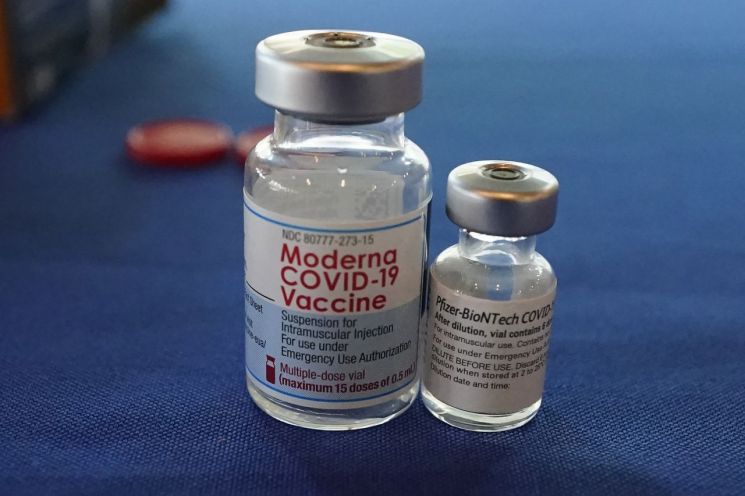
[Asia Economy Reporter Kim Suhwan] When considering whether vaccine effectiveness can be maintained long-term, an analysis showed that the Moderna vaccine is slightly better than the Pfizer-BioNTech vaccine.
On the 22nd (local time), The New York Times (NYT) reported based on recent studies that "the Moderna vaccine appears to maintain its infection prevention effectiveness better over time after vaccination compared to the Pfizer vaccine."
NYT added, "It is not true that all vaccines are equally effective."
The Pfizer and Moderna vaccines showed similar symptomatic infection prevention effectiveness in clinical trials, at 95% and 94%, respectively.
However, according to a paper published that day in the medical journal New England Journal of Medicine (NEJM), an analysis of 5,000 vaccinated healthcare workers across 25 U.S. states showed that the Moderna vaccine had a prevention effectiveness of 96.3%, higher than Pfizer's 88.8%.
Analyses conducted at the Mayo Clinic in Minnesota and in Qatar showed that Moderna's severe disease prevention effectiveness ranged from 92% to 100%, which was 10 to 15 percentage points higher than Pfizer's.
Additionally, according to research results announced on the 17th by the Centers for Disease Control and Prevention (CDC), the hospitalization prevention effectiveness 14 days after completing two doses was similar for Moderna and Pfizer vaccines at 93% and 91%, respectively. However, after 120 days, the effectiveness was 92% for Moderna and 77% for Pfizer, indicating that Moderna's effectiveness was essentially maintained, while Pfizer's declined.
NYT explained that studies have also shown that the antibody levels produced by the Moderna vaccine are two to three times higher than those of the Pfizer vaccine.
Both vaccines are mRNA vaccines but differ in dosage and intervals.
The Moderna vaccine is recommended as two doses of 100 μg (micrograms) administered four weeks apart, while the Pfizer vaccine is recommended as two doses of 30 μg administered three weeks apart.
Dr. Paul Burton, Chief Medical Officer (CMO) of Moderna, said, "There is a one-week longer interval between the first and second doses compared to the Pfizer vaccine, which seems to allow immune cells to proliferate more."
Since conditions cannot be strictly controlled, comparing prevention effectiveness between vaccines is very difficult, and caution is needed not to accept the calculated figures at face value.
For example, in the U.S., the Pfizer vaccine was administered earlier to priority groups such as the elderly and nursing home workers compared to the Moderna vaccine. Since immunity tends to wane faster in the elderly, analyses of actual vaccine recipients may make Pfizer's effectiveness appear to decline faster than Moderna's.
However, NYT reported that scientists who were previously skeptical about differences between the two vaccines are now shifting toward the view that "there is a small but real difference."
Natalie Dean, an assistant professor of biostatistics at Emory University, said, "The basic assumption was that mRNA vaccines function similarly, but now we are beginning to distinguish between them," adding, "There is a small but existing difference between the vaccines."
However, there are also warnings that these differences should not lead to distrust of the Pfizer vaccine.
Assistant Professor Dean emphasized that the differences between vaccines are very small and uncertain in terms of real-world outcomes, stating, "Both Moderna and Pfizer vaccines are very effective in preventing severe disease and hospitalization."
Professor John Moore of Weill Cornell Medical College pointed out, "It is questionable whether this difference will be a problem in reality," and added, "It is inappropriate for Pfizer vaccine recipients to panic thinking they received an 'inferior vaccine.'"
© The Asia Business Daily(www.asiae.co.kr). All rights reserved.
![Clutching a Stolen Dior Bag, Saying "I Hate Being Poor but Real"... The Grotesque Con of a "Human Knockoff" [Slate]](https://cwcontent.asiae.co.kr/asiaresize/183/2026021902243444107_1771435474.jpg)
















