KEPCO Raises Electricity Rates for the First Time in 8 Years
Cost Increases Not Fully Reflected... Fuel Price Surge and Nuclear Phase-Out Make Additional Hikes Inevitable
Year-End Consumer Prices Expected to Rise Further
[Sejong=Asia Economy Reporters Kim Hyunjung, Kwon Haeyoung, Joo Sangdon] The government's sudden decision to raise electricity rates is due to the faster-than-expected rise in international fuel prices. In particular, the coal phase-out, nuclear phase-out, and renewable energy policies expanded under the Moon Jae-in administration also affect the cost of power generation, raising concerns that these will act as pressure factors for electricity rate increases in the mid to long term.
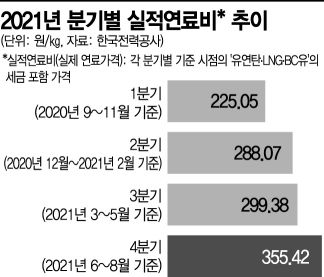
◆Power Coal Prices Surge 126%= Korea Electric Power Corporation (KEPCO) announced on the 23rd that the fuel cost adjustment unit price for the 4th quarter, reflecting the actual fuel costs from June to August, has increased and will be reflected in electricity rates. The post-tax average price of thermal coal was 151.13 KRW per kg, and LNG and BC oil were 601.54 KRW and 574.4 KRW per kg, respectively. This represents a 10.2% to 22.6% increase compared to the previous three months (March to May).
Oil price increases were also steeper than expected. According to the Ministry of Trade, Industry and Energy, the price of Dubai crude oil was $73.3 per ton as of the 22nd, up 39.5% since the beginning of the year. Especially, the price of coal for power generation surged 126.05% to $182.6 per ton as of the 17th, approaching the all-time high of $194.79 per ton recorded in July 2008.
However, despite this electricity rate hike, the fuel cost adjustment unit price is capped at a maximum of 3 KRW per quarter, so the increase in power generation costs was not fully reflected in electricity rates. Furthermore, with forecasts of continued fuel cost increases due to rising heating demand caused by global abnormal weather and expected price surges this winter, KEPCO's financial burden is expected to continue expanding. KEPCO internally projects an operating loss of 3.8492 trillion KRW on a consolidated basis this year due to insufficient reflection of power generation cost increases in electricity rates.
However, the bigger issue is the structural change in the power market. The rapid acceleration of energy transition policies such as nuclear and coal phase-out and expansion of renewable energy is likely to act as pressure for electricity rate increases. According to the draft '2050 Carbon Neutral Scenario' released on the 5th of last month by the Presidential Committee on Carbon Neutrality, South Korea must reduce the nuclear power share to a maximum of 6.1% by 2050. Unlike Scenario 3, which achieves net-zero carbon emissions (total emissions minus offsets), Scenarios 1 and 2, with 25.4 million tons and 18.7 million tons respectively, have nuclear power shares of only 7.2%. Meanwhile, the share of renewable energy must increase to 56.6% to 70.8% by 2050. This means expanding renewable energy, which has higher generation costs than nuclear and coal, making electricity rate increases inevitable.
Professor Jung Dongwook of the Department of Energy Systems Engineering at Chung-Ang University viewed this 4th quarter electricity rate hike as a signal for future electricity price increases. He said, "For at least the next ten years, fossil fuel demand will increase due to post-COVID-19 economic recovery, which will act as pressure for electricity rate hikes."
◆Public Utility Rate Increases Unavoidable= This electricity rate hike is expected to further drive up the perceived inflation rate by the end of the year. Public utility charges such as electricity, water, and gas have long been frozen and have been considered items that suppressed inflation. Among the items surveyed monthly by Statistics Korea to monitor price trends, public utility-related products are the only ones whose index has remained below 100. In the consumer price trend report for August released earlier this month, the electricity, water, and gas product index was 79.90 (base year 2015=100), the lowest among all goods and services. In contrast, the agricultural, livestock, and fishery product index (130.69) and industrial product index (105.04) rose 7.8% and 3.2% year-on-year, driving inflation.
City gas rates are also likely to increase. Although international natural gas prices have risen this year, domestic city gas rates have been frozen for 15 months since an average 13.1% reduction in July last year.
Liquidity released nationwide in a short period is also cited as a factor driving inflation. In particular, the number of recipients of the COVID-19 disaster relief fund, initially planned for 88% of the population, is expected to increase due to appeals, and local governments are following Gyeonggi Province in fully disbursing the funds.
In the 4th quarter, the government will also promote the Win-Win Consumption Support Fund (card cashback) to stimulate consumption. This program offers a 10% cashback in card points, usable like cash, on the increase in monthly average card spending during October and November compared to April to June, provided the increase is at least 3%.
© The Asia Business Daily(www.asiae.co.kr). All rights reserved.
![Clutching a Stolen Dior Bag, Saying "I Hate Being Poor but Real"... The Grotesque Con of a "Human Knockoff" [Slate]](https://cwcontent.asiae.co.kr/asiaresize/183/2026021902243444107_1771435474.jpg)

















