Four Consecutive Days of 'Highest Daily' Movement During Chuseok Holiday
Concerns Over Regional Infection Vicious Cycle Due to Increased Mobility
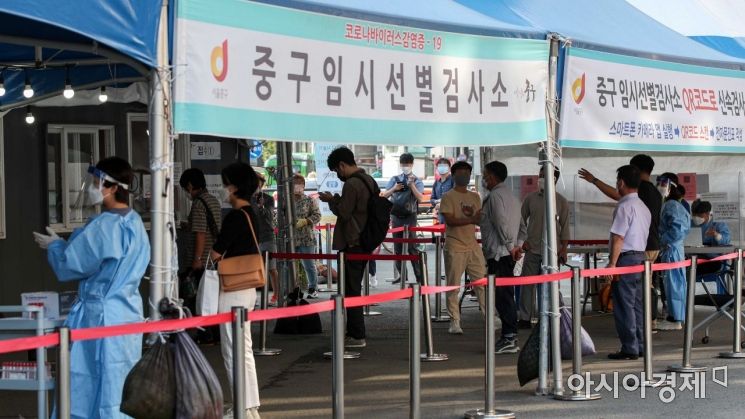 On the 23rd, when 1,716 new COVID-19 cases were reported, continuing the three-day streak of cases in the 1,700 range, citizens visiting the temporary screening clinic set up at Seoul Station Plaza are waiting to get tested. Photo by Jinhyung Kang aymsdream@
[Asia Economy Reporter Kim Ji-hee] The flames of the fourth wave of COVID-19 in South Korea, which began last July, have not subsided for nearly three months. During the Chuseok holiday period, daily records of the highest number of confirmed cases continued to be set, raising concerns that the epidemic could rapidly spread again through the long holiday.
The Central Disease Control Headquarters announced on the 23rd at midnight that there were 1,716 new confirmed COVID-19 cases. Typically, the daily number of new cases decreases due to reduced testing on weekends and then surges starting Wednesday, but due to consecutive holidays until the previous day, the number remained in the 1,700s for two consecutive days.
The domestic quarantine situation showed unstable patterns throughout the Chuseok holiday. Starting from the 18th (2,087 cases) based on the announcement date, records for the highest number of cases by day were set for four consecutive days: 1,909 on the 19th, 1,604 on the 20th, and 1,729 on the 21st. Notably, except for the 18th, during the other three days, large numbers of confirmed cases emerged despite daily testing numbers not even reaching 100,000.
Concerns are also rising that the domestic COVID-19 epidemic, which had entered a stagnant phase, could worsen again due to increased movement during the Chuseok holiday. In fact, one of the reasons for the prolonged fourth wave is the increased movement during the summer vacation season, which caused a vicious cycle of regional infections spreading from the metropolitan area to non-metropolitan areas and vice versa. It cannot be ruled out that the COVID-19 epidemic, which was concentrated in the metropolitan area accounting for 80% of total confirmed cases just before this holiday, has spread to non-metropolitan areas. Kang Do-tae, the first chief coordinator of the Central Disaster and Safety Countermeasures Headquarters, said, "Given the long period of social distancing, the increase in movement and gatherings during the Chuseok holiday is causing the epidemic scale to grow," adding, "There is also a risk that the metropolitan area epidemic could spread to non-metropolitan areas due to Chuseok holiday movement."
As the epidemic scale has not decreased even entering the latter half of September, the government's calculations regarding the phased transition to 'With Corona' are expected to become more complicated. The government plans to promote a phased recovery of daily life by the end of next month, setting "stabilization of the September quarantine situation" as a prerequisite. In the current situation, where daily confirmed cases can exceed 2,000 at any time, it is burdensome to expand vaccine incentives for the transition to With Corona.
Professor Cheon Eun-mi of the Department of Respiratory Medicine at Ewha Mokdong Hospital said, "Due to the aftermath of the Chuseok holiday, the number of confirmed cases next week will inevitably be higher than now," adding, "Although confirmed cases will increase as vaccination rates rise and quarantine measures are relaxed with more gatherings, it is important to reduce hospitalization and fatality rates to manageable levels."
© The Asia Business Daily(www.asiae.co.kr). All rights reserved.

















