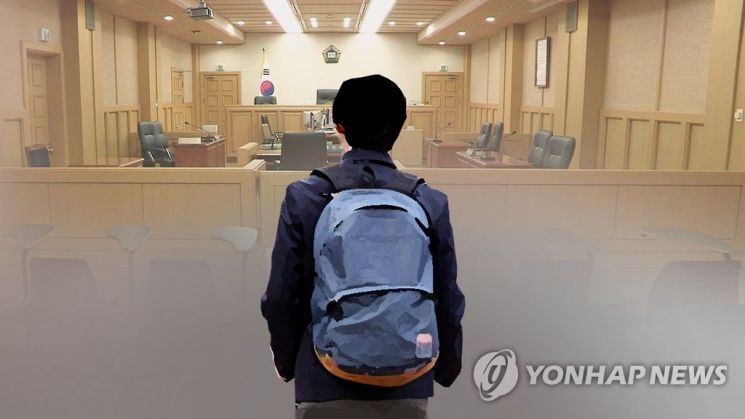
[Asia Economy Reporter Kim Daehyun] "I am sorry." On the 9th of last month, high school student A (17) appeared at the Seoul Central District Court as a defendant and ended his 'final statement' with just one word.
Dressed in a white school uniform, A was prosecuted for capturing photos of victims from the 'Telegram Nth Room case' under the direction of Cho Ju-bin at the end of 2019 when he was a middle school student, and displaying and distributing them on his social networking service (SNS) account, violating the Act on the Protection of Children and Juveniles Against Sexual Abuse.
After the brief final statement, the judge asked, "What do you admit you did wrong?" and A replied again, "Please take care of me. I ask for leniency." Eventually, the judge raised his voice. "Is saying 'please take care of me' something a defendant attending a criminal trial should say?"
When A said "I am sorry" again, the judge scolded him, "Is 'I am sorry' all you have to say? I cannot know what is in the defendant's heart. Please make at least one sincere final statement." A bowed his head and said, "I deeply reflect on what I have done. Please forgive those parts."
According to the legal community on the 23rd, Chief Judge Lim Gwang-ho of Criminal Division 20 at Seoul Central District Court recently transferred A to the Juvenile Division of the Seoul Family Court. This is a ruling under Article 50 of the Juvenile Act, which allows cases involving juveniles under 19 years old to be transferred to the Juvenile Division of the Family Court if it is judged that protective measures are necessary. While showing leniency so that A would not undergo a criminal trial, citing "there is a great possibility for behavioral improvement," the judge also demanded a sincere attitude of reflection in the earlier final statement.
The final statement is a procedure in criminal trials where, after evidence examination, the prosecutor's sentencing recommendation, and the defense attorney's final argument, the defendant directly appeals to the court with any last words they wish to say. Legal professionals emphasize that the defendant's final statement is also an important factor influencing the verdict.
Judge B of the Seoul Central District Court explained, "It is a procedure that shows the defendant's sincerity," adding, "A truthful final statement also has a self-suggestion effect that helps prevent the defendant from reoffending." Judge B further stated, "It is effective when the defendant speaks sincerely and that sincerity is conveyed to the court," and "Depending on the final statement, the same offender can be perceived differently."
© The Asia Business Daily(www.asiae.co.kr). All rights reserved.
![Clutching a Stolen Dior Bag, Saying "I Hate Being Poor but Real"... The Grotesque Con of a "Human Knockoff" [Slate]](https://cwcontent.asiae.co.kr/asiaresize/183/2026021902243444107_1771435474.jpg)
















