Leaders of Both Countries Talk for 30 Minutes... White House "Hopes for Normalized Relations"
West Urges Restraint in Bilateral Conflict... UK Prime Minister "Stop It"
Attention on Whether Relations Will Heal After AUKUS Launch
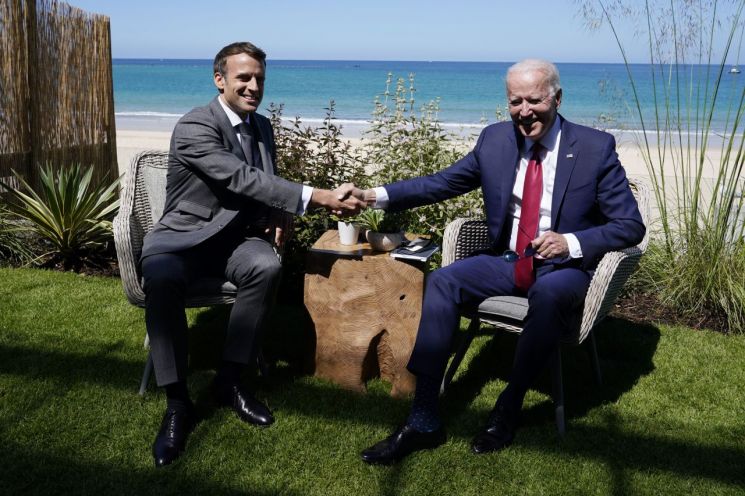
[Asia Economy Reporter Kim Suhwan] French President Emmanuel Macron has decided to enter in-depth consultations with U.S. President Joe Biden, aiming to hold a bilateral summit in Europe late next month.
Amid strong French opposition over the issue of nuclear submarine support following the launch of the AUKUS trilateral security alliance between the U.S., Australia, and the U.K., attention is focused on whether a summit between the two countries' leaders can resolve the rift in relations.
In a joint statement released after a phone call on the 22nd (local time), Presidents Biden and Macron said, "The two leaders spoke at President Biden's request to discuss the impact of the AUKUS announcement," adding, "They agreed that it would have been useful to have open consultations regarding France and European partners' strategic interests."
They further stated, "Biden conveyed his continued commitment in this regard." This is interpreted as a U.S. intention to appease France.
Additionally, President Macron ordered the French ambassador to the U.S., who had been recalled in protest over the U.S. announcement of nuclear submarine technology transfer to Australia, to return to Washington D.C. next week.
Notably, the two leaders agreed to push for a summit next month to resolve discord between the two countries.
In the statement, the two countries said, "The two leaders agreed to conduct in-depth consultations aimed at creating conditions that ensure trust and propose concrete measures toward common goals," and confirmed they would meet in Europe late next month.
The statement mentioned that the ambassador to the U.S., who returned under President Macron's directive, will begin focused consultations with senior U.S. officials.
It also stated, "Biden reaffirmed the strategic importance of France and European engagement in the region, including within the framework of the European Union's (EU) Indo-Pacific strategy."
Furthermore, it said, "They recognize the importance of a stronger and more capable European defense that positively contributes to transatlantic and global security and is complementary to NATO." This has been a consistent assertion by President Macron.
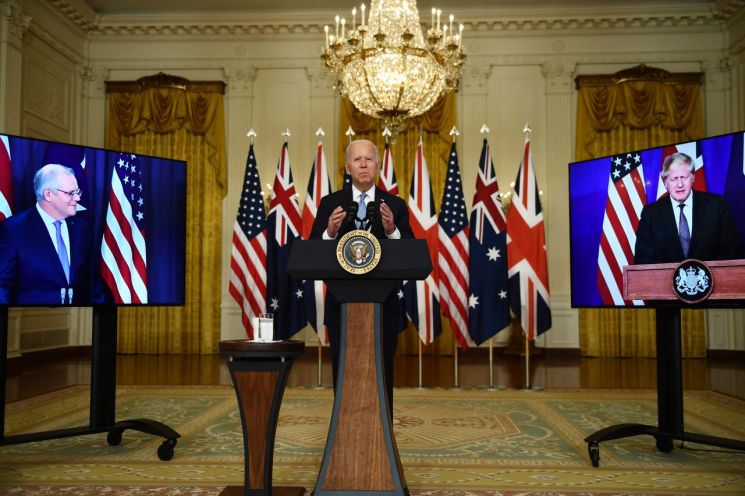 U.S. President Joe Biden announced the launch of the new security partnership among the three countries, 'AUKUS,' during a virtual joint press conference with British Prime Minister Boris Johnson (right on screen) and Australian Prime Minister Scott Morrison (left on screen) in the East Room of the White House on the 15th (local time). [Image source=Yonhap News]
Alongside this, "The U.S. commits to strengthening support for counterterrorism operations conducted by European countries in the Sahara Desert region within the framework of joint counterterrorism efforts," the statement added.
White House Press Secretary Jen Psaki said at a briefing that the call between the two leaders lasted 30 minutes amicably and expressed hope that it would mark a step toward normalizing relations. She said, "President Biden feels personally responsible for the discord with France," and "He will consult with the national security team on ways to maintain smooth diplomatic relations."
The call between the two leaders came exactly one week after President Biden announced the launch of AUKUS on the 15th, which triggered the nuclear submarine controversy and conflict between the two countries.
Previously, with the launch of AUKUS, the U.S. and the U.K. agreed to transfer nuclear submarine technology to Australia, leading Australia to cancel a 77 trillion won diesel submarine contract with France. France had abruptly recalled its ambassadors to both countries in protest of not being informed of the agreement in advance.
France recalling ambassadors from the U.S. and Australia, both key allies and long-standing partners, was unprecedented.
Following the nuclear submarine controversy, France harshly criticized the U.S. and Australia, saying they "stabbed us in the back" and "betrayed us."
In response, the Western bloc urged the two countries to resolve their conflict.
Danish Prime Minister Mette Frederiksen emphasized that cracks should not deepen among Western countries, stating, "Unnecessary challenging issues should not arise among allies."
British Prime Minister Boris Johnson, during his visit to the U.S. this week, urged the two countries to restrain from diplomatic conflicts, saying without naming any country, "Give me a break."
This rift in relations emerged amid ongoing conflicts between the U.S. and European allies over issues such as the Afghanistan withdrawal and China.
As the U.S. shifts its foreign policy priority from countering Russia to countering China, European countries worry that U.S. support for NATO may be reduced.
Moreover, the sudden U.S. withdrawal from Afghanistan caused confusion in European countries' own withdrawals, and security issues arising from the Taliban's rise have heightened tensions among European nations.
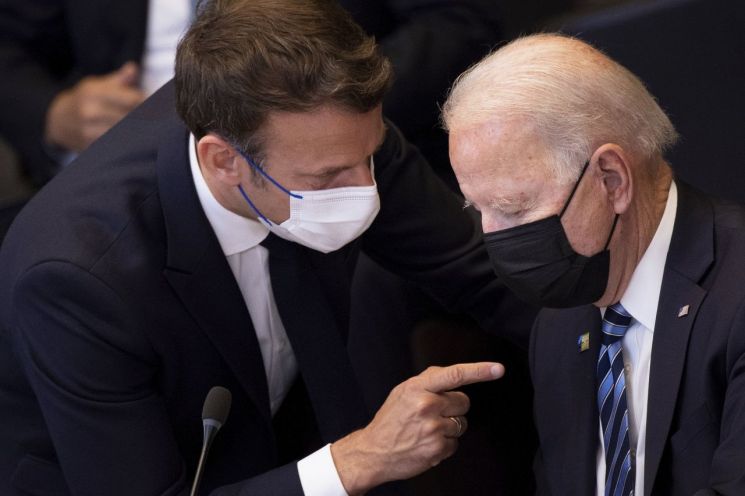 On June 14 (local time), at the NATO summit held in Brussels, Belgium, U.S. President Joe Biden (left) is seen conversing with French President Emmanuel Macron. [Image source=AP Yonhap News]
© The Asia Business Daily(www.asiae.co.kr). All rights reserved.



















