Macroeconomic and Financial Meeting
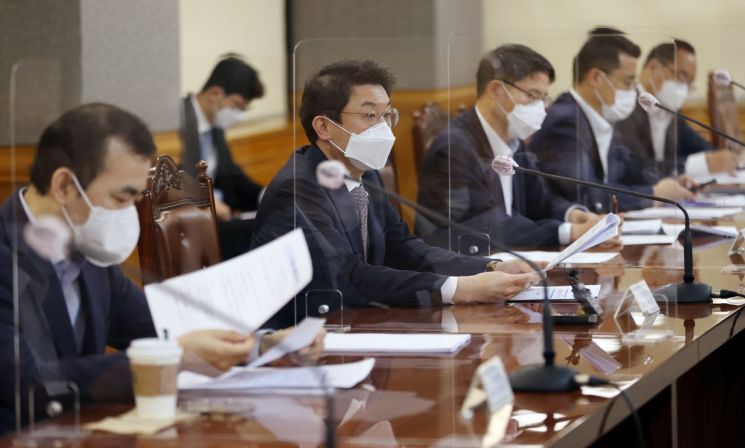 Lee Ok-won, First Vice Minister of Strategy and Finance (second from left), is speaking at the Macroeconomic Finance Meeting held at the Bankers' Hall in Jung-gu, Seoul on the 23rd. 2021.9.23 Photo by Yonhap News
[Sejong=Asia Economy Reporter Son Seon-hee] Lee Eok-won, the 1st Vice Minister of the Ministry of Economy and Finance, said on the 23rd, "If the U.S. employment recovery is delayed beyond the Federal Reserve's (Fed) expectations or if high inflation persists for a long time, there is a concern that uncertainty regarding the timing of interest rate hikes and other factors could rapidly increase," adding, "We will do our utmost to ensure the stability of the financial market and manage risks."
On the same day, Lee chaired a macroeconomic and financial meeting at the Bankers' Hall in Jung-gu, Seoul, attended by key financial institution officials including the Financial Services Commission, the Bank of Korea, the Financial Supervisory Service, and the International Finance Center. He made these remarks in relation to the results of the Federal Open Market Committee (FOMC) meeting held on the 22nd (local time) by the U.S. Fed.
Earlier, Jerome Powell, Chair of the U.S. Fed, hinted at tapering (reduction of asset purchases) as early as November during a press conference immediately following the FOMC meeting. There is also an assessment that the timing of interest rate hikes could be moved forward from 2023 to next year.
Regarding this, Lee said, "The impact of this U.S. FOMC result on the domestic financial market is limited," and evaluated, "Since the meeting results largely matched market expectations, the international financial market is showing relatively stable conditions." In fact, after the FOMC announcement, the Dow Jones Industrial Average on the New York Stock Exchange (NYSE) closed at 34,258.32, up 338.48 points (1.00%) from the previous trading day.
However, he warned, "There is a possibility that financial market volatility may increase as the pace of tapering becomes more concrete in the future," and added, "There is also a persistent risk that market instability factors like China’s Evergrande Group could suddenly emerge during the process of global monetary policy normalization and the resulting deleveraging." He further stated, "We will carefully monitor global inflation and the speed of economic recovery, policy trends of major monetary authorities such as the U.S. Fed and the European Central Bank (ECB), and risks originating from emerging markets."
Additionally, he said, "To prepare for the increased household repayment burden due to rising domestic and international interest rates, we will regularly check whether financial institutions comply with management targets to ensure household debt stabilizes quickly," and added, "We will manage carefully so that rising interest rates at home and abroad do not impose additional burdens on small business owners and low-income groups who are struggling due to the resurgence of COVID-19."
Regarding the policy shift movements such as the advancement of interest rate hike timing by major monetary authorities in the U.S. and Europe, Lee said, "We are at a macro-policy turning point where the abundant global liquidity supplied to respond to the COVID-19 crisis is being adjusted," emphasizing again, "While proactively and stably managing risks such as defaults caused by excessive lending and risk-taking, we will also push forward customized support for vulnerable groups as meticulously and swiftly as possible, thereby fully committing to maintaining economic recovery momentum, stabilizing livelihoods, and managing risks."
© The Asia Business Daily(www.asiae.co.kr). All rights reserved.
![Clutching a Stolen Dior Bag, Saying "I Hate Being Poor but Real"... The Grotesque Con of a "Human Knockoff" [Slate]](https://cwcontent.asiae.co.kr/asiaresize/183/2026021902243444107_1771435474.jpg)
















