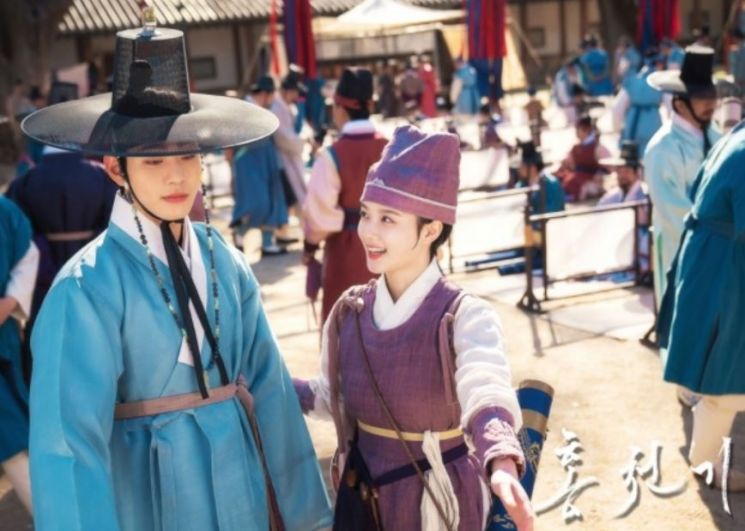
 Unfounded claims by Chinese netizens have emerged, alleging that the costumes and props in the SBS historical drama 'Hong Cheon Gi' plagiarized Chinese culture.
 [Photo by SBS historical drama 'Hong Cheon Gi' official website capture]
[Asia Economy Reporter Hwang Sumi] Another baseless claim by Chinese netizens against Korean content has emerged. They allege that the costumes and props in the SBS historical drama Hong Cheon Gi plagiarized Chinese culture.
Chinese netizens claimed that the hanbok worn by the drama's protagonist Kim Yoo-jung was copied from Ming Dynasty clothing. They also reacted by saying that the costumes and props of the male and female leads were directly copied from the Chinese drama You Are My Glory.
There were even absurd claims that the ink wash paintings featured in the drama's trailer plagiarized Chinese paintings. Additionally, the drama’s background and graphic effects (CG) were said to be Chinese-style plagiarisms of Chinese dramas.
Some local online media have also continued to propagate these claims.
As a result, concerns are rising that China’s 'Cultural Northeast Project' against Korean content is increasingly crossing the line.
The Northeast Project is a research initiative launched by China in 2002 to claim all history within its borders as Chinese history, and it has been at the center of historical distortion controversies.
Domestic netizens responded with disbelief, saying things like "China is crossing the line again," "What exactly did they copy?" "They are making baseless claims again," and "This is unacceptable."
Meanwhile, this is not the first time China has made such baseless claims against Korean content.
Previously, when the Joseon-era gat (traditional Korean hat) featured in the Netflix original drama Kingdom gained worldwide attention, Chinese netizens sparked controversy by claiming "the gat is also Chinese."
At that time, the cyber diplomatic mission VANK warned, "We oppose China's cultural imperialism."
Regarding the actions of these Chinese netizens, Professor Seo Kyung-deok of the Department of Liberal Arts at Sungshin Women’s University said, "It is because Korea’s traditional and popular culture is gaining global attention, which makes them feel threatened." He added, "This reveals a misguided form of patriotism."
Professor Seo further explained, "As viewers worldwide watch our dramas and movies, whereas before Westerners recognized China as the center of Asian culture, now they recognize Korea as such." He added, "Consequently, Chinese dramas demean and belittle Korean culture by, for example, dressing maids in our hanbok."
© The Asia Business Daily(www.asiae.co.kr). All rights reserved.

















