[Asia Economy Reporter Kim Hyemin] Among the inter-floor noise complaints filed over the past five years, only 7% exceeded the measurement standards based on actual on-site inspections. It has been pointed out that the inter-floor noise problem remains unresolved due to measurement standards that disregard reality.
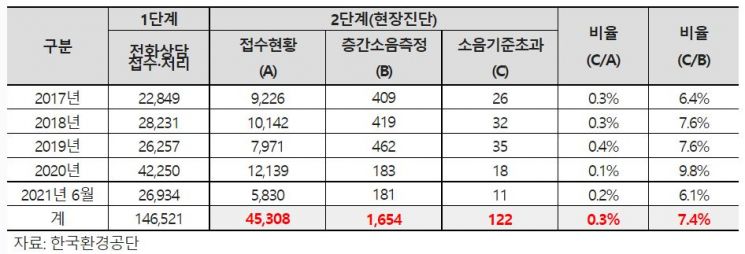
On the 21st, Rep. No Woong-rae of the Democratic Party analyzed data submitted by the Korea Environment Corporation's Inter-floor Noise Neighbor Center and found that from 2017 to June of this year, a total of 146,521 consultations were conducted regarding inter-floor noise issues over five years.
Among these, 45,308 cases applied for on-site diagnosis services after phone consultations, and 1,654 cases directly measured noise due to dissatisfaction with the on-site diagnosis service. However, only 122 cases (7.4%) exceeded the standards set by the Ministry of Environment. The results of inter-floor noise measurements are used as grounds for noise-related disputes, mediation, and compensation for damages.
The inter-floor noise standards are stipulated in the "Regulations on the Scope and Standards of Inter-floor Noise in Apartment Housing," jointly established by the Ministry of Environment and the Ministry of Land, Infrastructure and Transport in 2014. According to the standards, direct impact noise such as footsteps is defined as inter-floor noise if the average noise exceeds 43dB per minute during the daytime, or if noise above 57dB occurs three or more times within one hour.
Among the 60,061 on-site inter-floor noise cases reported to the Korea Environment Corporation from 2012 to last year, the largest proportion is "sounds of running or walking." However, according to the "Inter-floor Noise Consultation Manual and Complaint Casebook" published by the Ministry of Environment, the average inter-floor noise generated by "children running" is 40dB. While the parties involved feel discomfort, it is highly likely that this does not meet the inter-floor noise standards set by the Ministry of Environment and the Ministry of Land, Infrastructure and Transport.
Due to the high threshold set for inter-floor noise standards, the proportion of cases exceeding the standards has not surpassed 10% annually. However, Rep. No pointed out that the Ministry of Environment has not taken any separate measures so far.
He stated, "The Ministry of Environment has established inter-floor noise measurement standards but has failed to reflect the actual damage," and argued, "The measurement standards should be strictly reset to meet the public's expectations."
© The Asia Business Daily(www.asiae.co.kr). All rights reserved.

















