Democratic Labor Union Demands Legislation from the National Assembly
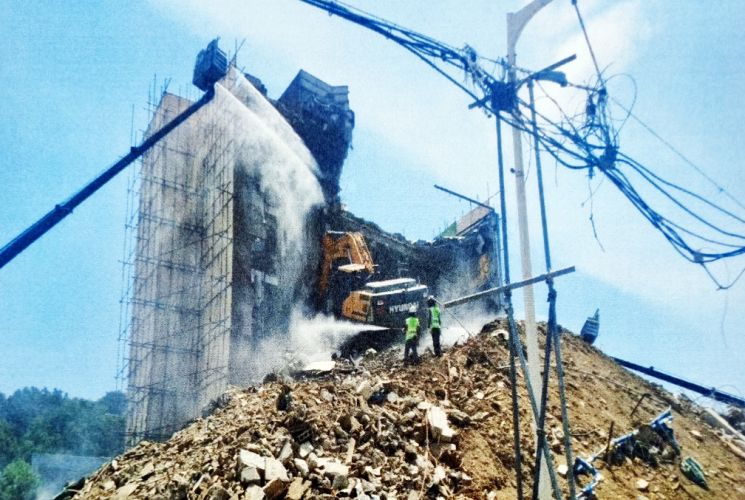 A few hours before the collapse of a demolition building in Gwangju Hakdong 4 District on June 9, which resulted in 17 casualties, the demolition site was captured. Workers from the demolition company were seen demolishing multiple floors at once instead of dismantling the building floor by floor. (Image source=Yonhap News)
[Sejong=Asia Economy Reporter Moon Chaeseok] As the Serious Accidents Punishment Act is set to be enforced next year, causing confusion and management risks in the industrial field, the labor sector has demanded the enactment of a Construction Safety Special Act. They urged the inclusion of provisions such as guaranteeing appropriate construction periods by the client and specifying the primary contractor's responsibility for construction machinery accidents. There are concerns that if introduced alongside the Serious Accidents Punishment Act, it could lead to harsher penalties for construction industry managers.
The Korean Confederation of Trade Unions (KCTU) issued a statement on the 16th demanding the enactment of the Construction Safety Act. The KCTU explained that among the 474 industrial accident fatalities from January to June this year, half were construction workers. Industrial accidents involving the top 10 domestic construction companies and their subcontractors increased from 812 cases in 2017, the first year of the Moon Jae-in administration, to 1,705 cases last year, a 2.1-fold increase.
The KCTU stated that the biggest causes of serious accidents are the illegal multi-tier subcontracting structure and the client's unreasonable demands to shorten construction periods. They insisted that at minimum, provisions for punishing clients and penalizing serious accidents at small-scale construction sites with projects under 5 billion KRW should be included. The KCTU argued, "If the government and the National Assembly truly want to prevent another construction site tragedy and save the lives of construction workers, they must enact the Construction Safety Act that strengthens the responsibilities of clients and primary contractors."
The problem is that there are many laws with similar purposes, such as the Serious Accidents Punishment Act and the Occupational Safety and Health Act, and enacting a law exclusively for the construction industry could result in excessive regulation. The Occupational Safety and Health Act also includes punishment provisions for cases where workers die due to violations of safety and health measures. The penalty level is not low, with imprisonment of up to 7 years or fines up to 100 million KRW for fatalities. Since the Serious Accidents Punishment Act mandates punishment of CEOs whenever an accident occurs regardless of cause, creating a law solely for the construction industry could increase the burden on managers of small businesses.
There is also a view that confusion will only intensify. Even if the government identifies a violating company's CEO as a 'pilot case' under the Serious Accidents Punishment Act, many believe that due to corporate opposition, it will only lead to actual punishment after investigations and court proceedings. It is also unclear whether the investigation authority lies with the police or the Occupational Safety and Health Headquarters. Currently, there is widespread speculation that the construction industry is most likely to be the first to be caught after the Serious Accidents Punishment Act is enforced next year, so creating 'construction industry-exclusive' punishment regulations could cause even greater confusion at the sites.
© The Asia Business Daily(www.asiae.co.kr). All rights reserved.
![Clutching a Stolen Dior Bag, Saying "I Hate Being Poor but Real"... The Grotesque Con of a "Human Knockoff" [Slate]](https://cwcontent.asiae.co.kr/asiaresize/183/2026021902243444107_1771435474.jpg)
















