[Asia Economy Reporter Choi Seok-jin, Legal Affairs Specialist] The Supreme Court has ruled that posting a disciplinary committee attendance notice containing reasons for disciplinary action on the bulletin board of the building where the disciplinary subject works constitutes defamation.
Even if there is a public aspect to the fact that disciplinary procedures have been initiated due to misconduct committed during work, the disciplinary charges are confirmed through the disciplinary process. Therefore, disclosing such facts at the stage of referral to disciplinary procedures and damaging the victim's reputation is not considered a socially significant act.
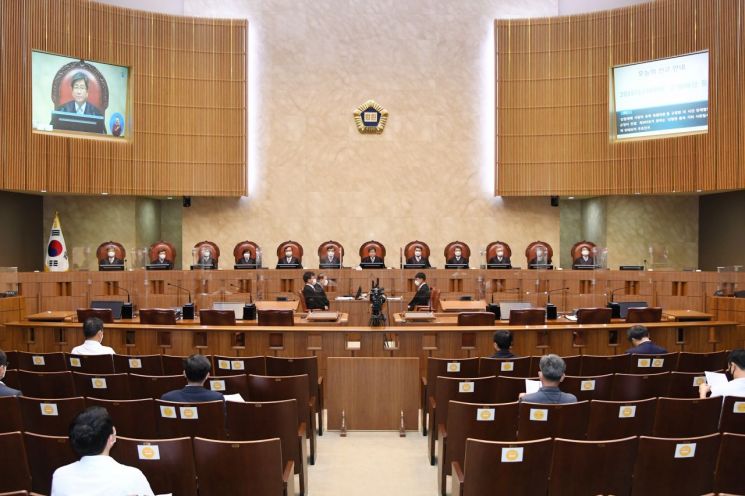
The Supreme Court's 2nd Division (Presiding Justice Lee Dong-won) overturned the lower court's acquittal of A, who was indicted for defamation, and remanded the case to the Suwon District Court on the 20th.
The court stated, "The lower court judged the defendant's act to be related to the public interest, but this ruling contains an error in understanding the legal principles regarding 'public interest' in defamation cases, which affected the judgment. The prosecutor's appeal pointing out this is justified."
B, the HR manager of Company A, judged that disciplinary procedures were necessary when employee C, who was in charge of electrical management in a building in Hanam-si, clashed with the building manager D, also from the same company. B reported this to the higher-ups, and Company A decided to initiate disciplinary procedures.
In early July 2019, B drafted a document titled "Request to Attend Personnel Committee" addressed to C and sent it to the building where C worked. The document included disciplinary charges against C such as ▲poor work performance or attitude ▲damaging the company's honor or credit ▲unjustified disobedience to superior's work-related orders ▲showing a bad attitude toward superior's work-related reprimands.
After sending this document, B called D, who had clashed with C, and instructed him to open the mail and post it on the bulletin board. D posted the document on the bulletin boards of the disaster prevention room, machine room, and management office of the building where C worked, allowing about 40 employees of the same company to see it.
In the first trial, B was found guilty of defaming C by posting unconfirmed disciplinary charges and was fined 300,000 won.
However, the second trial ruled that the fact that C was referred to disciplinary action was not a matter of private life but a public procedure related to "promoting the smooth and efficient operation of the company," thus a matter of public interest. Therefore, under Article 310 of the Criminal Act, illegality was excused, and B was acquitted.
But the Supreme Court's judgment differed.
The Supreme Court stated, "It cannot be denied that the contents specified in this document are not related to the victim's private life but concern the initiation of disciplinary procedures for misconduct committed by the victim while working at the company, thus having a public aspect. However, having a public aspect does not mean that the entire process from the stage of referral to disciplinary procedures can be fully disclosed."
It added, "Since disciplinary charges are tentatively confirmed after going through the disciplinary process, disclosing the fact at the stage of referral alone and damaging the victim's reputation cannot be regarded as a socially significant act."
Furthermore, the Supreme Court noted, "Moreover, this document contains not only the fact that the victim was referred to disciplinary procedures but also an outline of the disciplinary reasons, so it cannot be said that only procedural matters were disclosed."
© The Asia Business Daily(www.asiae.co.kr). All rights reserved.
![Clutching a Stolen Dior Bag, Saying "I Hate Being Poor but Real"... The Grotesque Con of a "Human Knockoff" [Slate]](https://cwcontent.asiae.co.kr/asiaresize/183/2026021902243444107_1771435474.jpg)
















