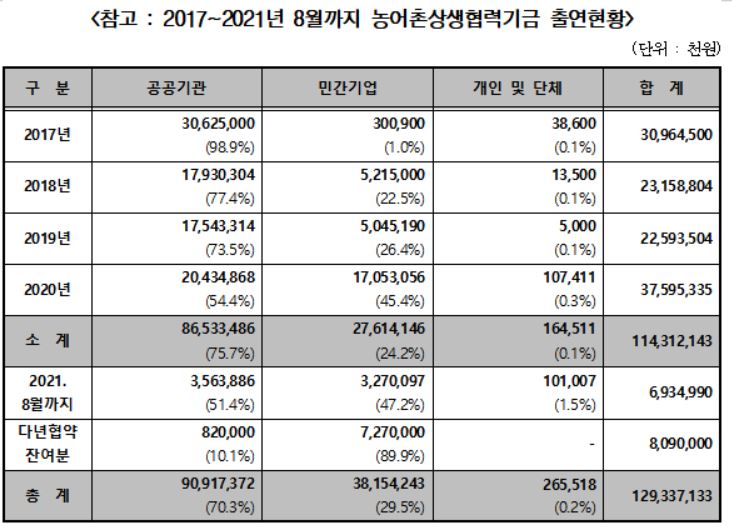
KRW 129.3 billion raised over 4 years and 8 months against 10-year KRW 1 trillion target
Public institutions contributed KRW 90.9 billion (about 70.3%), private companies KRW 38.1 billion (about 29.5%)
[Sejong=Asia Economy Reporter Kim Hyunjung] Although the Nong-eo Village Win-Win Cooperation Fund has recently been cited as a model case of the profit-sharing system, actual fundraising performance has been revealed to be only a very small portion of the target.
On the 21st, Jeong Jeomsik, a member of the People Power Party, announced that an analysis of the Nong-eo Village Win-Win Cooperation Fund's fundraising status up to August this year, ahead of the 2021 national audit, showed that the amount raised was significantly insufficient compared to the target. The Nong-eo Village Win-Win Cooperation Fund was established in 2015 during the National Assembly ratification of the Korea-China FTA to support farmers, fishermen, and rural areas facing crises due to market opening.
In November of that year, through a bipartisan agreement, it was decided to raise a total of KRW 1 trillion over 10 years by collecting KRW 100 billion annually from 2017, funded by voluntary donations from private companies benefiting from the FTA. This is a statutory fund established accordingly. The raised fund mainly supports projects such as welfare improvement and educational scholarships for farmers and fishermen, rural revitalization projects, and joint cooperation projects. At the time of the bipartisan agreement, Moon Jae-in, then leader of the New Politics Alliance for Democracy and now President, cited corporate donations to the Nong-eo Village Win-Win Cooperation Fund as a model case during his New Year's press conference earlier this year, mentioning the COVID-19 profit-sharing system.
However, an analysis of the fund's contributions shows that only KRW 129.3 billion has been raised over 4 years and 8 months from 2017 to August 2021, reaching less than 30% of the annual KRW 100 billion target.
As the government incorporated win-win growth evaluation indicators into public enterprise management assessments, most of the contributions came from public institutions, which contributed KRW 90.9 billion (about 70.3%), while private companies contributed KRW 38.1 billion (about 29.5%), which does not align with the fund's original purpose of sourcing donations from private companies and others.
In contrast, the Large and Small Business Win-Win Cooperation Fund, established in 2013, surpassed KRW 1 trillion in cumulative contributions within six years by 2018, and as of May 2021, KRW 1.5006 trillion has been raised, supporting various assistance projects for small and medium-sized enterprises.
Regarding this, Representative Jeong Jeomsik stated, "Although large corporations have gained considerable benefits from the FTA, the reality is that they are stingy in contributing to funds for rural development," and added, "Through the national audit, we plan to summon witnesses from companies with insufficient fund contributions to analyze the cooperation structure and urge them to contribute to the fund."
© The Asia Business Daily(www.asiae.co.kr). All rights reserved.

















