As Contactless Consumption Increases, Cases of Origin Fraud Also Surge
Distinguishable to the Naked Eye, but Livestock Traceability App Also Useful
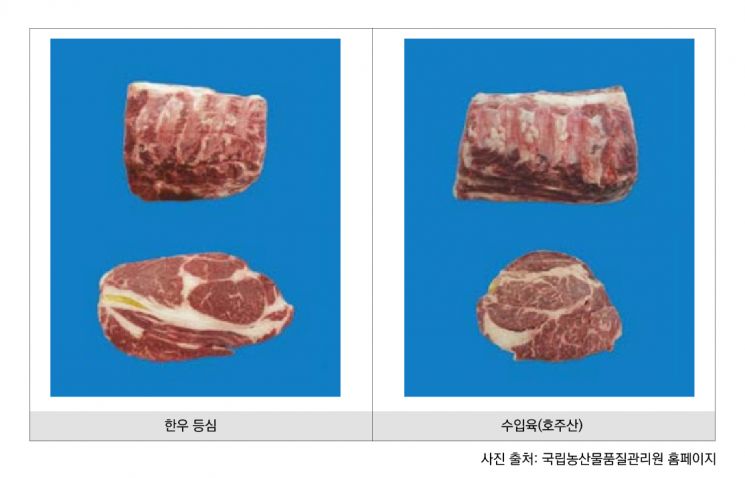 (Left) Korean Beef Sirloin (Right) Australian Sirloin _(Photo by National Agricultural Products Quality Management Service)
[Sejong=Asia Economy Reporter Kim Hyunjung] Ahead of the Chuseok holiday, as consumption of Hanwoo beef increases, cases of origin fraud are also surging due to the rise in preference for contactless transactions such as online purchases and convenience foods amid COVID-19.
In fact, during the last Lunar New Year holiday, the National Agricultural Products Quality Management Service conducted on-site inspections of 10,892 food sales and manufacturing businesses and found 443 companies violating origin labeling regulations (209 false labeling, 234 no labeling). Among the violated items, beef (67 cases) was the second most common after pork (88 cases).
With violators becoming more cunning by disguising Hanwoo grades or selling domestic beef cattle or imported beef as Hanwoo, it is indeed difficult for general consumers to distinguish genuine Hanwoo. As the saying goes, knowledge is power, here is how consumers can choose authentic Hanwoo beef to avoid being deceived.
Hanwoo meat color is bright red, imported meat tends to be dark reddish
Generally, Hanwoo meat has a bright red color, whereas imported meat tends to be darker red. The fat layers also differ. Hanwoo has fine, even grain and bright milky white fat, while imported meat has thicker and uneven fat layers. The color often appears yellowish due to discoloration. This is because most imported meat is transported frozen and goes through thawing. Many butcher shops use red bulbs inside display cases, making color distinction difficult, so it is better to take the meat out and visually inspect it directly.
For ribs, which are in high demand during holidays, Hanwoo has smaller and rounder bones compared to imported meat. It also has attached meat layers making it thicker. The "tteokshim" (a type of connective tissue) commonly found in sirloin is embedded within the fat layer in Hanwoo, whereas in imported meat it is located on the outside. Additionally, unlike Hanwoo which has a deep yellow hue, imported meat often shows blood seepage.
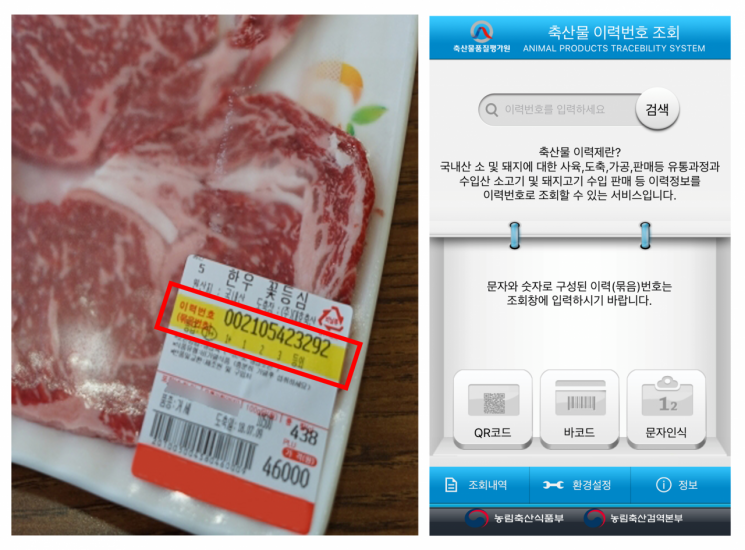
Authentic Hanwoo can be reliably verified through the Livestock Traceability App
Hanwoo is strictly managed through the Livestock Traceability System. Therefore, by downloading the Livestock Traceability app and searching the individual identification number attached to the Hanwoo packaging you intend to purchase, or by scanning the QR code or barcode, you can instantly view information such as birth date, type, gender, slaughter date, slaughter inspection results, meat quality grade, as well as foot-and-mouth disease vaccination and brucellosis test information.
If you verify through the app at a butcher shop or supermarket and find that imported meat, domestic beef cattle, or dairy cow meat is being fraudulently sold as Hanwoo, you can report it by calling the National Agricultural Products Quality Management Service’s illegal distribution reporting hotline.
‘Domestic’ label on restaurant menus does not always mean Hanwoo
Hanwoo beef labeling can only be used for meat produced from Hanwoo cattle. Some consumers mistakenly think domestic beef is Hanwoo, but the labeling is clearly different. The type of meat should be labeled as domestic with the specific type in parentheses next to it, such as domestic (Hanwoo), domestic (beef cattle), or domestic (dairy cow). For imported meat, the label must state foreign origin with the exporting country in parentheses, for example, foreign (beef, USA). Violations can result in fines up to 10 million KRW.
Additionally, restaurants and butcher shops must display slaughter certificates or grade confirmation documents on the wall or show them upon consumer request. According to the Act on the Labeling of Origin of Agricultural and Fishery Products, meat sold in cut or divided form must be labeled with origin, type, slaughter location, and traceability number.
Min Kyungcheon, Chairman of the Hanwoo Self-Governing Fund, said, “Hanwoo is produced under a thorough management system from birth, breeding, slaughter, to distribution,” and added, “We hope consumers use the Livestock Traceability System well to confidently consume our Hanwoo and have a bountiful Chuseok.”
© The Asia Business Daily(www.asiae.co.kr). All rights reserved.


















