Household Violence Increased by About 43.8% During Last Year's Holiday Period
Influence of Entrenched Traditional Gender Roles
Experts: "Holiday Stress Affects a Wider Range... Including Male Heads of Households and Young Generations"
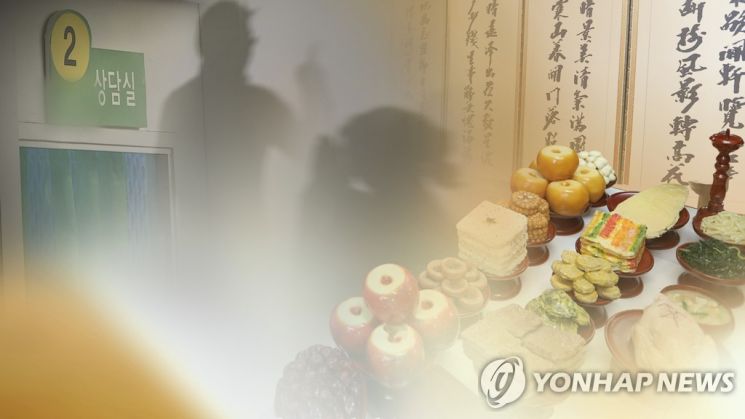 Reports of domestic violence during the holiday period have been found to increase by about 50% compared to normal times. [Image source=Yonhap News]
[Asia Economy Reporter Kim Seohyun] # In September last year, Mr. A was brought to trial on charges of assault and special threats for hitting his wife and wielding a knife at family members who tried to stop him. In court, Mr. A stated, "I was dissatisfied because my wife spoke to me disrespectfully." He had lost his wallet while visiting his paternal home during Chuseok, and when his wife found it, she allegedly made sarcastic remarks, which led him to strike her. When his mother and younger brother scolded him, he wielded a kitchen knife and shouted, "I will kill you all."
Despite holidays being a time for family harmony, reports of domestic violence have actually increased. The main reason is household conflicts between spouses arising from traditional and customary holiday labor roles. Experts analyze that with the recent rise in women's status and the prolonged COVID-19 situation, the range of people experiencing holiday stress has broadened.
According to the police, during the three-day Chuseok holiday last year (September 30 to October 2), 112 emergency calls surged compared to usual. The breakdown is △domestic violence 43.8% △sexual violence 15.4% △dating violence 22.2%. The number of domestic violence reports reached 2,729 cases.
Every year, domestic violence during holidays has shown a sharp increase of about 50%. From 2016 to 2019, the average daily domestic violence cases during holiday periods were 1,024, which is 44.9% higher than the average daily cases of 708 during the same period.
This points to conflicts within families surfacing due to issues such as the distribution of household labor and gender discrimination during holidays. Domestic violence counseling centers analyze that most conflicts between spouses explode over the distribution of household chores during holidays. Traditional gender roles, where women prepare food and men perform ancestral rites, remain a source of conflict.
According to the "Seoul Gender Equality Life Dictionary - Chuseok Special" survey conducted by the Seoul Foundation of Women and Family in 2018 with 1,170 men and women, both genders cited "household chores such as setting the table that only women do during holidays" (53.3%) as the top form of holiday gender discrimination.
 Domestic violence and divorce rates have also been revealed to be increasing. Photo is unrelated to specific expressions in the article. [Image source=Yonhap News]
Conflicts arising during holidays tend to continue afterward. According to the 'Divorce Statistics for the Last 5 Years' by the Court Administration Office and Statistics Korea, the number of divorces steadily increases in March and October-November, the months following Seollal and Chuseok holidays. For example, in 2019, divorces rose from about 8,200 cases in February to about 9,100 in March, and from about 9,000 in September to 9,900 in October.
The trend was similar in 2018. Divorce cases increased from about 7,700 in February to 9,100 in March, and from about 7,800 in September to 10,500 in October and 11,100 in November. Based on the last five years, the divorce rate in the month following holidays increased by an average of 11.5%.
Given this situation, there are calls to create practical ancestral rites customs that foster a warm family atmosphere rather than being bound by traditional holiday table customs.
Experts explain that the range of people experiencing holiday stress has expanded compared to the past, now including male heads of households and young adults.
Professor Lee Gyuho of Daegu University’s Department of Family Welfare said, "Fixed gender roles must be considered a fundamental cause." He analyzed, "Recently, as women's status has risen, men tend to feel burdened as economic providers." He added, "This is especially severe during the COVID-19 pandemic when economic capacity is lost. When combined with issues like parental care, it becomes an even greater source of stress."
Professor Lee mentioned young adults as the generation most economically affected since the spread of COVID-19, pointing out, "Issues such as employment and marriage, which come up in family conversations during holidays, create a more stress-sensitive atmosphere." He emphasized, "Domestic violence can decrease only if there is a shared understanding that everyone is going through difficult times."
© The Asia Business Daily(www.asiae.co.kr). All rights reserved.
![Clutching a Stolen Dior Bag, Saying "I Hate Being Poor but Real"... The Grotesque Con of a "Human Knockoff" [Slate]](https://cwcontent.asiae.co.kr/asiaresize/183/2026021902243444107_1771435474.jpg)












