[Asia Economy Reporter Kwon Jae-hee] Volkswagen Group, the world's second-largest electric vehicle manufacturer, is starting to produce battery cells in-house.
Volkswagen Group plans to invest 30 billion euros (approximately 41 trillion KRW) by 2024 to transition to e-mobility.
According to local media such as Germany's Handelsblatt on the 16th (local time), Volkswagen Group has opened four research centers in Salzgitter, Lower Saxony, Germany, which has played a key role in internal combustion engine manufacturing, for in-house battery cell production and manufacturing.
Until now, Volkswagen Group has used battery cells 95% produced in Korea, China, and Japan. However, going forward, they plan to intensify preparations for in-house battery cell production centered in Salzgitter.
Volkswagen Group plans to build six battery cell factories in Europe by 2030. Each of these factories is expected to have a maximum production capacity of 40 gigawatt-hours (GWh).
In addition to Salzgitter, construction has been confirmed in Sweden and Spain, with the locations of the remaining three factories to be finalized within a few months.
One factory will start operation in Western Europe in 2026, and another in Eastern Europe in 2027.
Volkswagen Group expects these six factories to be capable of producing battery cells for 5 million electric vehicles annually.
The investment for building these six factories, which will be completed within the next 8 to 9 years, is expected to reach 15 billion euros (approximately 21 trillion KRW).
The total investment by Volkswagen Group in the transition to e-mobility by 2024 is expected to reach 30 billion euros (approximately 41 trillion KRW).
Volkswagen Group aims for electric vehicles to account for 70% of total new car sales by 2030, with Porsche targeting 80%.
Meanwhile, Volkswagen Group invested 70 million euros (approximately 100 billion KRW) in the four newly opened research centers, creating 250 jobs.
At these research centers, battery cells will be tested under various climate conditions ranging from the Arctic to deserts, and new raw materials will be explored for battery cell manufacturing.
Volkswagen Group is pinning hopes on so-called solid-state cells, which are expected to be producible in the late 2020s. Solid-state cells have shorter charging times and longer driving ranges compared to current battery cells.
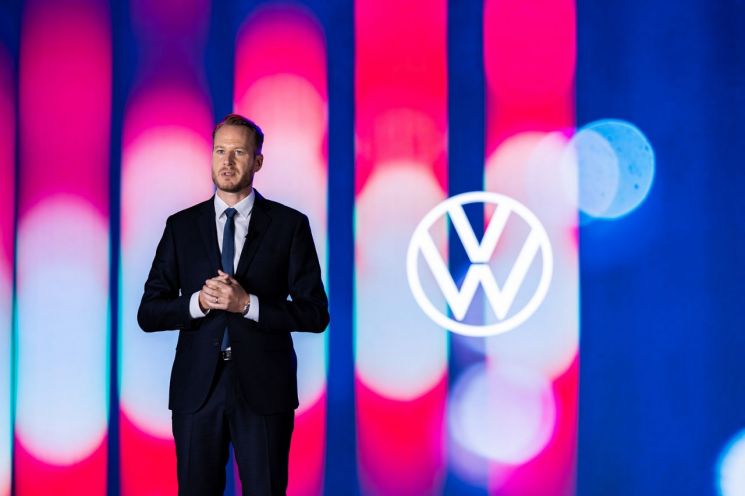
Thomas Schmall, Volkswagen Group's Chief Technology Officer, said, "Germany is still at the beginning stage in battery technology," adding, "Volkswagen is striving to compete through in-house battery cell production, and for this, we need to redeploy large-scale facilities."
© The Asia Business Daily(www.asiae.co.kr). All rights reserved.
![Clutching a Stolen Dior Bag, Saying "I Hate Being Poor but Real"... The Grotesque Con of a "Human Knockoff" [Slate]](https://cwcontent.asiae.co.kr/asiaresize/183/2026021902243444107_1771435474.jpg)
















