Decrease in Local Government Education Participation... Impact of Reduced In-Person Education
Increase in Participation Rates for National Agencies and School Education
Overall Institution Heads' Education Participation Also Declines Compared to Last Year
Implementation of Yangpyeong Act Amendment, Poor Performance Institutions Publicly Disclosed After One Year
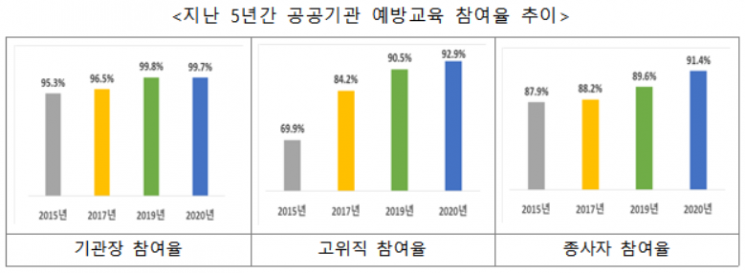
As a result of checking the status of sexual violence prevention education in public institutions, the participation rate of local governments has decreased. Starting next year, if heads of national institutions or local governments do not receive sexual harassment prevention education, their names will be disclosed.
On the 17th, the Ministry of Gender Equality and Family reported the results of the "2020 Public Institution Sexual Harassment, Sexual Violence, Prostitution, and Domestic Violence Prevention Education Performance Inspection," conducted on 17,693 institutions including national institutions, local governments, public service-related organizations, and schools at all levels, at the Cabinet meeting.
The survey results showed that the participation rate of local government employees was 85.7%, institution heads 98.3%, and high-ranking officials 88.3%, each decreasing by 1.3 percentage points, 0.9 percentage points, and 1.3 percentage points respectively compared to the previous year. This contrasts with the increased participation rates in national institutions and schools. The sharp drop in face-to-face education in local governments to 38.8% last year made it difficult to encourage education participation.
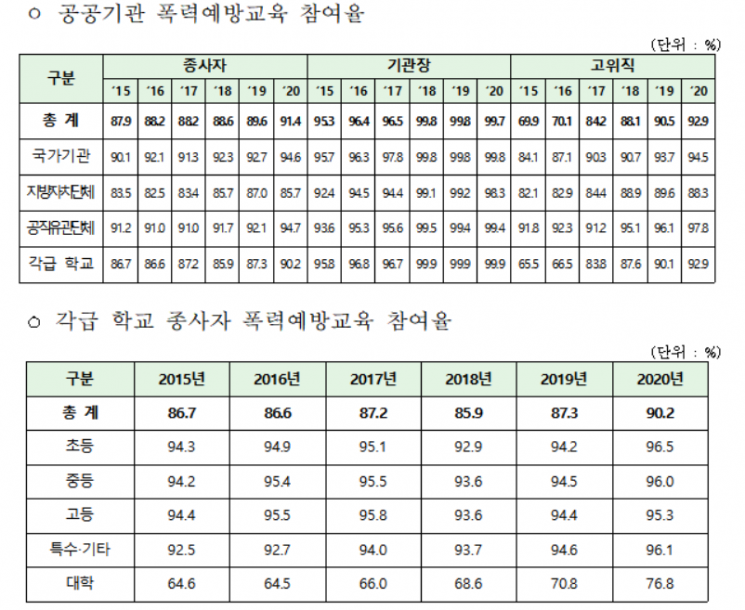
The overall public institution education participation rate for institution heads (99.7%) decreased by 0.1 percentage points from the previous year, but high-ranking officials (92.9%) and employees (91.4%) increased by 2.4 percentage points and 1.8 percentage points respectively. Participation rates rose as management focused on institutions with low high-ranking official participation.
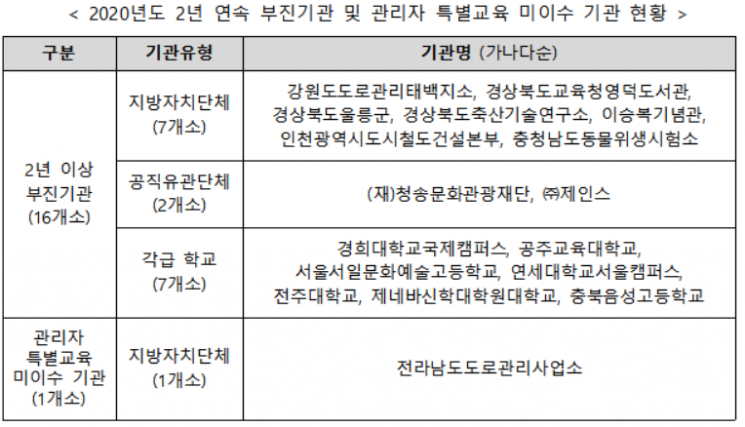
Institutions with poor education performance numbered 246 (1.4%), slightly increasing from the previous year. Sixteen institutions with poor performance for two or more years include Ulleung-gun in Gyeongbuk, Gyeongbuk Livestock Technology Research Institute, Jane's, Kyung Hee University International Campus, Kongju National University of Education, Yonsei University Seoul Campus, Jeonju University, and Chungbuk Eumseong High School. The Ministry of Gender Equality and Family is conducting special training for managers at underperforming institutions and requiring submission of improvement plans for prevention education.
Starting next year, if heads of national institutions or local governments do not participate in sexual harassment prevention education, their names will be disclosed. This follows the enforcement of the amendment to the Framework Act on Gender Equality from October 21. Institutions with poor performance for just one year will also be publicly announced in the media, applicable from the 2021 education performance.
From next year, institutions required to conduct separate education for high-ranking officials will be expanded to include public service-related organizations and schools at all levels. According to the amendment to the Act on the Prevention of Sexual Violence and Protection of Victims, effective from July next year, the results of university sexual violence prevention education inspections can be reflected in university accreditation evaluations.
Jeong Young-ae, Minister of Gender Equality and Family, stated, "To prevent sexual harassment and sexual violence within organizations, comprehensive efforts including not only prevention education but also organizational culture improvement are necessary. Therefore, public institutions must take a leading role in violence prevention education and in creating a gender-equal organizational culture with greater interest."
© The Asia Business Daily(www.asiae.co.kr). All rights reserved.



















