Housing Purchase Attitude Index Rises for 2 Consecutive Quarters, Employment Outlook Index Falls for the First Time in a Year
64.4% of Seoul Citizens Expect This Chuseok Economy to Be Worse Than Last Year
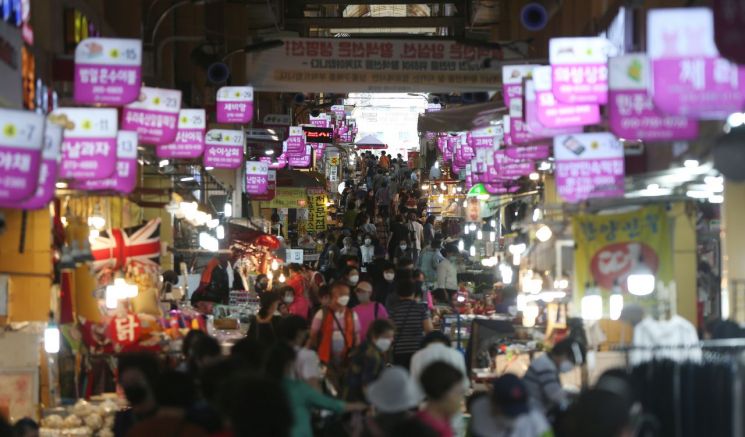
[Asia Economy Reporter Lim Cheol-young] The Consumer Attitude Index, which represents the perceived economic conditions of Seoul citizens, remained above the 90-point mark for the third quarter in a row, following the second quarter. The Seoul Consumer Attitude Index first recovered to above 90 points in the second quarter of this year since the outbreak of COVID-19. Additionally, the majority of Seoul citizens expected their Chuseok holiday spending to be between 200,000 and 500,000 KRW, and more than six out of ten anticipated that the Chuseok economy would be worse than last year.
According to the Seoul Institute on the 18th, the third quarter survey on 'Seoul Citizens' Perceived Economic Conditions and Chuseok Economy Diagnosis' showed a slight increase of 0.3 points from the previous quarter to 93.2, maintaining the 90-point level for two consecutive quarters. However, the institute noted, "The rapid increase in new COVID-19 cases, the spread of the Delta variant, rising raw material prices, and the resulting rapid inflation are acting as domestic and international risk factors, leaving uncertainty still present."
Both components of the Consumer Attitude Index?the Current Living Conditions Index and the Future Living Conditions Index?increased compared to the previous quarter. The Current Living Conditions Index rose by 2.6 points to 79.2, showing an upward trend for two consecutive quarters, while the Future Living Conditions Index increased by 2.0 points to 97.1. The main reasons cited for the expected improvement in household living conditions one year from now were 'increased household income' and 'rising value of owned assets.'
The Durable Goods Purchase Attitude Index for Seoul citizens in the third quarter decreased by 0.3 points from the previous quarter to 81.6, whereas the Housing Purchase Attitude Index rose by 1.5 points to 58.0, marking an increase for two consecutive quarters. Meanwhile, the Employment Outlook Index, which had been rising for four consecutive quarters, fell by 2.5 points to 76.0 in the third quarter of this year. The Net Asset Index and the Inflation Expectation Index both showed slight increases of 0.4 points and 1.9 points, respectively.
Meanwhile, a survey conducted by the institute targeting a sample of 1,200 households in Seoul (1,200 respondents) revealed that 64.4% of Seoul citizens expect the Chuseok economy this year to be worse than last year. The highest response rate, 55.8%, indicated that Chuseok spending would be similar to last year, but a significant 31.8% expected it to decrease.
When asked about travel plans during the Chuseok holiday, 65.1% of Seoul citizens responded that they had 'no travel plans.' Regarding the top priority for Chuseok livelihood stabilization measures, 54.3% chose 'COVID-19 infectious disease response,' followed by 'stabilization of prices for Chuseok seasonal goods' (24.0%) and 'recovery of consumer sentiment' (7.5%).
The expected Chuseok spending amount for Seoul citizens this year was highest in the '200,000 to less than 500,000 KRW' range at 36.8%, followed by '500,000 to less than 1,000,000 KRW' at 29.4%, and 'less than 200,000 KRW' at 16.8%. Looking at the expected Chuseok spending over the past five years, the proportion of those expecting to spend 'less than 200,000 KRW' increased the most (6.9% in 2017 → 16.8% in 2021).
Additionally, the most burdensome cost when preparing for Chuseok was 'pocket money for family and relatives,' accounting for 43.1%, followed by 'holiday gift expenses' (27.3%) and 'Chuseok table setting expenses' (22.8%). The primary purchase location for products needed for Chuseok table settings was 'large discount stores' at 49.0%, followed by 'traditional markets' (20.2%) and 'online shopping malls' (14.0%). Notably, the share of 'online shopping malls' as a purchase location for Chuseok table setting products rose sharply from 1.9% in 2017 to 14.0% in 2021.
© The Asia Business Daily(www.asiae.co.kr). All rights reserved.
![Clutching a Stolen Dior Bag, Saying "I Hate Being Poor but Real"... The Grotesque Con of a "Human Knockoff" [Slate]](https://cwcontent.asiae.co.kr/asiaresize/183/2026021902243444107_1771435474.jpg)
















