Holding the Plenary Committee and Expressing Opinions to the Speaker of the National Assembly
"Agree with the Purpose of Strengthening Media Responsibility
But Concepts like False and Manipulated Reports Are Abstract and Unclear"
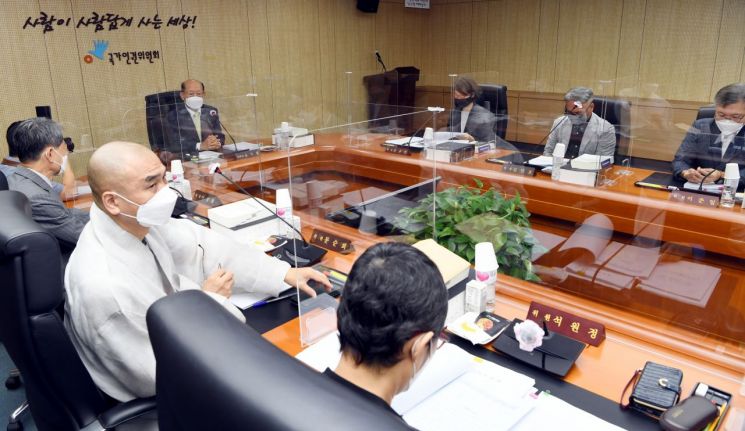 Song Doo-hwan, the newly appointed Human Rights Commissioner, is presiding over the 16th plenary meeting held on the afternoon of the 13th at the National Human Rights Commission in Jung-gu, Seoul.
 [Image source=Yonhap News]
[Asia Economy Reporter Lee Gwan-joo] The National Human Rights Commission has expressed concerns that the ruling party's push to amend the 'Media Arbitration Act' could restrict freedom of the press and stated that careful review is necessary.
According to the Human Rights Commission on the 17th, the commission discussed the amendment to the Media Arbitration Act at the plenary committee meeting on the 13th and made this decision. The commission explained, "While we agree with the purpose of the amendment to strengthen the responsibility of the media, we believe that some newly introduced provisions may restrict the freedom of the press guaranteed by the Constitution. Therefore, we have expressed to the Speaker of the National Assembly that careful consideration is needed in legislating this."
The commission acknowledged the amendment's intent to enhance media responsibility by emphasizing the importance of truthful reporting amid the serious social problem of false and manipulated information. However, it noted that strengthening regulations on media reporting is inevitably closely related to restrictions on freedom of speech and expression guaranteed by our Constitution, and thus principles such as the 'prohibition of excess' and 'clarity' required for limiting fundamental rights must be strictly observed.
Furthermore, the commission pointed out that the concepts of false and manipulated reporting and the presumption clauses regarding intentional or gross negligence in establishing punitive damages stipulated in the amendment are abstract and unclear. This could potentially include critical media reports that differ in political orientation or ideology, as well as investigative reports on crimes, corruption, and corporate wrongdoing, making them subject to punitive damages. The commission judged that this raises concerns about a 'chilling effect' on media reporting.
The commission suggested that the concept of false and manipulated reporting should at least include requirements such as ▲falsity ▲intent to cause harm ▲purpose of gaining political or economic benefit ▲manipulative acts that cause confusion with verified facts or actual media reports. It emphasized the need to specify these concretely to minimize the chilling effect on media reporting.
Additionally, the commission proposed deleting the existing presumption clauses of intentional or gross negligence, which contain vague and abstract requirements. However, since this could excessively increase the burden of proof on the victim, it recommended establishing separate provisions to appropriately adjust the burden of proof between parties.
The commission also criticized including internet news service providers, who find it difficult to recognize the illegality of all distributed news in advance, as subjects of punitive damages, stating that treating intermediaries as equal to news producers imposes excessive responsibility.
The commission concluded, "We hope that the Media Arbitration Act will be amended through careful review so that freedom of expression, including freedom of the press guaranteed by the Constitution and the International Covenant on Civil and Political Rights, is not restricted and that the public responsibility of the media is harmoniously ensured."
© The Asia Business Daily(www.asiae.co.kr). All rights reserved.

















