Government "70% Achievement Possible Before Chuseok"
'With Corona' Possibility Anticipated
'Freedom Day' UK Second Dose Rate 53%... Korea Around 40%
Experts "Risk Possible Even at 80% Vaccination Rate"
"Infection Speed Must Be Controlled Through Quarantine Management and Vaccination"
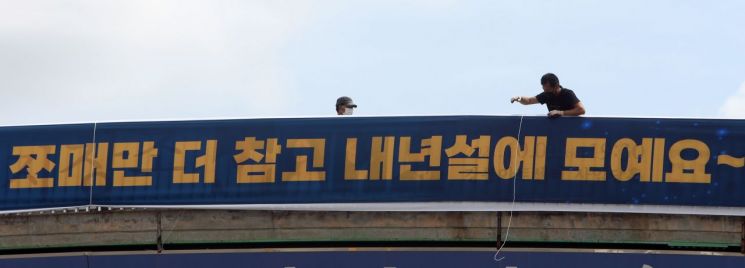 On the 13th, a banner in the local dialect urging people not to gather during the Chuseok holiday to prevent the spread of COVID-19 was posted in downtown Gangneung, Gangwon Province. / Photo by Yonhap News
[Asia Economy Reporter Lim Juhyung] As the first dose COVID-19 vaccination rate is expected to exceed 70% of the population before Chuseok, expectations for 'With Corona' are also rising. With Corona refers to a policy approach that simultaneously pursues COVID-19 prevention measures and a return to daily life. Unlike previous responses that focused on reducing the number of confirmed cases, it places more emphasis on managing the fatality rate.
However, some express concerns that a premature transition to With Corona could lead to another public health crisis. Various virus variants that reduce vaccine effectiveness are emerging, and since COVID-19 spreads very rapidly, there are concerns that the prevention system could collapse before herd immunity is achieved. Experts urge that even after vaccination is completed, strict infection control measures to 'adjust the pace' must be maintained.
◆Korea's first dose vaccination rate near 70%... Is 'With Corona' feasible?
According to the COVID-19 Vaccination Response Promotion Team, as of the 15th, the cumulative number of people who have completed the first dose vaccination reached 34,970,773, which is 68.1% of the total domestic population.
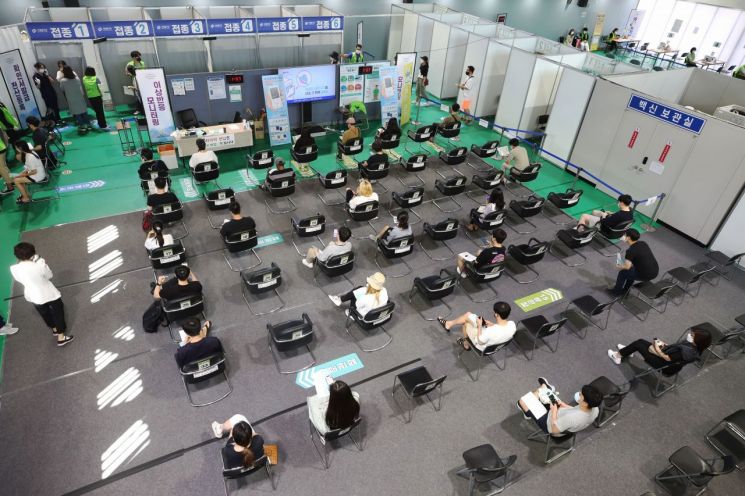 On the afternoon of the 15th, citizens are being monitored for adverse reactions after receiving vaccinations at the COVID-19 vaccination center set up at Bukahyeon Culture and Sports Center in Seodaemun-gu, Seoul. / Photo by Yonhap News
In this regard, Park Hyang, head of the Central Disaster and Safety Countermeasure Headquarters' quarantine general team, stated in a briefing, "If vaccinations continue at the current pace, achieving 70% first dose coverage before the Chuseok holiday is possible."
With 7 out of 10 people in the country receiving the vaccine, expectations are growing that the transition to With Corona could be accelerated. The political sphere has also begun shifting the focus from existing quarantine policies to With Corona.
The ruling party recently formed a 'With Corona Task Force (TF)' and started discussions on transitioning the quarantine system. The With Corona TF held its first meeting at the National Assembly on the 16th to discuss specific transition plans and government support measures.
The health authorities are also considering recommending home treatment for asymptomatic or mild patients to respond to With Corona. Son Youngrae, head of the social strategy team at the Ministry of Health and Welfare's Central Disaster and Safety Countermeasure Headquarters, explained at a regular briefing on the 15th, "While home treatment increases the risk of transmission, managing all confirmed cases by isolating them in facilities, as is currently done, places a heavy burden on the healthcare system."
◆UK's 'Freedom Day' vaccination rate was 63%... second dose rate much higher
As the COVID-19 pandemic prolongs, voices are calling for sustainable policies that match the situation. Medical staff have reached their limits, submitting resignations or protesting, and self-employed and small business owners, whose incomes have been hit by strengthened social distancing, are losing patience. This is why demands are growing to shift to With Corona, managing quarantine levels based on fatality rates rather than focusing solely on confirmed cases.
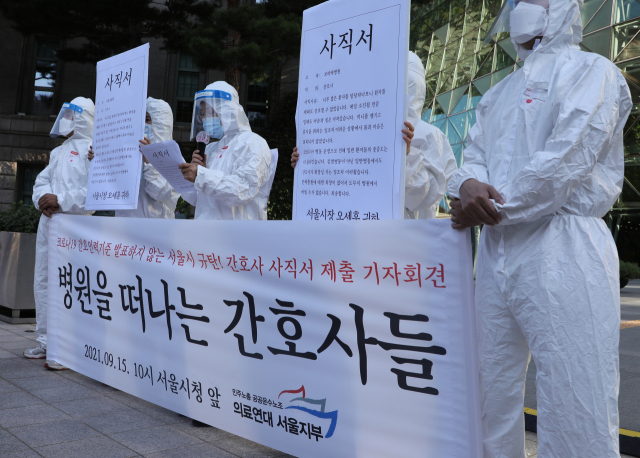 The Korean Confederation of Trade Unions Medical Solidarity Headquarters is protesting the shortage of nursing staff due to COVID-19 in front of Seoul City Hall on the 15th. / Photo by Yonhap News
Countries declaring With Corona are appearing overseas as well. The representative country is the United Kingdom, which on July 19th effectively removed almost all social distancing restrictions in what was called 'Freedom Day.' Mask-wearing was no longer mandatory. At that time, the UK's total population vaccination rate was 63%, lower than Korea's.
After Freedom Day, the number of confirmed cases in the UK surged sharply for a while. On the 6th, new daily cases exceeded 44,000, with daily patient numbers increasing by nearly 1,000.
However, recently, the weekly average number of confirmed cases has decreased by 22%, indicating a phase of stabilization, and the National Health Service (NHS) has not been overwhelmed to the point of being unable to operate.
However, there are concerns that a bold transition to With Corona like the UK is too risky in Korea's current environment. First, although the UK's first dose vaccination rate was lower than Korea's at the time of Freedom Day, the second dose rate was much higher. The UK's second dose rate was 53% of the population, while Korea's is currently around 40%. The Delta variant is known to be difficult to achieve immunity with only the first dose.
 On July 19, when the UK lifted COVID-19 quarantine regulations, known as "Freedom Day" (local time), young people are cheering at a club in Farringdon, London. / Photo by Yonhap News
Also, unlike the UK during the COVID-19 pandemic last year, Korea did not have a large portion of the population infected. This means fewer people with natural antibodies, so infections could spread faster than in the UK. Additionally, unlike the UK where the NHS manages most of the national health system making resource allocation like beds and medical staff easier, Korea must cooperate with private hospitals, which may reduce short-term response capacity when patient numbers suddenly increase.
◆"Thousands of deaths even if 80% vaccinated" Experts urge thorough preparation
Experts emphasize that even if quarantine policies shift to With Corona, thorough preparation including quarantine guidelines and additional vaccinations is necessary.
Professor Jung Jaehoon of the Department of Preventive Medicine at Gachon University Gil Medical Center wrote on his Facebook on the 6th, "Korea's target vaccination rate is about 80% of the total population. Even if we estimate that 10% have already had or will have COVID-19, giving a total immunity of 90%, COVID-19 will rapidly spread until the remaining 10%, about 5 million people, are cumulatively infected." He added, "Assuming a fatality rate of 0.1%, this would result in 5,000 deaths, and assuming a 3% critical illness rate, 150,000 critically ill patients."
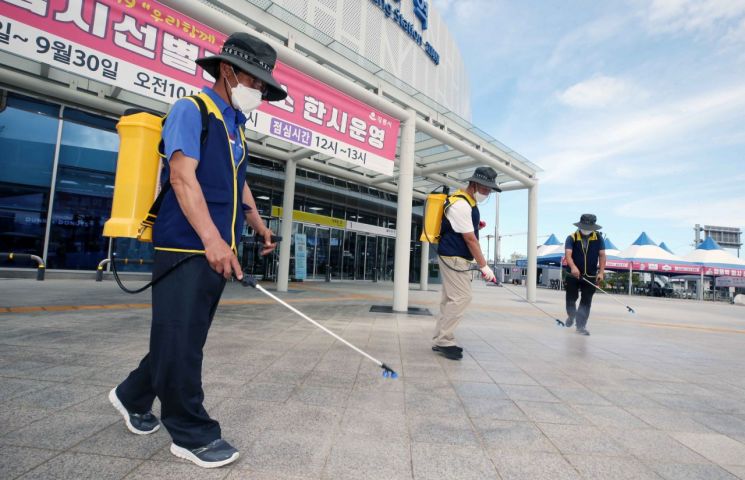 On the 16th, quarantine officials in Gangneung-si, Gangwon, are conducting disinfection work near Gangneung Station, where a large number of tourists are expected during the Chuseok holiday. / Photo by Yonhap News
He continued, "The total damage will be the same, but the key is that if damage surges, additional deaths may occur due to secondary damage such as healthcare system collapse. Ultimately, the success of With Corona depends on how well the damage is spread out. Measures to control transmission speed such as isolating confirmed cases, contact tracing, and mask-wearing are necessary," he added.
Professor Kim Wooju of the Department of Infectious Diseases at Korea University Guro Hospital emphasized the importance of the third 'booster' vaccination. He said, "Due to the Delta variant, protection from the virus is difficult with only the first dose. Advanced countries are considering not only the second dose but also the third booster vaccination." He explained, "The 70% first dose rate has now become a largely meaningless number."
He added, "The booster vaccination plan has not yet been concretely announced, and with the second dose rate lower than in advanced countries, With Corona is premature," emphasizing, "Now is the time to focus all efforts on vaccination."
© The Asia Business Daily(www.asiae.co.kr). All rights reserved.



















