- UNIST Researchers Develop Single Molecule Synthesized as Protein Inside Cancer Cell Mitochondria
- Protein Polymers Attack Mitochondria Inducing Cell Death, Promising New Anticancer Drug... Published in ACS Nano -
[Asia Economy Reporter Kim Bong-su] Domestic researchers have developed a technology that creates artificial protein polymers inside cells to kill cancer cells. The synthesized protein polymers damage the mitochondrial membrane of cancer cells, cutting off their energy supply. This anticancer effect was also confirmed in experiments using mice with skin cancer. This development signals a green light for new anticancer drugs with fewer side effects and resistance.
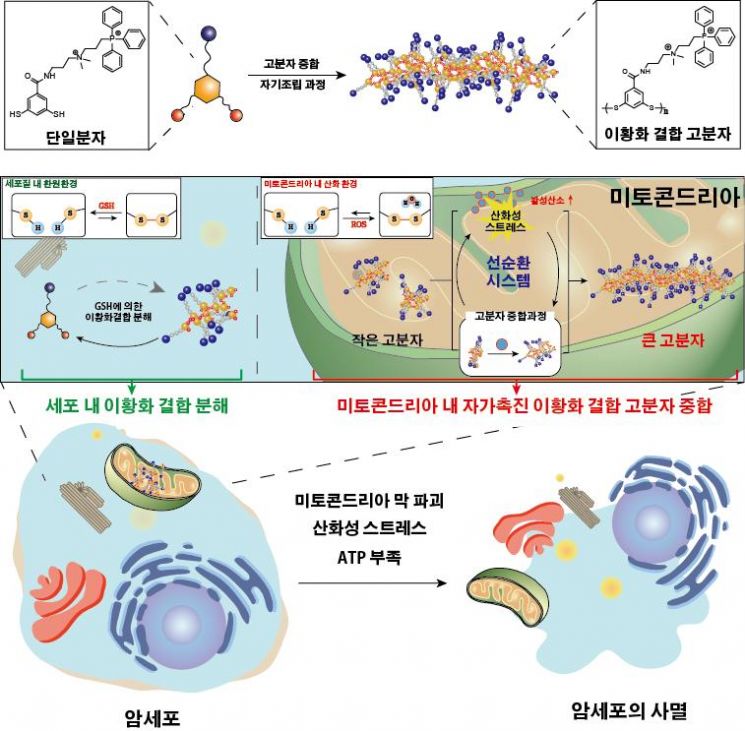
Ulsan National Institute of Science and Technology (UNIST) announced on the 16th that the research team led by Professors Yu Ja-hyung and Kwak Sang-gyu, in collaboration with Professor Jin Jun-oh's team at Yeungnam University, developed a single molecule (monomer) that self-assembles inside the mitochondria of cancer cells. Multiple monomers combine through a polymerization reaction to form protein polymers. This polymerization reaction does not occur in normal cells, allowing selective killing of cancer cells.
Cancer cells are characterized by a high level of reactive oxygen species inside the cell. The researchers focused on this point and designed the monomer molecular structure accordingly. The monomer molecules were designed to connect via disulfide bonds. Disulfide bonds are not easily broken down inside the mitochondria of cancer cells, where reactive oxygen species are abundant.
The synthesized small-sized protein polymers attack the mitochondrial membrane, inducing oxidative stress. The reactive oxygen species generated at this time further promote disulfide bonding, forming large protein polymers. This creates a positive feedback system. These large polymers simultaneously attack the mitochondrial membrane, destroying the mitochondria and killing the cancer cells. Mitochondria located inside the cell are organelles that supply energy to the cell.
The research team also demonstrated this through animal experiments. When the monomer substance was directly injected into the skin cancer (SCC7) tissue of mice, the tumor size was reduced to less than half within three weeks.
This monomer molecule consists of a triphenylphosphonium part that targets mitochondria and a di-thiol part capable of polymerization. Artificial protein polymers are formed through a polymerization reaction where di-thiol groups meet and form disulfide bonds.
The research team stated, "The method developed this time generates protein-mimicking substances inside cells to control cell fate, and it is expected to lead not only to cancer treatment but also to the development of various disease therapeutics."
The research results were published on the 3rd in the international journal 'ACS Nano.'
© The Asia Business Daily(www.asiae.co.kr). All rights reserved.

















