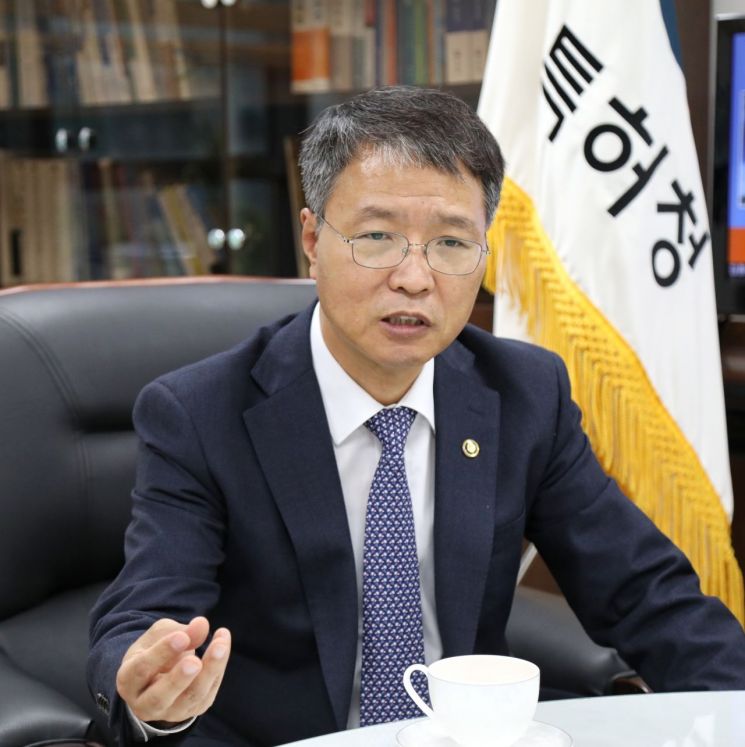
 Commissioner Kim Yong-rae of the Korean Intellectual Property Office explained the global technological hegemony competition surrounding the securing of intellectual property rights for new technologies and the response measures of the Korean Intellectual Property Office in an interview with this publication on the 16th. Photo by Korean Intellectual Property Office
[Asia Economy (Daejeon) Reporter Jeong Il-woong] “Patents that serve as both spear and shield, the Korean Intellectual Property Office (KIPO) will fulfill its role to help domestic companies strengthen their competitiveness through patents in the era of technological hegemony.” KIPO Commissioner Kim Yong-rae said this in an interview with our publication. Commissioner Kim marked his first anniversary since taking office last month.
Commissioner Kim stated, “The changing domestic and international environment surrounding intellectual property demands more from KIPO than before. With the acceleration of digital transformation triggered by COVID-19, intellectual property issues in previously nonexistent areas such as artificial intelligence and visual design have emerged. In a situation where global competition for technological hegemony has intensified, supporting companies in securing (spear) and protecting (shield) their intellectual property has become a key task for KIPO.”
For example, the United States has recently shown movements to dominate global technological hegemony amid trade disputes with China, while Chinese President Xi Jinping has personally emphasized the protection of intellectual property rights for global economic openness and innovation. Japan, too, has fueled the global technological hegemony competition by announcing an intellectual property strategic vision aiming for a “value design society” in response to future environmental changes.
Considering these domestic and international circumstances, KIPO is enhancing its responsiveness based on the judgment that securing core technologies of domestic companies is crucial.
First, South Korea boasts its status as an intellectual property powerhouse, ranking 4th worldwide in patent applications (2020), 1st globally in patent applications relative to GDP and population (2019), and 1st in standard essential patents (2020). However, the so-called “Korea R&D Paradox,” where economic outcomes are relatively poor compared to the scale of research and development (R&D) investment, remains a challenge to be addressed at this point.
Furthermore, the acceleration of digital transformation amid the COVID-19 pandemic highlights the urgent need to properly protect new types of digital intellectual property such as AI-generated works and data, and to industrially utilize them.
Commissioner Kim said, “As technological hegemony competition between countries intensifies, especially in AI and semiconductor sectors, the importance of establishing national and corporate technology and industrial strategies has become prominent. Reflecting this, KIPO is currently promoting the enactment of the ‘Act on the Management and Promotion of Industrial Property Information’ as a legal basis to support the nationwide utilization of patent data.”
In particular, Commissioner Kim emphasized, “Overcoming the ‘R&D Paradox’ is a prerequisite for South Korea to join the ranks of advanced intellectual property countries. To this end, KIPO plans to focus on promoting intellectual property-R&D initiatives and protection systems tailored to new technologies in the digital economy era, as well as facilitating transactions and commercialization to establish a virtuous cycle of ‘R&D-commercialization-R&D reinvestment.’ Above all, the ultimate goal of KIPO at this time is to support domestic companies in equipping themselves with both spear and shield through the protection and nurturing of new types of digital intellectual property, enabling them to compete on the global stage.”
In the global technological hegemony competition structure, the protection of intellectual property also plays a key role. In this regard, KIPO recently established and is implementing a “Five-Year Basic Plan for the Prevention of Unfair Competition and Protection of Trade Secrets.”
Commissioner Kim said, “In April, KIPO launched the ‘Task Force for the Establishment of the Basic Plan for Prevention of Unfair Competition and Protection of Trade Secrets,’ led by KAIST President Lee Kwang-hyung, to strengthen the protection of intellectual property rights for domestic companies. The task force will take charge of effectively addressing technology leakage damages through measures such as easing punishment requirements for industrial espionage, strengthening investigations by technology police, and improving civil and criminal litigation systems.”
He added, “We plan to prepare a draft of the basic plan by next month, gather opinions from related ministries, and finalize the ‘Basic Plan for Prevention of Unfair Competition and Protection of Trade Secrets’ within this year.”
KIPO has also recently established a technology police unit as an intellectual property protection measure. The establishment of the technology police focuses on expanding the investigative scope of special judicial police within KIPO from trademark investigations mainly targeting counterfeit goods to cover patents, trade secrets, designs, and other intellectual property areas, and on strengthening investigation and inquiry capabilities to prevent technology leakage and infringement, which are core to national competitiveness.
Commissioner Kim said, “The technology police have the advantage of possessing extensive examination and trial experience, enabling them to professionally investigate technical infringement and leakage cases such as patents and trade secrets, which are difficult for regular police to handle. With the establishment of the technology police, KIPO expects to prevent the leakage of innovative technologies painstakingly developed by domestic companies and to enable proactive responses to technology infringement in national security and core technology fields.”
© The Asia Business Daily(www.asiae.co.kr). All rights reserved.
![Clutching a Stolen Dior Bag, Saying "I Hate Being Poor but Real"... The Grotesque Con of a "Human Knockoff" [Slate]](https://cwcontent.asiae.co.kr/asiaresize/183/2026021902243444107_1771435474.jpg)
















