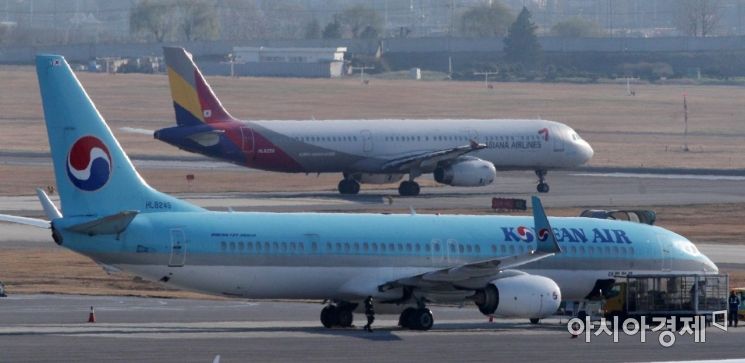
 As the court's decision on Korean Air's acquisition of Asiana Airlines approaches, on the 30th, Korean Air and Asiana Airlines passenger planes were moving toward the runway at Gimpo Airport apron in Gangseo-gu, Seoul. The Seoul Central District Court is expected to deliver a ruling today or tomorrow on the injunction request filed by activist private equity fund KCGI against Hanjin KAL to prohibit the issuance of new shares. If the court dismisses the injunction request, the acquisition process will accelerate, but if the injunction is granted, the acquisition is likely to be canceled. Photo by Kim Hyun-min kimhyun81@
[Asia Economy Reporter Dongwoo Lee] It has been suggested that Korean Air and Asiana Airlines should establish a limited competitive system through independent management. This claim comes amid expectations that the combined market share of many international routes following the merger of the two leading domestic full-service carriers (FSCs) will exceed 50%, raising concerns about preventing certain anti-competitive behaviors such as fare increases.
On the morning of the 16th, Lee Sang-hoon, a lawyer at the People's Solidarity for Participatory Democracy Economic and Financial Center, stated at a forum titled "Korean Air-Asiana Airlines Merger, What Is the Problem?" held in a building in Yeouido, Seoul, hosted by Park Sang-hyuk of the Democratic Party of Korea and attended by the Ministry of Land, Infrastructure and Transport, the Korea Development Bank, and others, “Out of the 143 international routes operated by Korean Air and Asiana Airlines, both airlines operate on 58 routes, and there are 32 routes (22.4%) where the combined market share exceeds 50%.”
Lawyer Lee explained, “In particular, the fact that the market share on routes such as Incheon to New York and Sydney will reach 100% after the merger means there is a high risk of reducing consumer welfare through fare increases,” adding, “It is reasonable to have a competitive system with limited scope under the condition of independent management by both airlines.” He also emphasized that non-economic factors such as consumer welfare, workers, small and medium-sized enterprises, and local communities should be considered during the merger process to reduce the possibility of monopoly-related harms.
There was also an opinion that the Korea Development Bank should prioritize debt restructuring for existing creditors during the integration process. Kim Kyung-yul, head of Economic Democracy 21, stressed, “Existing shareholders of Asiana Airlines have shared some losses through a 3-to-1 capital reduction, and existing creditors such as the Korea Development Bank should also share some losses.”
Referring to precedents of mergers and acquisitions (M&A) among global airlines, there was a call to shift toward strengthening support policies rather than pursuing a merger. Shim Kyu-deok, chairman of the Asiana Airlines Labor Union, explained, “In M&A cases, the acquired company underwent large-scale workforce restructuring before the merger,” adding, “The world is currently protecting the airline infrastructure industry through support policies rather than mergers, such as direct subsidies in the form of grants in the U.S. and loans mainly through national policy banks in major countries.”
Meanwhile, about 40 stakeholders from the Chamsesang Research Institute, Economic Democracy 21, the Ministry of Land, Infrastructure and Transport, the National Assembly Legislative Research Office, and others attended the forum, which was also broadcast live online.
© The Asia Business Daily(www.asiae.co.kr). All rights reserved.
![From Hostess to Organ Seller to High Society... The Grotesque Scam of a "Human Counterfeit" Shaking the Korean Psyche [Slate]](https://cwcontent.asiae.co.kr/asiaresize/183/2026021902243444107_1771435474.jpg)
















