10-Year Periodic Evaluation Report Proves Compliance with Biosphere Reserve Criteria
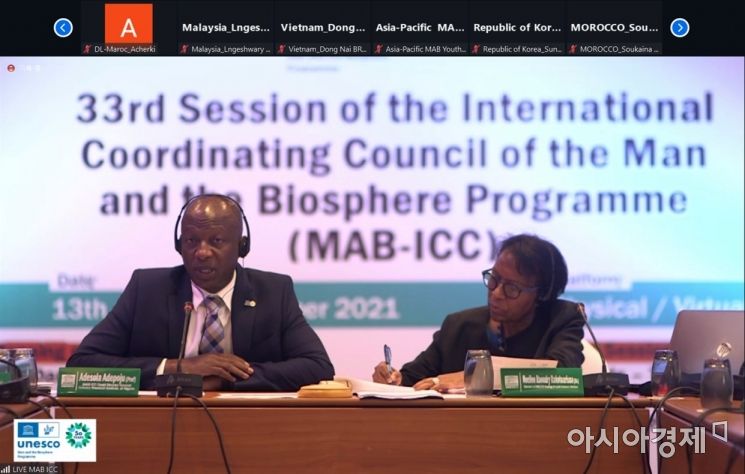
[Asia Economy Reporter La Young-cheol] The 'Gwangneung Forest Biosphere Reserve' received a 'passing grade' in UNESCO's first periodic evaluation, reaffirming its status as a treasure trove of ecosystems.
Gyeonggi Province announced on the 19th that "the 'periodic report' of the Gwangneung Forest Biosphere Reserve was adopted at the 'UNESCO Man and the Biosphere International Coordinating Council (MAB-ICC)' meeting held on the afternoon of the 14th local time in Abuja, Nigeria."
According to the province, the 'UNESCO International Advisory Committee for Biosphere Reserves (IACBR)' expressed the opinion that the Gwangneung Forest Biosphere Reserve sufficiently meets the 'World Network of Biosphere Reserves (WNBR)' criteria, including biodiversity conservation.
A 'biosphere reserve' is an ecosystem area recognized by UNESCO worldwide as outstanding and worthy of conservation, without legal regulations. South Korea has eight UNESCO biosphere reserves, including Gwangneung Forest.
It was especially evaluated that remarkable achievements were made through efforts such as ecosystem monitoring activities, forest protection, operation of ecological education programs, and festivals linked with local historical and cultural resources.
However, the MAB-ICC recommended cooperation among related local governments (Namyangju, Uijeongbu, Pocheon) to revitalize the Gwangneung Forest Biosphere Reserve.
The MAB-ICC requires submission of periodic reports every ten years according to the World Network of Biosphere Reserves (WNBR) regulations.
This evaluates the status, management, conservation, development, and support functions of the biosphere reserve after its designation. At this MAB-ICC meeting, a total of 27 periodic reports, including Gwangneung Forest, were submitted, and 19 were approved as meeting the standards.
Thus, the Gwangneung Forest Biosphere Reserve maintained its international status as a 'biosphere reserve' by meeting the criteria in its first periodic evaluation after ten years since designation.
The 'Gwangneung Forest Biosphere Reserve' was designated as a biosphere reserve at the 2010 UNESCO MAB General Assembly, applied for by the province and the Korea National Arboretum. It covers an area of 24,465 hectares across Namyangju, Uijeongbu, and Pocheon cities, divided into core, buffer, and transition zones.
The province has been systematically conserving and managing the Gwangneung Forest Biosphere Reserve by converting the management center to a direct management system since last year and is currently conducting a management plan study (2022?2026) to present a long-term vision for the biosphere reserve.
Lee Sung-gyu, Director of the Forestry Division, said, "Taking the adoption of the biosphere reserve periodic report as an opportunity, we will preserve the excellent ecological resources of Gwangneung Forest and make every effort to operate sustainably based on the management plan." He added, "Following the MAB-ICC recommendations, we will cooperate with related organizations to promote conservation and development."
© The Asia Business Daily(www.asiae.co.kr). All rights reserved.

















