Park Hwajin, Vice Minister of Employment and Labor, Holds Safety and Health Leadership Meeting for Refining and Petrochemicals
147 Fatal Accidents in 5 Years... Chemical Accidents Account for Only 18%
47% of 282 Detailed Factors Violate the '3 Major Occupational Accident Prevention Obligations'
Government Warns "Occupational Fatal Accidents Violating 3 Major Obligations Considered 'Intentional'"
Vice Minister Park: "Companies Must Significantly Expand Safety and Health Management Systems and Budgets"
LG Chem Responds: "Reinforcing 122 Personnel, Investing 1.5 Trillion Won Over 5 Years"
[Sejong=Asia Economy Reporter Moon Chaeseok] Since 2016, half of the 147 workers who died in oil refining and petrochemical workplaces were victims of entrapment or falls. Only one in five deaths was due to chemical accidents, which contradicts the common belief that proper chemical management alone is sufficient. It was also revealed that violations of the 'three major occupational accident prevention duties'?prevention of falls and entrapment, and wearing protective gear?highlighted by the government for focused inspection in industrial accident death investigations, accounted for half of all fatal accidents.
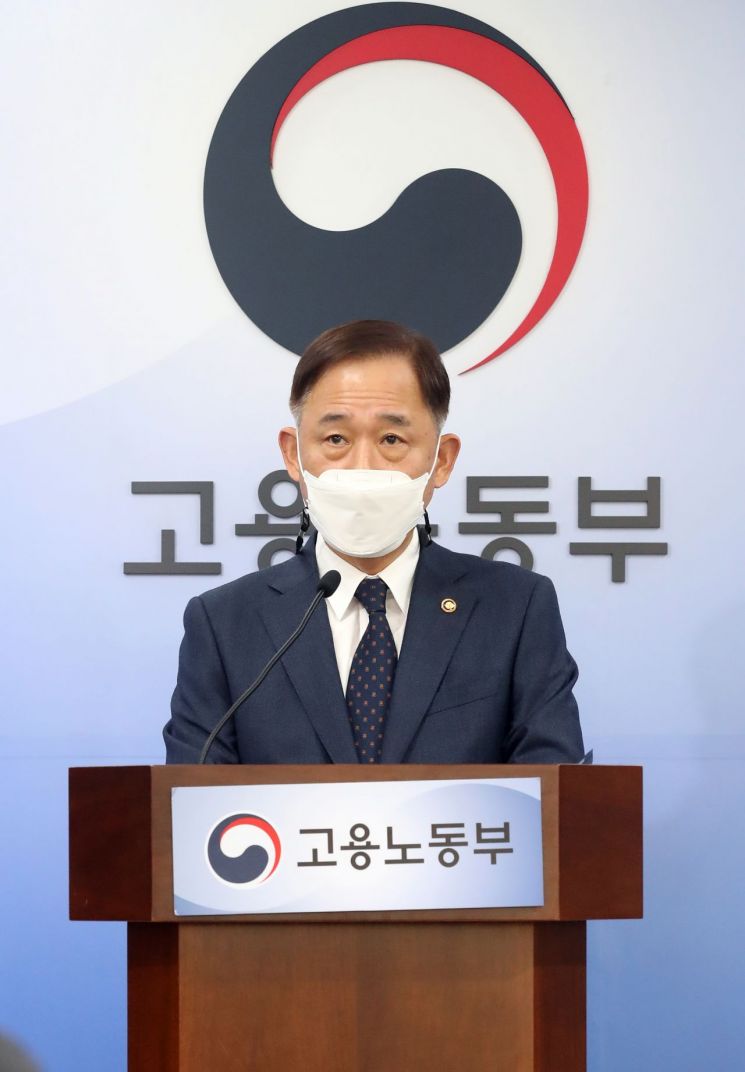
The Ministry of Employment and Labor disclosed this fact on the 16th, when Vice Minister Park Hwajin held a 'Safety and Health Leaders Meeting' at the Bankers Hall in Myeong-dong, Jung-gu, Seoul, together with 10 oil refining and petrochemical companies including SK Energy and LG Chem. This is the result of analyzing the detailed causes of 147 fatal accidents that occurred from 2016 until last month. These figures may differ from official statistics announced based on industrial accident compensation approval criteria.
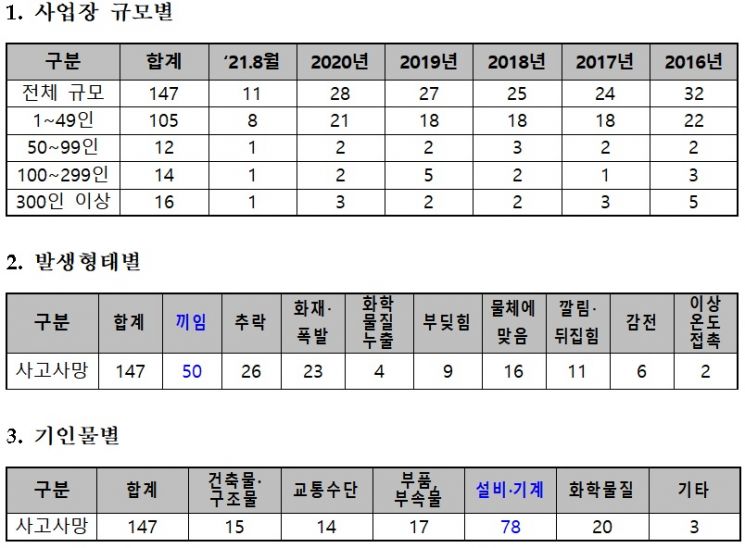 Status of fatal accidents in the chemical industry from 2016 to August of this year. (Data from the Ministry of Employment and Labor)
Notably, most fatal accidents occurred due to entrapment or falls during equipment and machinery operation. Entrapment accidents numbered 50 cases (34%), and fall accidents 26 cases (18%). These are typical 'traditional fatal accidents' where the government focuses its supervisory efforts. In contrast, fire, explosion, and leakage accidents accounted for only 27 cases (18%).
Among 282 detailed causes of the 147 fatal accidents, 135 cases (48%) involved violations of the 'three major occupational accident prevention duties.' Specifically, insufficient protective measures (66 cases, 23%), failure to wear protective gear (37 cases, 13%), and failure to install safety facilities (32 cases, 11%) were the most common. The Ministry of Employment and Labor has warned that if a fatal industrial accident occurs due to violation of these duties, it will be considered 'intentional.'
Vice Minister Park Hwajin pointed out, "The chemical industry is a large-scale plant industry that uses hazardous machinery and chemicals, and frequent maintenance and repair of equipment and machinery increase the likelihood of industrial accidents." A ministry official added, "In the chemical industry, it is important to establish and implement a safety and health management system that identifies and improves not only chemical accidents but also traditional fatal accident risk factors such as entrapment and falls, and induces the execution of work plans. Especially during non-routine tasks such as maintenance and inspection of equipment and machinery, it is crucial for both contractors and subcontractors to share risk information and actively communicate during work."
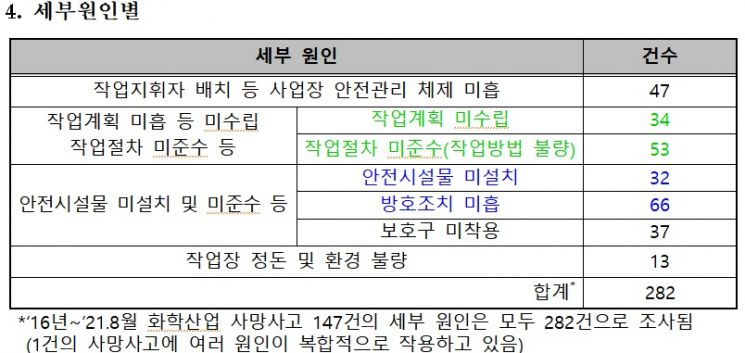 Detailed Causes of Fatal Accidents in the Chemical Industry from 2016 to August of Last Year. (Data from the Ministry of Employment and Labor)
Experts and government officials attending the meeting emphasized that only when the Chief Executive Officer (CEO) takes responsibility for and establishes a safety and health system can industrial accidents be prevented.
Kwon Hyukmyeon, former director of the Korea Occupational Safety and Health Agency, advised, "Under the existing paradigm where safety is perceived as the responsibility of the safety department alone, accidents will inevitably continue to occur. Only by establishing and operating a safety management system in which all workers participate in safety activities based on the CEO's strong leadership can accidents be prevented."
Vice Minister Park also urged, "Ahead of the enforcement of the Serious Accident Punishment Act in January next year, companies need to significantly expand their safety organizations and budgets so that they can identify and eliminate or improve risk factors on their own and implement safety and health management systems. Management must maintain continuous interest to ensure that safety management policies function effectively on the ground, and workers should also diligently follow safety rules to create a safe workplace."
Companies responded that they are expanding safety organizations, personnel, and budgets, and actively identifying and improving risk factors through detailed inspections. LG Chem announced plans to reinforce 122 dedicated safety and environmental personnel and conduct emergency safety inspections at all domestic and overseas business sites to identify risk factors, investing 1.5 trillion won over five years.
© The Asia Business Daily(www.asiae.co.kr). All rights reserved.



















