[Asia Economy Reporter Byunghee Park] Due to the COVID-19 pandemic, household income in the United States decreased last year for the first time in nine years. Although the federal government undertook large-scale fiscal spending to support households, it could not prevent the decline in household income. However, the U.S. Census Bureau evaluated that thanks to the federal government's massive fiscal spending, many citizens were prevented from falling into poverty.
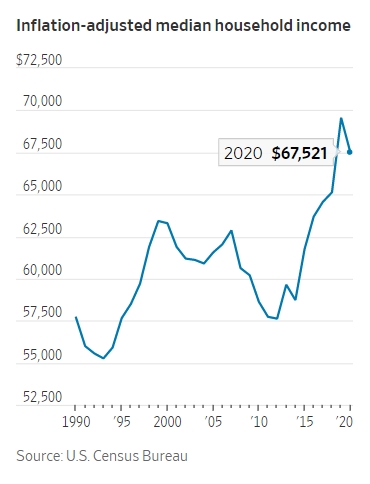
According to the Census annual statistics cited by The Wall Street Journal (WSJ) on the 14th (local time), the median household income in the U.S. last year was $67,500 (approximately 79.2 million KRW), down 2.9% compared to 2019. This marks the first decrease in household income since 2011.
The poverty rate last year was 11.4%, up 1 percentage point from 2019. The poverty rate rose for the first time in six years. This means that 37.2 million Americans were living in poverty, an increase of 3.3 million compared to 2019. The income threshold for determining poverty for a family of four was $26,000.
However, the household income statistics used by the Census to calculate the official poverty rate do not include non-cash government assistance such as tax credits, housing subsidies, and free school meals. Since 2009, the Census has separately calculated a broader poverty rate that includes such non-cash government assistance. Last year, the broader poverty rate was confirmed at 9.1%, a decrease of 2.6 percentage points compared to 2019, marking the lowest level since the statistics began in 2009.
The Journal assessed that unlike the official poverty rate, the decline in the broader poverty rate was due to the expanded social safety net during the COVID-19 pandemic.
The Census also analyzed that without the first and second rounds of cash support last year, the broader poverty rate would have been about 1 percentage point higher.
Specifically, it was analyzed that cash support policies reduced the number of people in poverty by 11.7 million. Additionally, expanded unemployment benefits saved 5.5 million people, and tax refunds rescued 5.3 million from poverty. Above all, the largest social safety net was the Social Security system, which prevented 26.5 million people from falling into poverty, the Census emphasized.
The median income of full-time workers last year increased by 6.9% compared to 2019. Women's income was about 83% of men's, showing little change from 2019.
Income distribution also slightly worsened. The top 20% high-income group (quintile) held 52% of total household wealth. The top 5% held 23%. The top 20% earned more than $141,100, and the top 5% earned more than $273,700.
The share of total household wealth held by the bottom 20% (first quintile) slightly decreased from 3.1% in 2019 to 3.0% last year. The first quintile's income last year was below $27,000. The income share of the second quintile also decreased from 8.3% in 2019 to 8.1%. The income range for the second quintile was $27,000 to $52,000.
By region, the Northeast had the highest average income at $75,211, followed by the West ($74,951), Midwest ($66,968), and South ($61,243).
The lower the educational attainment, the greater the income decline. Income for those without a high school diploma fell by 5.7%, whereas the income decrease for those with a bachelor's degree or higher was only 2.8%.
© The Asia Business Daily(www.asiae.co.kr). All rights reserved.
![Clutching a Stolen Dior Bag, Saying "I Hate Being Poor but Real"... The Grotesque Con of a "Human Knockoff" [Slate]](https://cwcontent.asiae.co.kr/asiaresize/183/2026021902243444107_1771435474.jpg)
















