"Strongly Condemn with Stern Protest"
"Seems Aimed at Diverting International Attention"
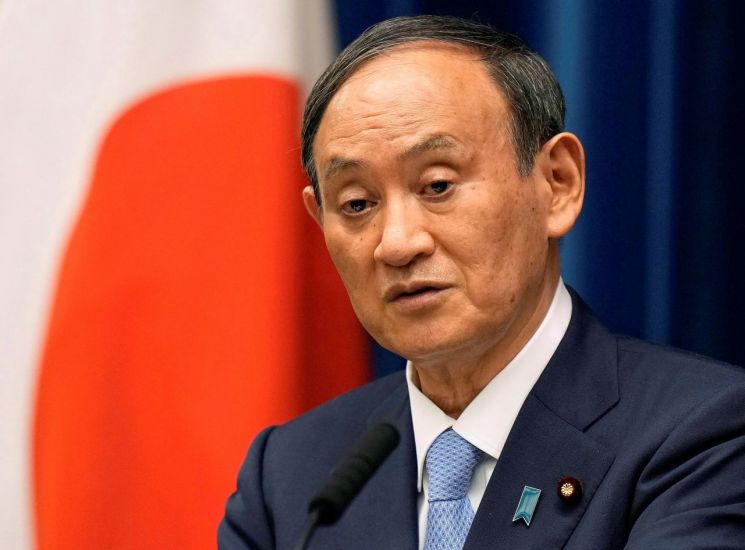
[Asia Economy Reporter Hyunwoo Lee] Japanese Prime Minister Yoshihide Suga expressed strong protest against North Korea's ballistic missile launch, calling it a violation of the United Nations Security Council resolution. The Japanese government also stated that it will continue tracking the missile trajectory, gathering information, and conducting surveillance activities, while closely monitoring the diplomatic repercussions going forward.
On the 15th, immediately after North Korea's ballistic missile launch, Prime Minister Suga held an emergency press conference at the Prime Minister's Official Residence, stating, "North Korea's ballistic missile launch is a violation of the UN Security Council resolution, and we strongly protest and condemn it," adding, "We will closely cooperate with related countries including the United States and South Korea."
Earlier, the Japanese Ministry of Defense also issued a statement confirming, "Two ballistic missiles were launched from North Korea," and noted, "They did not violate Japan's airspace or EEZ, and it is estimated that missile debris will not fall within Japanese territory." The ministry further emphasized, "North Korea's repeated ballistic missile launches pose a serious challenge to the international community including Japan," and pledged, "We will do our utmost in information gathering and surveillance to protect the lives and property of our citizens."
The news of North Korea's ballistic missile launch was broadcast worldwide as breaking news that day. South Korean and U.S. intelligence authorities announced around 1 p.m. that North Korea had launched two ballistic missiles from the central inland area toward the East Sea. This was North Korea's fifth missile launch this year; earlier, on the 13th, North Korea announced a successful launch of a long-range cruise missile and then launched missiles into the East Sea just two days later.
This launch is interpreted as North Korea's move to attract U.S. attention and gain an advantage in dialogue and negotiations. Previously, North Korea launched cruise missiles on January 22 and March 21, shortly after U.S. President Joe Biden took office, and on March 25 launched short-range ballistic missiles, drawing attention from the U.S. and the international community.
NHK broadcast, citing a Japanese Ministry of Foreign Affairs official, reported, "This missile launch is presumed to be a provocative act intended to divert international attention, which is currently focused on Afghanistan, back to North Korea."
© The Asia Business Daily(www.asiae.co.kr). All rights reserved.

















