Total Floor Area of 120,000㎡, Maximum Capacity of 28,000, Annual 1.8 Million Visitors Expected
Jungnangcheon Area Reborn as a Cultural Hub Linked to Seoul Arena
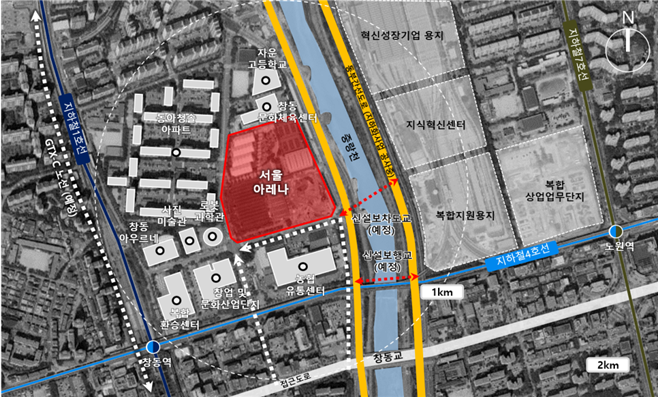
[Asia Economy Reporter Onyu Lim] The 'Seoul Arena' project, the country's first concert-specialized venue with a capacity of about 20,000 seats, has passed the Seoul city architectural review, and construction is set to begin in earnest with a target completion in 2025. It is expected that Seoul Arena will attract 1.8 million visitors annually through K-pop concerts and other events.
On the 15th, Seoul city announced that the architectural plan for the 'Seoul Arena Complex Cultural Facility Private Investment Project' (located at 1-23 Chang-dong, Dobong-gu) was approved at the 17th Architectural Committee meeting held on the 14th.
Passing the architectural review is the final hurdle for obtaining a building permit. Seoul city plans to sign an implementation agreement in December with the project negotiation partner, tentatively named Seoul Arena Co., Ltd., and commence construction in 2022 once the building permit is finalized. The goal is to complete the project by 2025.
According to the architectural plan completed through consultations with Seoul city’s chief architect and other experts, Seoul Arena will be developed as a complex cultural facility with a total floor area of 119,096㎡ (from two basement levels to six above ground). It will include the nation’s first arena-level music-specialized concert hall (18,269 seats), a medium-sized performance hall (2,010 seats), a cinema complex (7 theaters), popular music support facilities, and retail and office spaces.
In particular, the concert hall is expected to accommodate between 18,000 and up to 28,000 people simultaneously when standing arrangements are combined. Currently, indoor venues in Korea with over 10,000 seats are multi-purpose facilities such as indoor gymnasiums not specialized for music performances; Seoul Arena will be the first music-specialized concert hall of this scale.
Seoul Arena will operate as a cultural platform organically connecting three types of ‘Chang’ (창): 창 (倉) meaning warehouse, 창 (唱) meaning singing, and 창 (창문) meaning window, based on the design concept that "Chang-dong (倉) will be reborn as Chang-dong (唱), the music city."
The 'Jicheon Renaissance' to be realized around the Jungnangcheon area near Seoul Arena focuses on four core development directions: ▲waterfront-centered ▲emotional city ▲providing open spaces ▲breaking down boundaries.
Seo Seong-man, head of Seoul city’s Balanced Development Headquarters, said, “Seoul Arena, together with ‘Seed Cube Chang-dong’ (a startup and cultural industry complex scheduled for completion in 2023), will form a key axis of the 'Chang-dong·Sangye New Economic Center Development Project' and is expected to maximize Seoul’s global cultural competitiveness.”
He added, “Through the Jicheon Renaissance, we will transform the Seoul Arena area from a space solely for performances into a tourist attraction filled with rest and vitality. Furthermore, we will do our best to develop Chang-dong and Sangye into a world-class music mecca where popular culture is produced, consumed, and distributed, contributing to Seoul’s balanced development.”
© The Asia Business Daily(www.asiae.co.kr). All rights reserved.
![Clutching a Stolen Dior Bag, Saying "I Hate Being Poor but Real"... The Grotesque Con of a "Human Knockoff" [Slate]](https://cwcontent.asiae.co.kr/asiaresize/183/2026021902243444107_1771435474.jpg)
















