Office-tel Floor Heating Allowed from 85㎡ to 120㎡
Supply of 30-Pyeong Units for 3-4 Person Households Increases
Expanded Area for 3-Room Studio-Type Urban Housing
Unlikely to Fully Absorb Apartment Demand
Regulation Easing May Increase Speculation and Housing Price Instability
The government's significant deregulation of urban-style residential housing and residential officetels at the real estate market inspection meeting of related ministers on the 15th is interpreted as a desperate measure to curb soaring housing prices centered on apartments. Since apartments take a long time to be ready for occupancy, the intention is to ease regulations on non-apartment housing in urban areas to resolve short-term supply-demand imbalances.
However, considering that urban-style residential housing and residential officetels have limited substitution effects for apartments, experts evaluate that demand dispersion will be limited. While temporary supply-demand instability can be alleviated, it is unlikely to be a fundamental solution. Because urban-style residential housing and officetels are subject to weaker regulations compared to apartments, there are concerns that speculative demand could expand, further destabilizing the real estate market.
 Kim Young-han, Director of Housing Policy at the Ministry of Land, Infrastructure and Transport, is giving a weekly housing supply briefing on the 15th at the Ministry of Land, Infrastructure and Transport press room in the Government Sejong Complex. (Photo by Ministry of Land, Infrastructure and Transport)
Will 'Officetels and Urban-Style Residential Housing' Like Apartments Emerge?
The Ministry of Land, Infrastructure and Transport's announced "Plan to Expand Urban Housing Supply and Accelerate Apartment Supply" focuses on easing regulations on urban-style residential housing and officetels to provide living conditions similar to apartments. Urban-style residential housing was introduced in May 2009 during the Lee Myung-bak administration to stabilize housing for low-income one- to two-person households. It is classified into three types: complex-type row houses, complex-type multi-family houses, and studio-type. Unlike apartments, it is not subject to the price ceiling system, but due to smaller area and spatial composition constraints, it has been less preferred compared to apartments. Especially, the studio-type can only be built with two spaces?a bedroom and a living room?within 50㎡ (exclusive area), leading to strong demands for deregulation.
The government plans to revitalize the supply of urban-style residential housing by reorganizing the "studio-type" into "small-type" and significantly easing regulations. The allowable area limit for studio-type will be expanded from the current 50㎡ or less to 60㎡ or less. Currently, if the area is 30㎡ or more, it can only be divided into two spaces: bedroom and living room, but going forward, it will be possible to partition into four spaces, such as three bedrooms and one living room. This is expected to meet the demands of those wanting larger housing. However, to prevent overloading infrastructure such as parking lots, the number of households with relaxed spatial composition will be limited to one-third of the total.
Officetels, classified as quasi-housing, will have the allowable exclusive area for floor heating expanded from 85㎡ to 120㎡, enabling the construction of officetels up to about 40 pyeong (based on apartment supply area). Since officetels have smaller usable areas compared to apartments, even 85㎡ is difficult for 3-4 person households to live in. Therefore, the industry had many demands to increase the floor heating area to 120㎡. With this deregulation, residential officetels with exclusive areas in the 30-pyeong range can effectively be built, and it is analyzed that officetels similar to apartments will significantly increase.
Deregulation of Sale Price Controls... Reduction of Local Government Discretion
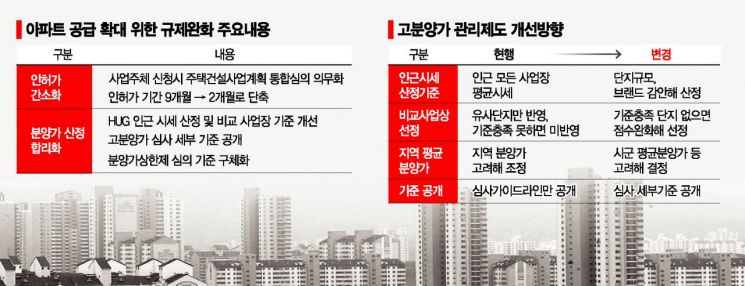
Some improvements will be made to the high-priced sale price management system and the price ceiling system, which have been criticized for excessive regulations hindering supply activation. Currently, the Housing and Urban Guarantee Corporation (HUG) manages sale prices by reviewing apartment sale guarantees in high-priced management areas, considering prices of comparable projects and nearby market prices, but the industry complains that the standards are too strict and unclear, resulting in excessively low sale prices.
The Ministry of Land, Infrastructure and Transport will improve the system by reflecting only the market prices of similar projects considering complex size and brand, instead of averaging all projects in nearby areas, and will relax the criteria for selecting comparable projects. The aim is to enable more rational calculation of sale prices. Also, while only the sale price review guidelines are currently disclosed, detailed review criteria will be disclosed going forward. Regarding the price ceiling system, since local governments have had different recognized sale price items and review methods, causing disputes with project owners, detailed sale price items will be clearly refined to reduce excessive discretion by local governments and increase predictability.
Additionally, to activate the supply of non-apartment housing such as urban-style residential housing, residential officetels, multi-family, and multi-household houses, the housing and urban fund loan limits will be temporarily raised and interest rates lowered until next year. In particular, integrated local government reviews during the housing construction process will be made mandatory to accelerate supply speed. In this case, the approval period is expected to be shortened from an average of 9 months to 2 months.
Limits to Absorbing Apartment Demand
However, despite these deregulations, many forecasts suggest it will be difficult to curb the rising housing prices centered on apartments. Urban-style residential housing has a parking standard of about 0.6 spaces per household and lacks sunlight rights, views, and community facilities compared to apartments, making it difficult to serve as an adequate substitute. Even with deregulation, it is challenging to absorb all apartment demand.
There are also concerns that deregulation could further destabilize the housing market. Urban-style residential housing and similar types allow anyone aged 19 or older to apply regardless of whether they hold a subscription savings account, and there are no re-winning restrictions or residency obligations. Recently, prices have skyrocketed in major areas such as Gangnam. Since the price ceiling system does not apply, it is likely to fuel overall future housing price increases, and tax evasion by registering residential officetels as office use may become active. There are also analyses that mandatory integrated reviews to accelerate apartment supply speed could cause side effects due to rushed reviews.
© The Asia Business Daily(www.asiae.co.kr). All rights reserved.
![Clutching a Stolen Dior Bag, Saying "I Hate Being Poor but Real"... The Grotesque Con of a "Human Knockoff" [Slate]](https://cwcontent.asiae.co.kr/asiaresize/183/2026021902243444107_1771435474.jpg)


















