Workplace and Metropolitan Area Cluster Infections Surge
Nationwide Mobility Increases for 3 Consecutive Weeks
Sharp Rise in Confirmed Cases Signals 'Danger Alert'
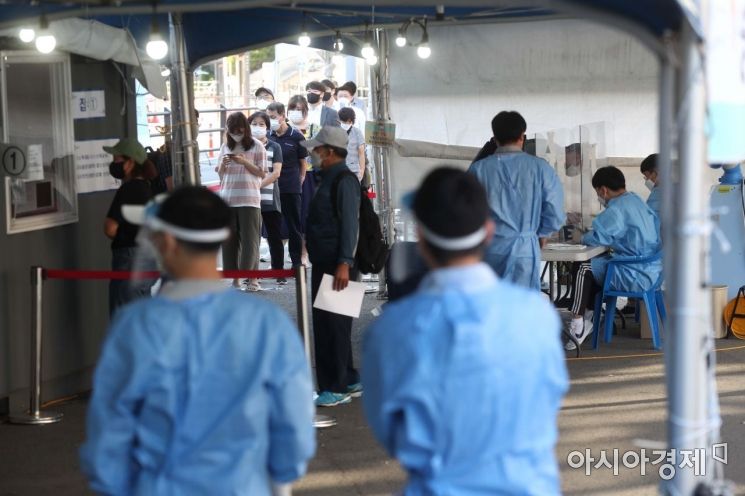 On the 15th, as the spread of COVID-19 intensifies mainly in the metropolitan area, the temporary screening clinic set up at Seoul Station Plaza is crowded with citizens. Photo by Mun Ho-nam munonam@
[Asia Economy Reporter Seo So-jeong] As the spread of COVID-19 in the Seoul metropolitan area remains uncontrolled, concerns are growing that confirmed cases may surge again around the Chuseok holiday. With the more transmissible Delta variant spreading and cluster infections erupting in workplaces, markets, and academies in the densely populated metropolitan area, some analyses predict that the fourth wave will peak after Chuseok.
The government plans to maximize the vaccination speed and implement special Chuseok quarantine measures to control the number of confirmed cases. However, with family gatherings expanding during the Chuseok holiday and vaccination incentives added, it is expected to be difficult to reverse the downward trend.
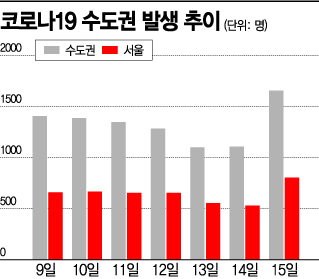
According to the Central Disease Control Headquarters, as of midnight on the 15th, out of 2,080 new COVID-19 confirmed cases, 1,656 were from the metropolitan area, accounting for 80.5% of the locally transmitted cases. This is the highest number since the COVID-19 outbreak began.
Various indicators are also sending warning signals. The reproduction number, which shows how many people one infected person transmits the virus to, exceeded 1 last week. A reproduction number above 1 indicates epidemic spread, while below 1 indicates containment. Park Hyang, head of the Central Accident Response Headquarters' quarantine team, expressed concern, saying, "Due to the increase in the scale of the epidemic in the metropolitan area, the reproduction number last week was slightly above 1 at 1.01, showing a gradual rise since the second week of August. The metropolitan area is experiencing sustained spread along with increased mobility, which is a warning sign."
Not only mobility but also auxiliary indicators such as highway traffic volume and credit card sales are all on the rise. Nationwide mobility has also increased for three consecutive weeks. Analyzing mobile phone mobility data, the nationwide mobility for the week of September 6?12 was 233.02 million cases, a 1.9% increase compared to the previous week. Weekly mobility in the metropolitan area was 122.45 million cases, up 1.5% from the previous week.
Another issue is the frequent cluster infections occurring in everyday places, suggesting there may be many hidden confirmed cases in the community. So far, 151 confirmed cases have been reported at the market in Songpa-gu, Seoul, and 12 and 14 confirmed cases have occurred at workplaces in Dongdaemun-gu and Jongno-gu, respectively. In Incheon’s Gyeyang-gu and Namdong-gu, 37 and 25 confirmed cases related to medical institutions have been reported, raising concerns about further spread. The proportion of new confirmed cases with unknown infection sources, labeled as ‘under investigation,’ has also risen from 30% to 37.7% over the past four weeks.
Professor Cheon Eun-mi of the Respiratory Medicine Department at Ewha Mokdong Hospital said, "A high proportion of cases under investigation means there are still many hidden infections in the community. This year’s Chuseok is expected to see increased mobility compared to last year, and after Chuseok, confirmed cases are likely to spread nationwide."
© The Asia Business Daily(www.asiae.co.kr). All rights reserved.
![Clutching a Stolen Dior Bag, Saying "I Hate Being Poor but Real"... The Grotesque Con of a "Human Knockoff" [Slate]](https://cwcontent.asiae.co.kr/asiaresize/183/2026021902243444107_1771435474.jpg)

















